
Australian lenders have already tightened borrowing capacity for property investors through changes to how they assess after‑tax cashflow and serviceability following the 2026 budget’s negative gearing and capital gains tax (CGT) reforms.
Because losses on established properties purchased after budget night can no longer be deducted against wages, lenders now model lower after‑tax income for these borrowers.
The change is material because serviceability tests rely heavily on net disposable income.
“With 30% less borrowing power, investors will be removed from (contention) for a lot of properties”, said Refinance.com.au director Aidan Hartley.
A buyer’s agent friend of mine informed me that one of their investor clients had a verbal agreement with a lender to borrow $800,000, which was then reduced to $500,000 following the federal budget’s changes to negative gearing.
The changes to investor borrowing capacity come as Melbourne and Sydney property prices are tipped to fall by as much as 9% by the end of 2026, with Louis Christopher from SQM claiming the Sydney and Melbourne property markets are “tanking”.
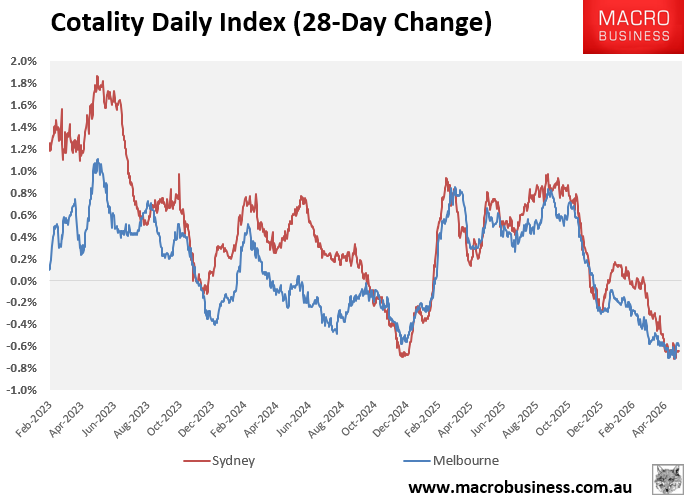
“Based on our modelling, housing prices are likely to fall up to 9% in our two largest capitals this calendar year”, Christopher said. “The live reality on the ground is the housing market is tanking in Sydney and Melbourne”.
“At the beginning of this year’s property season, it was a normal market and auction clearance rates were far higher”, he said. “Then, the interest rate outlook changed and the February rate rise knocked the wind out of the market. Then, the war came along, and it took the market another leg down”.
“The market has had a series of shocks over the first half of 2026, and we are not sure if they are over yet. There is no light on the horizon”, Christopher said.
In his weekend market wrap, leading Sydney auctioneer Tom Panos also reported that “reality” has hit the market, “something has absolutely changed”, “the urgency is gone”, “even owner-occupiers appear to be concerned” and “buyer depth is low”.
Separately, Panos warned that suburbs “packed with investors” are facing a day of reckoning:
“If investors suddenly think, “Hang on, the tax benefits are changing, borrowing capacity is shrinking, growth may slow, then fewer investors will buy after me’. Then demand is going to dry up quickly”.
“And if existing investors start offloading at the same time that fewer investors enter the market, that’s when you get pressure on prices”.
Higher interest rates and the changes to negative gearing and CGT are a ‘perfect storm’ for the housing market.
