
After years of vendors having the upper hand, the scales have finally tilted in favour of home buyers.
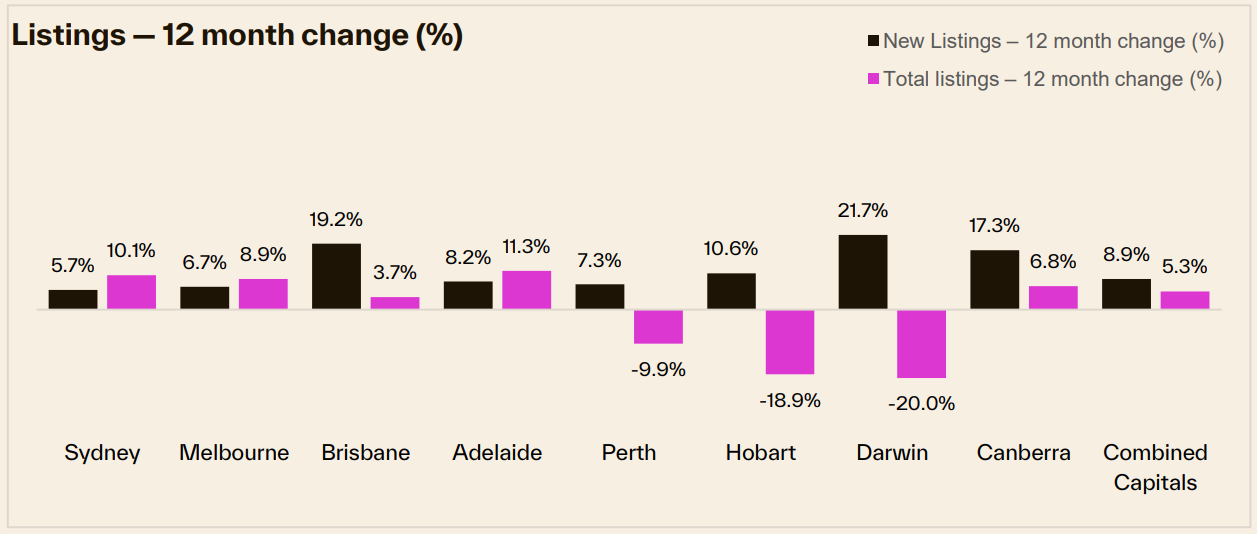
The latest weekly housing market indicators report from Cotality shows that for-sale listings are rising, meaning that supply is flooding the market:
Source: Cotality
As illustrated above, new for-sale listings have increased by 8.9% at the combined capital city level versus the same time last year, with all markets recording increases.
Total for-sale listings have also increased by 5.3% at the combined capital city level, with only Perth, Hobart, and Darwin tracking below the same time last year.
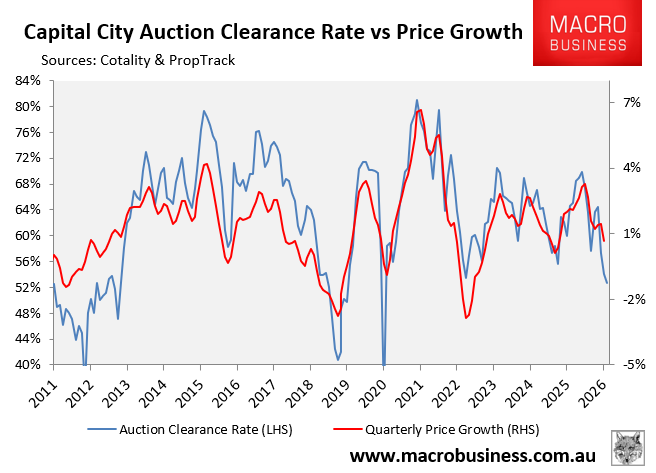
Meanwhile, the national auction clearance rate has collapsed, which is typically the best leading indicator of prices, especially across Sydney and Melbourne.
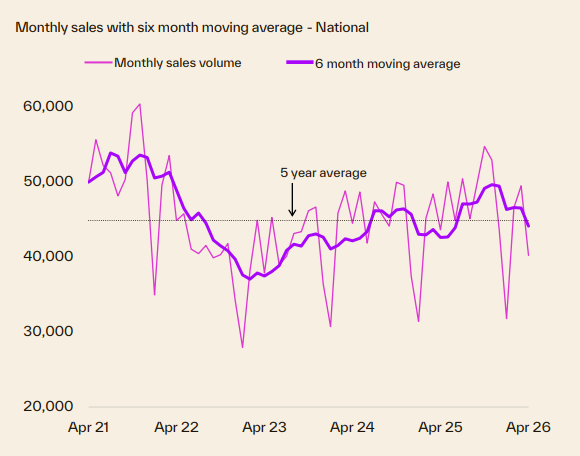
Cotality’s monthly data shows that monthly sales volumes have also plunged below the five-year average, which, alongside the collapse in auction clearance rates, suggests that buyer demand has evaporated.
Source: Cotality
SQM Research founder Louis Christopher said the nation’s two largest housing markets are “tanking” and face heavy price falls.
“Based on our modelling, housing prices are likely to fall up to 9% in our two largest capitals this calendar year”, he said. “The live reality on the ground is the housing market is tanking in Sydney and Melbourne”.
“The market has had a series of shocks over the first half of 2026, and we are not sure if they are over yet. There is no light on the horizon”, Christopher said.
Separately, Christopher told the ABC that “the national housing market has turned, and the downturn is now broadening”.
“Our latest monthly data shows asking prices have now begun to fall in Perth, Brisbane, Adelaide and Canberra, each down around 1 per cent over the past month”, he said.
Ray White chief economist Nerida Conisbee added that the number of buyers attending open homes has plummetted.
“The most important signal remains open home attendance”, she said.
Nationally, attendance averaged 2.1 attendees per property, well below 3.5 at the same time last year.
“This shows buyer foot traffic has not recovered after the sharp fall seen in recent weeks”.
“With policy uncertainty still settling, interest rates higher and buyer attendance materially lower than a year ago, this softer demand environment is likely to persist for some time”, Conisbee said.
The reality is that three consecutive interest rate hikes from the RBA have reduced borrowing capacity to the tune of tens of thousands of dollars.
Then budget’s changes to negative gearing and capital gains tax have further reduced investor borrowing capacity alongside broader market sentiment and demand.
Buyers are also worried about their job security.
As a result, the market is facing a major correction – likely the worst in 40 years.
