
Snowy hydro 2.0 transforms into $42 billion sinkhole
The former Turnbull Coalition government initially announced that the Snowy Hydro 2.0 pumped-hydro scheme would cost $2 billion and be completed by 2021. The government increased the cost to $6 billion, then to $12 billion by 2023.
The government-owned Snowy Hydro confirmed in October 2025 that the project’s costs would easily exceed its $12 billion budget.
A nine-month cost study by independent building experts was initiated to determine the extent of cost overruns and delays.
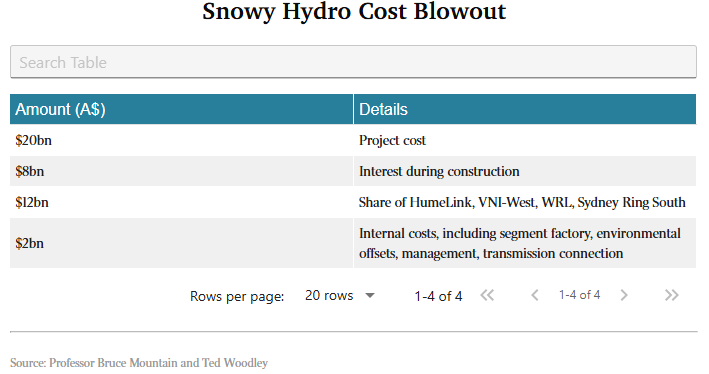
The Victoria Energy Policy Centre’s director, Bruce Mountain, and energy executive Ted Woodley estimate that the Snowy 2.0 pumped hydro project will now cost about $42 billion in total. This includes direct construction costs of $20 billion, transmission infrastructure costs totalling $12 billion and interest charges of $8 billion over 15 years.
Mountain and Woodley say Snowy 2.0 had always been a “dreadful idea” and labelled it “one of the biggest disasters” in Australian infrastructure. They agree that a royal commission into the project may be justified.
“Successive governments have failed to respond to a project that was so obviously doomed right from the start”, said Dr Mountain.
“What’s always been needed here is properly independent investigation”, he said. “I think there is a case for a Royal Commission into this”.
Mountain noted that Snowy Hydro 2.0 now employs 50% or roughly 3,000 more workers than originally budgeted, averaging $250,000 annually, with powerful unions including the CFMEU and ETU participating.
“Snowy 2.0 is, and always was, a dreadful idea”, he said, citing its price, environmental damage and a storage system that cannot be quickly recharged like batteries.
Concerns have also been raised that the federal government has sought to conceal the true cost of Snowy 2.0 by using off-budget vehicles and blocking freedom-of-information requests.
Former ACTU President and federal Labor MP Jennie George also criticised the way in which the true cost of the renewable energy transition has been deliberately hidden from public scrutiny through off-budget accounting and separation of interconnected costs.
“The NDIS, at least you know the cost of it, because that’s public in all the Budget papers. Whereas a lot of this is hidden, you just wouldn’t know”, George said.
“For a government committed to accountability and transparency, there’s no defence for keeping from the public – particularly from the taxpayer who underwrites a lot of these projects – just what it’s actually costing us”.
“Vested interests wouldn’t be pursuing projects unless they had the certainty of being underwritten by government”, she said.
The estimated cost of the 2,000-megawatt QLD Borumba Pumped Hydro project has also increased by $4.2 billion to $18.4 billion, with completion not expected until 2033 at the earliest. As with Snow Hydro 2.0, costs are certain to rise.
Snowy Hydro 2.0 and Borumba are only microcosms of the astronomical costs of the renewable ‘revolution’.
Pumped hydroelectric projects create no net power. They serve as storage vehicles for excess renewable energy (mostly solar) generated in the middle of the day.
Battery storage and a distributed network of solar and wind turbines with transmission lines scattered throughout the countryside are also very costly.
Weather-dependent energy is intermittent by nature. As a result, it is prohibitively expensive due to the extensive infrastructure, transmission, and storage requirements, as well as the need to keep dispatchable hydrocarbon generators on standby in case wind and solar power fail.
Australian customers, therefore, face increasing energy costs, both directly on their bills and indirectly through taxes to fund renewable energy subsidies and projects like Snowy Hydro 2.0.
Policymakers should stop gaslighting and be transparent about the costs and trade-offs of Australia’s renewable energy transition.
