
Australian power users received a reprieve earlier this year as the default market offer (DMO), which is the benchmark against which retailers price their plans, was cut by between 1% and 10% from 1 July, following lower wholesale power (generation) costs amid a relatively calm summer.
The relief will be short-lived, however, with network costs, which account for around 40% of electricity bills, set to rise by 10% for some customers following approval from the Australian Energy Regulator (AER).
Approved increases for 2026–27 include:
- NSW (Endeavour Energy): +11%
- NSW (Ausgrid): +9.5%
- Queensland (various distributors): >11%
These are average increases for residential flat‑rate tariffs.
The network costs have been driven by two main factors.
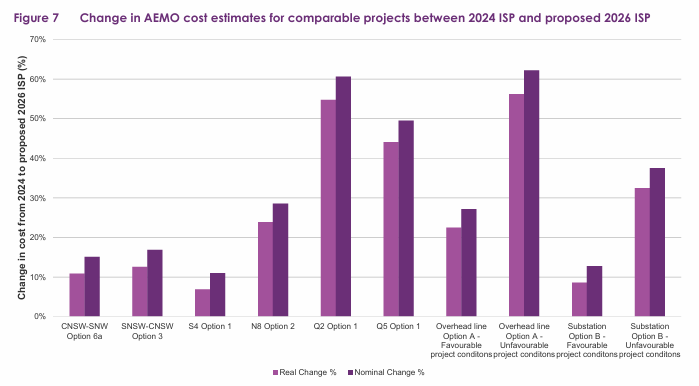
First, a giant pipeline of new transmission projects is pushing up costs. Overhead line costs have risen up to 55%, whereas substation costs have risen up to 35%, according to AEMO:
Second, state renewable‑energy schemes are also driving up costs. These include NSW’s $20 billion Renewable Energy Zone roadmap and South Australia’s Firm Energy Reliability Mechanism.
These schemes require new transmission, system strength, and backup capacity.
The AER now says the higher network charges will be incorporated into the final DMO, reducing the size of the expected cuts flagged earlier this year.
Retailers will ultimately decide how much of the network increase flows through to customers.
Network costs will inevitably rise into the future, driving up power bills.
Australia needs 10,000 km of new high‑voltage transmission by 2050, with half required in the next decade. But projects are running three years behind schedule on average and costs are rising fast.
The cost of constructing each renewable transmission project raises the regulatory asset base and, ultimately, retail electricity costs.
Australia’s governments are also spending billions on subsidies for renewables generation and transmission. For example, the federal government’s Rewiring the Nation program is providing $20 billion in concessional finance and underwriting to accelerate transmission projects.
As a result, consumers will face higher energy costs, which will be reflected directly in their bills and indirectly in their taxes to support renewable energy subsidies.
Policymakers should stop gaslighting and be upfront about the true costs and trade-offs in Australia’s renewable energy transition.
