
Productivity Commission ignores easiest housing policy fix
Productivity Commission (PC) chair Danielle Wood has admitted that it is “going to take decades” for fixes to improve housing supply to make home ownership more affordable, “to filter through”.
Wood also admitted that the Albanese government’s fantastical target to build 1.2 million homes over five years, which is currently tracking around 27% behind its required run rate, is “not going to be met”.
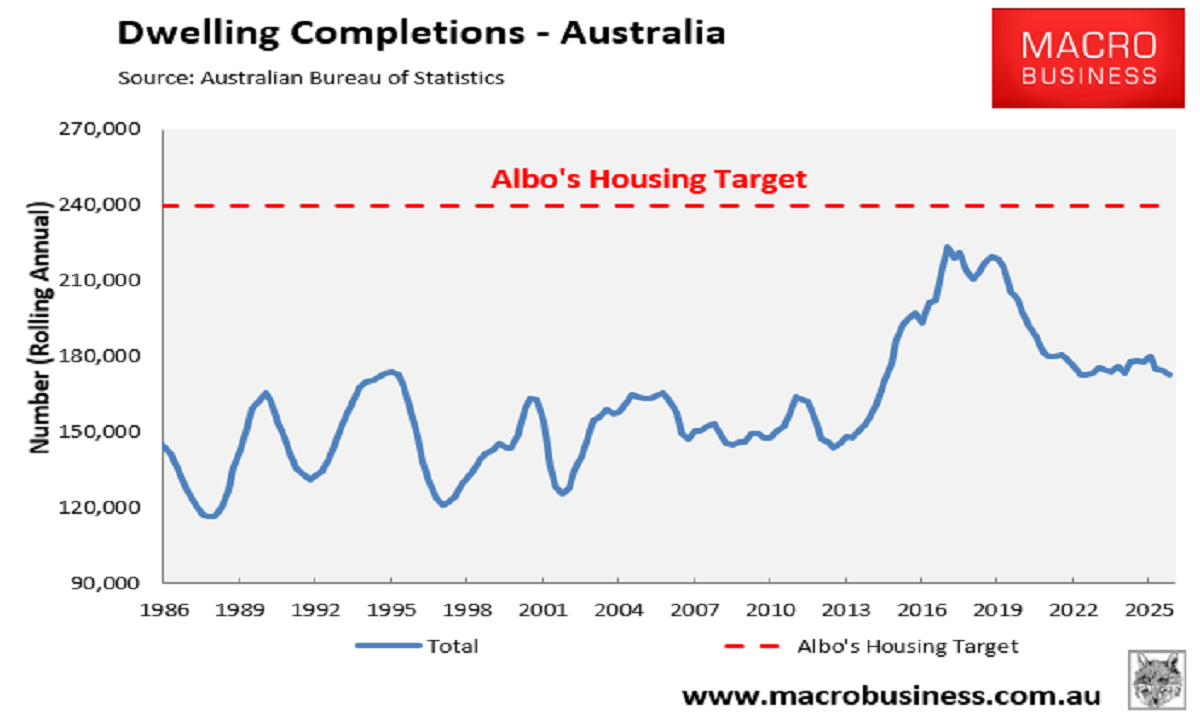
Housing supply is the top priority for the PC because affordability has deteriorated for decades and is now structurally entrenched.
Wood warns that young people are leaving Sydney in large numbers because they can’t afford to live near jobs.
She says Australia cannot continue with a system in which parental wealth predicts homeownership more than individual effort.
Wood identifies two major barriers:
- Planning and zoning restrictions limiting what can be built and where.
- Falling construction productivity, which has dropped 12% over 30 years, even after adjusting for larger, higher‑quality homes.
“A world where whether your parents own a house is more predictive of whether you own a house than your own efforts and incomes — those are not great outcomes”, Wood told Alan Kohler on the ABC’s That’s Business podcast.
“That’s partly around planning rules and zoning and what you can build and where, and then it’s partly the fact that we’ve just got less good at building when we can build”.
She argues governments must push harder on planning reform and construction efficiency.
As usual, Daniel Wood has ignored the easiest and fastest solution: cutting immigration to a level below the nation’s capacity to build housing and infrastructure.
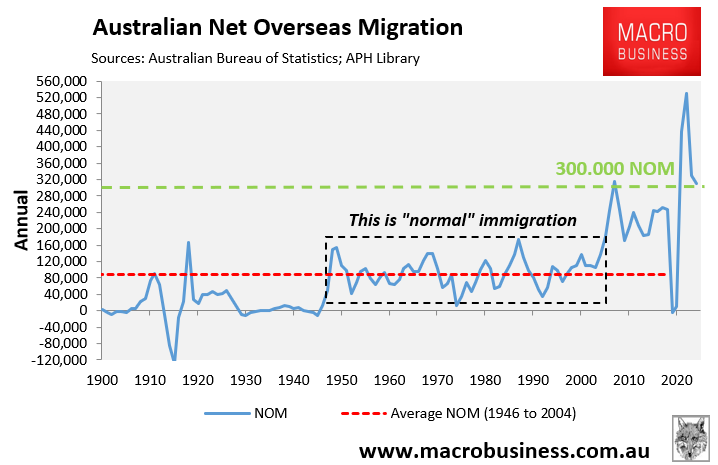
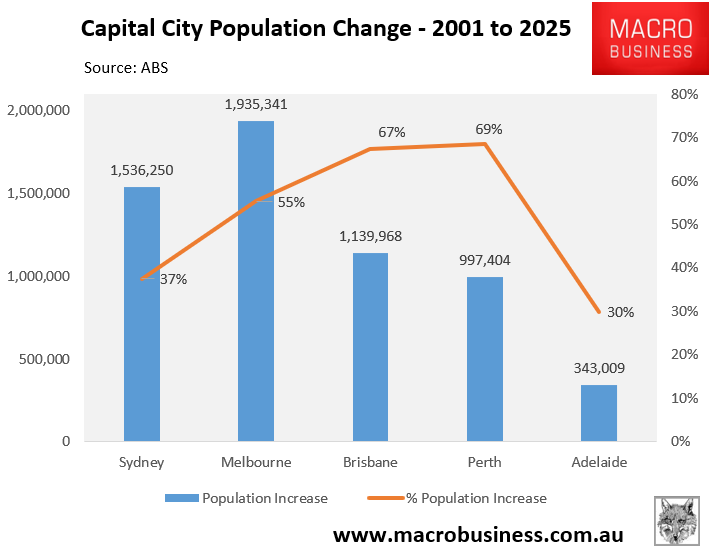
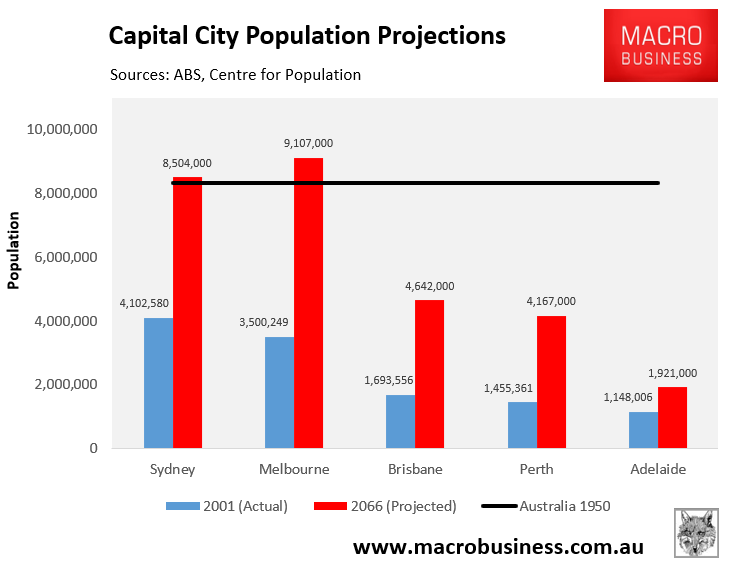
Australia’s major cities experienced extraordinary population growth this century, thanks to extreme levels of immigration:
The Centre for Population expects this extreme, city-centric population growth to continue indefinitely, with the combined capital cities projected to balloon in size by 10,850,000 over the 41 years to 2065-66:
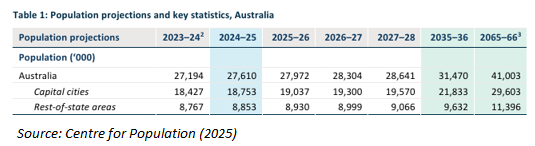
As a result, Sydney and Melbourne are projected to balloon in size into megacities of more than 8 million people. Both are also projected to be larger in 2065-66 than the entire Australian population was in 1950:
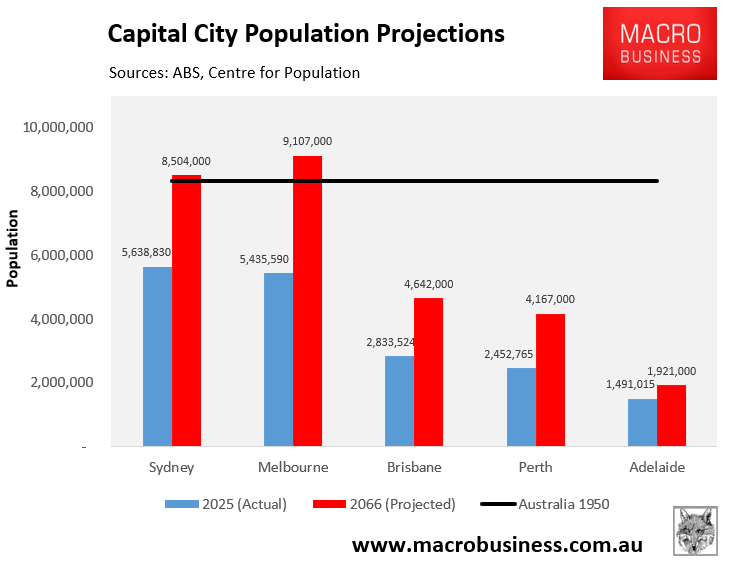
Strong growth is also projected for the other major capital cities.
This volume of population growth in Sydney and Melbourne needs to be put into context:
- It took Sydney roughly 210 years to reach a population of 4.1 million in 2001. Yet the official Centre for Population projection projects Sydney will more than double that number to 8.5 million people in only 65 years.
- It took Melbourne nearly 170 years to reach a population of 3.5 million in 2001. However, the official Centre for Population projection expects Melbourne’s population will increase by 160% to 9.1 million in only 65 years.
The reality is that Australia’s immigration levels and population growth exceed the capacity of our cities, and despite our best efforts, Australia’s housing and infrastructure supply cannot meet the demand.
Why won’t the PC acknowledge that immigration is simply far too high, rather than always focusing on the supply bogeyman?
The federal government’s own National Housing Supply and Affordability Council’s (NHSAC) latest State of the Housing System report showed that Australia would build 40,000 more homes than demanded over the five years to 2028-29 if population growth was simply 15% slower than Treasury’s forecasts:
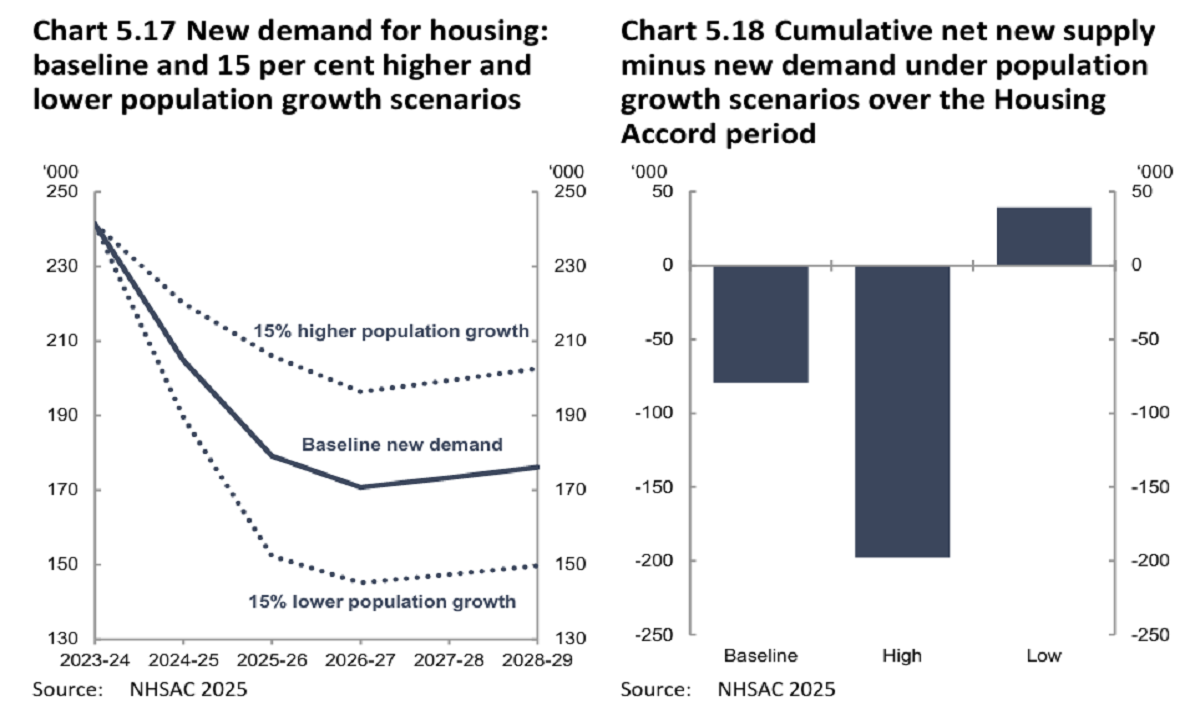
Regrettably, Treasurer Jim Chalmers last month upgraded Australia’s net overseas migration by 15% from last year’s federal budget, suggesting that Australia’s housing shortage over five years could balloon to an additional 200,000 homes (illustrated above), rather than the 79,000 baseline shortfall.
Thus, NHSAC’s own modelling shows that reducing population growth via cutting immigration is the only realistic way of solving the nation’s housing shortage.
Australia’s original “productivity tsar”, Professor Gary Banks, was the long‑serving founding Chair of the PC (1998-2013).
Back then, you could trust the PC to deliver sound advice grounded in evidence.
Banks has advocated for a significantly smaller and better-targeted migration program.
Sadly, after Banks departed as chair in 2013, the PC lost its way and became politicised. That’s why you don’t see the PC advocate for a lower migration intake, even though it is the most obvious policy solution.
