
National interest gets sacrificed at the gaslit immigration altar

You would think that Australia should be able to have an informed, logical discussion about immigration. It is, after all, one of the world’s migration success stories, and currently about a third of us were born elsewhere, with more than half of us having a parent born elsewhere.
Compared with the rest of the world, there is remarkably little ethnic protest and tension on Australian streets. Certainly, there may be occasional things that get out of hand with machetes and the steaming of alcohol purveyors on the streets of Melbourne, and for sure, trips to various locales in the major cities may have the feel of trips to other continents. But history tells us that machete concerns will likely go the way of knife concerns of the 1970s, as the little Italies and Greeces of the past morph into the little Chinas and Indias of the present, en route to whatever they will be in 50 years. There may be the odd policing issue, but they aren’t generally social issues.
The fact remains that you can take kids from anywhere and slap them into Australian schools – let them cook for ten years, and they will come out pretty Australian, regardless of their race, their colour, or their creed. They sound like us; they do the same things we do and see the same issues we do.
The national interest is about the interests of those kids – whether those kids have 10, 50, 100 or 200 years of swatting away flies, or being bitten by our insects. It isn’t about whether our forebears were better or worse than theirs. It isn’t about what they eat or wear, how they get to work or school, whether they look at us strangely, or the sports they do or don’t play. It is about the economic bequest we leave those kids and the set of expectations they will inherit from us about what they should leave to the kids who come after them.
The Liberal Party unveiled a new Immigration policy in the last fortnight. Like almost everything about the contemporary Liberal party, it was a weird form of performance art, invoking comedy and incompetence within a body of hypocrisy, and with a whiff of something off the moment the tureen was lifted. This is the same Liberal Party that, in power from 2014 to 2022, was fine with running Net Overseas Migration at all-time highs, juxtaposed with an ALP in power after 2022 and between 2007 and 2013, which set new all-time immigration highs in both periods.
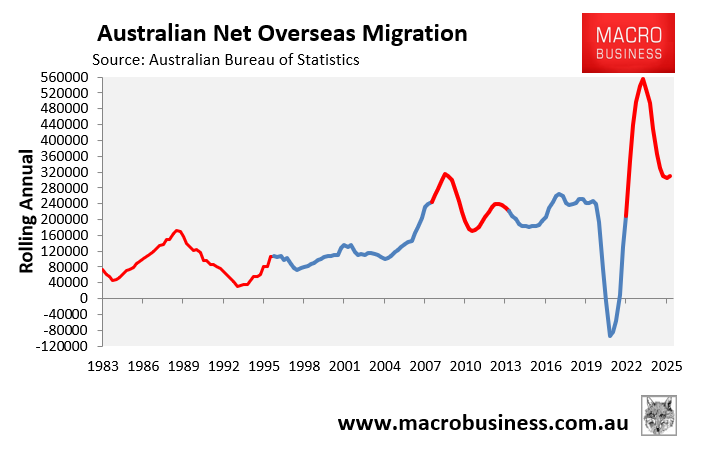
That followed on from a John Howard-era Liberal Party, which, after 2005, decided to effectively treble net overseas migration from the average of 80,000 per annum maintained between 1980 and 2006.
Neither party distinguishes itself on immigration. Both parties in power have run an essentially ‘more is better’ policy regarding numbers. Neither party has made any comment about the ‘values’ of those immigrants, and neither party has been all that forthcoming with Australians about the purpose of the policy and the practice of immigration to Australia.
Despite this bipartisan unanimity, the Liberal policy declared:-
“Since Labor came to power, Australia’s migration program has been in chaos. Numbers have been too high and standards have been too low,” Mr Taylor said.
“We have people in Australia who seek to undermine our country. The Coalition’s plan will change this for the better by restoring integrity, rebuilding confidence, and ensuring our migration system serves the national interest.
“The Coalition will pursue a values-based migration scheme that puts Australian values first, and shuts the door to those who hate our country or abuse our legal system to stay here without a right to do so.”
Shadow Minister for Home Affairs and Immigration Senator Jonno Duniam said the Coalition’s plan reinforces Australia’s right to choose who comes in and under what circumstances they come through enforceable laws.
“Living in Australia is a privilege not a right,” Senator Duniam said.
“Our plan will strengthen our borders, fix our broken migration system and ensure Australia is a safe and united nation.”
“By shutting the door to system abuse and giving the red light to radicals, we are ensuring our migration system works in the best interests of all Australians while backing those who have come here the right way.”
That policy position, of course, brought out a fairly standard condemnation. Former ALP PM Paul Keating weighed in with an excoriation.
But by adopting racism with its shabby appeal to differentiation and primal instincts, Angus Taylor marks himself out as a political leader unworthy of the leadership of a party that has managed Australia for the greater part of the last century and which celebrated the country’s unifying values.
Racism is not simply immoral and abhorrent, it is absurd. The notion that some of us are in some way different to the rest of us – in some way born differently, of some alien biology.
The two-party system has served Australia well over the last century and more. But more than that, it has superintended the development of a country where notions of equality and justice have underpinned the flourishing of one of the most open and decent societies in the world.
The blight of Pauline Hanson is that her dumb bigotry offers a fantasy. The fantasy that Australia in the modern age can return to a monoculture. A monoculture which fails to acknowledge or accept that a continent of our scale is able to turn its back on the multilateralism of neighbouring states or on the vitality of their societies. And, more than that, shun them while disparaging any contribution they may make or bring to us as migrants.
There have been countless others, of course, with the ABC and the SMH weighing in on the diversity and racism angles, leading to a couple of weeks worth of vitriol.
At that point it is worth asking if either the policy or the responses are doing anything for what mainstream Australians have shown are their concerns about immigration volumes. Are the replies to the Liberals and their almost comic policy any better for the punterariat and their concern?
That concern is about how immigration volumes, which our leaders have told us for a generation are based on ‘skills’, fit with an economy which has offloaded manufacturing and almost all external-facing services.
In 2026 Australia relies on the exports of Coal, Iron ore and Gas for more than 80% of its export revenues. As an exporter of those commodities, Australia is distinctive for being a bulk, lowest global cost source of supply, very lightly taxing them by international comparison. Those employed in those sectors comprise less than 4% of the Australian workforce. Another 2% are employed in agriculture which contributes nearly all of the remaining export revenues.
So about 5-6% of Australians are involved in something viable in a global market. The government directly or indirectly employs the rest of us, or we work in the domestic consumer bubble created by government policy. About 95% of us are employed in an environment where being the world’s most expensive is no impediment, and utilising the world’s most expensive energy, internet and housing is no problem either.
At that point, Australia bringing in a trebled net overseas migration intake for about 20 years brings some obvious questions for people in the suburbs, which our politicians have been legendarily reticent to address, or even talk about.
They include
- How sustainable is the demand for the skills we are bring in with our immigration intake?
- How many immigrants are working in a field which earns a national income? (while recognising that very few Australians do)
- How many immigrants are working in a field which is directly or indirectly funded by governments, and how sustainable is that?
- What are the social costs of having such a heavy immigration programme?
- What are the economic implications of having such a heavy immigration programme? and
- Who benefits from having such a heavy immigration programme?
The people in the burbs are far more interested in these questions than they are in values or racism.
The people in the burbs are living in burbs where Croatians and Serbs have come to live and let live, the same as the Turks and Greeks or the Vietnamese and Chinese. Large numbers of Australians are likely living in streets where their neighbours’ grandfathers limbered up for the Wehrmacht or the Regio Esercito.
The core values of Australians presumably do still include the belief that we should be handing over a better future to our children and children’s children, and that is fundamentally an economic question.
Anyone coming to Australia now, and anyone who has been here for the journey, knows that Australia is a very expensive place with expensive houses, energy and internet. Anyone thinking about it knows that immigrants are not the cause of any of those issues. They come here, they get a roof over their heads, and they turn on the switches the same way we do. The problem is not so much them but the economic straitjacket they have come to and our politicians have encouraged while discouraging us from talking about.
So while the Liberals will experience the thrill of values and immigration being branded into their public perception, and while many others will wave their placards decrying racism, how about bringing the discussion back to something the public actually wants?
Could we please have a rational discourse on immigration and its economic implications rather than cheap vitriol from our politicians and opinion leaders?