
Over recent weeks, I have exposed the blatant immigration lies of federal Assistant Treasurer Andrew Leigh.
On three separate occasions over the past six months, Leigh has erroneously claimed that the Albanese government has reduced net overseas migration by 40% from its peak under the former Coalition government.
Yet, the actual migration data show unequivocally that immigration has never been higher than under the current Labor government:
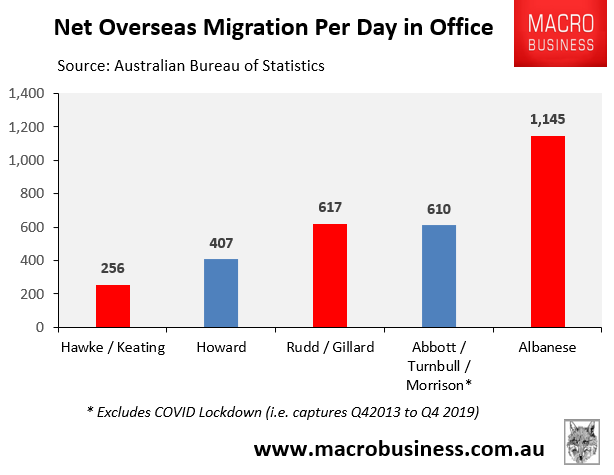
When Labor came to office in June 2022, Australia’s official annual net overseas migration (NOM) was 208,000. It peaked under Labor at an all-time high of 556,000 in Q3 2023, and over the first 3.25 years under Labor, a record 1,360,000 net migrants landed in Australia, representing 1,145 migrants a day, or an average of 419,000 a year.
The highest-ever 12-month NOM under a Coalition government in Australia’s history was 263,400 in the 2016-17 financial year.
Leigh also erroneously claimed that “migrants build our homes”:

Yet the government’s own Build Skills Australia (BSA) explicitly noted that migrants are vastly underrepresented in the construction industry.
According to BSA, “the residential construction sector has consistently employed between 4.0% and 5.0% of the working-age population in Australia”. However, “only 3.2% of recent immigrants—those who arrived in the last decade—are employed in the residential construction sector”.
“This indicates that immigration’s contribution to population growth has not been matched by its contribution to the workforce needed to construct housing for these additional residents”, BSA concluded.
The Grattan Institute has arrived at a similar conclusion, noting the following in 2024:
“Migrants are less likely to work in construction than in most other industries. About 32% of Australian workers were foreign-born, but only about 24% of workers in building and construction were born overseas”.
“And very few recent migrants work in construction. Migrants who arrived in Australia less than five years ago account for just 2.8% of the construction workforce, but account for 4.4% of all workers in Australia”.
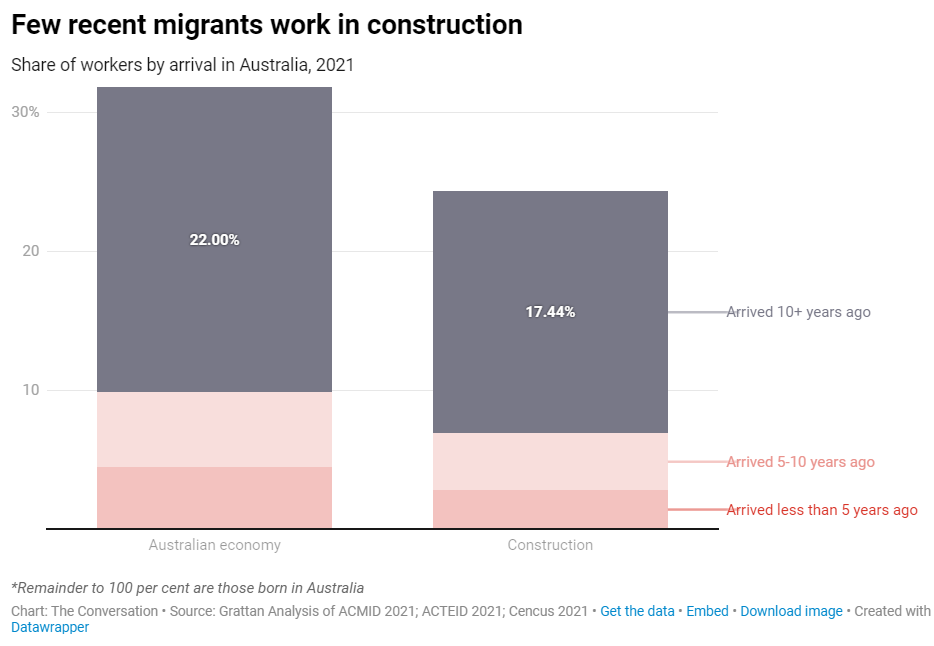
Therefore, the data unambiguously show that migrants are adding far more demand for housing and infrastructure than they are adding to supply, driving shortages of both.
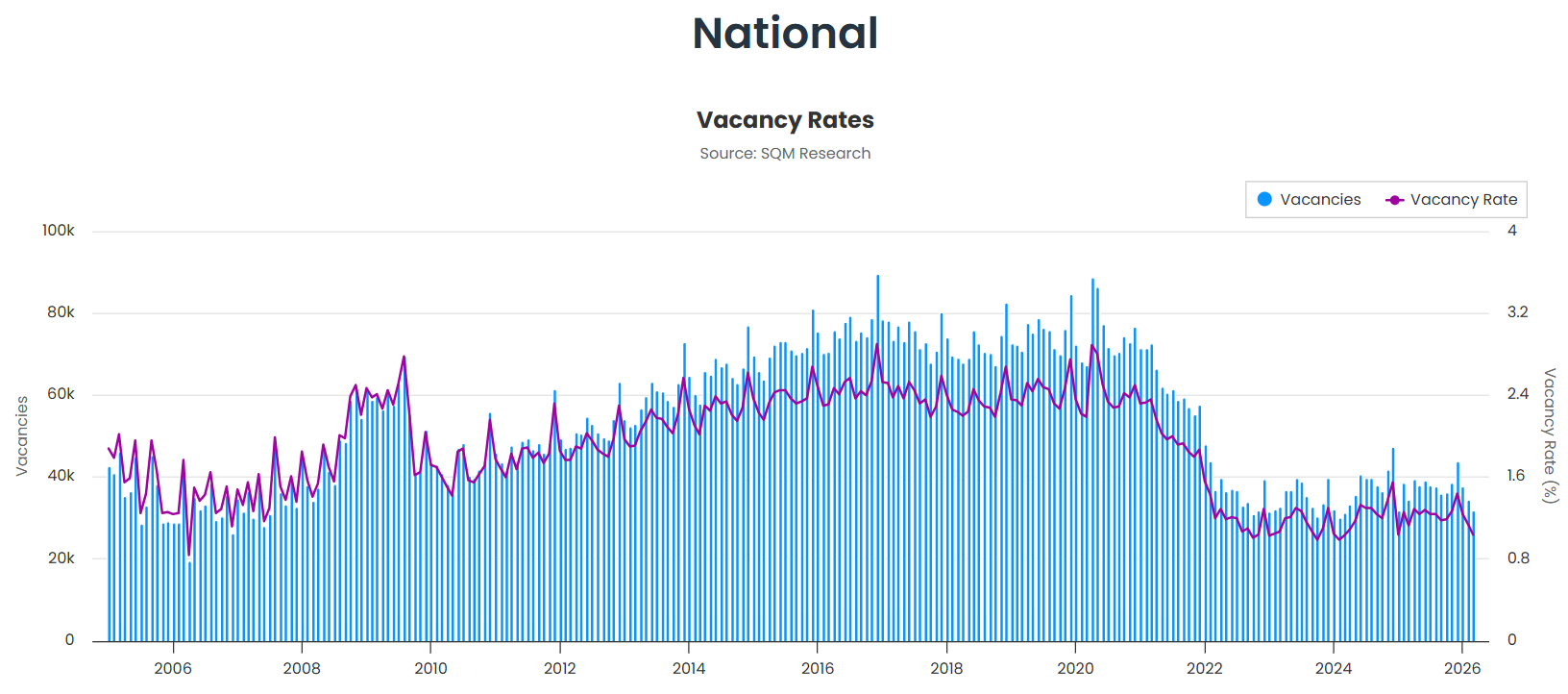
For this reason, Australia’s rental vacancy rate has collapsed to a historical low:
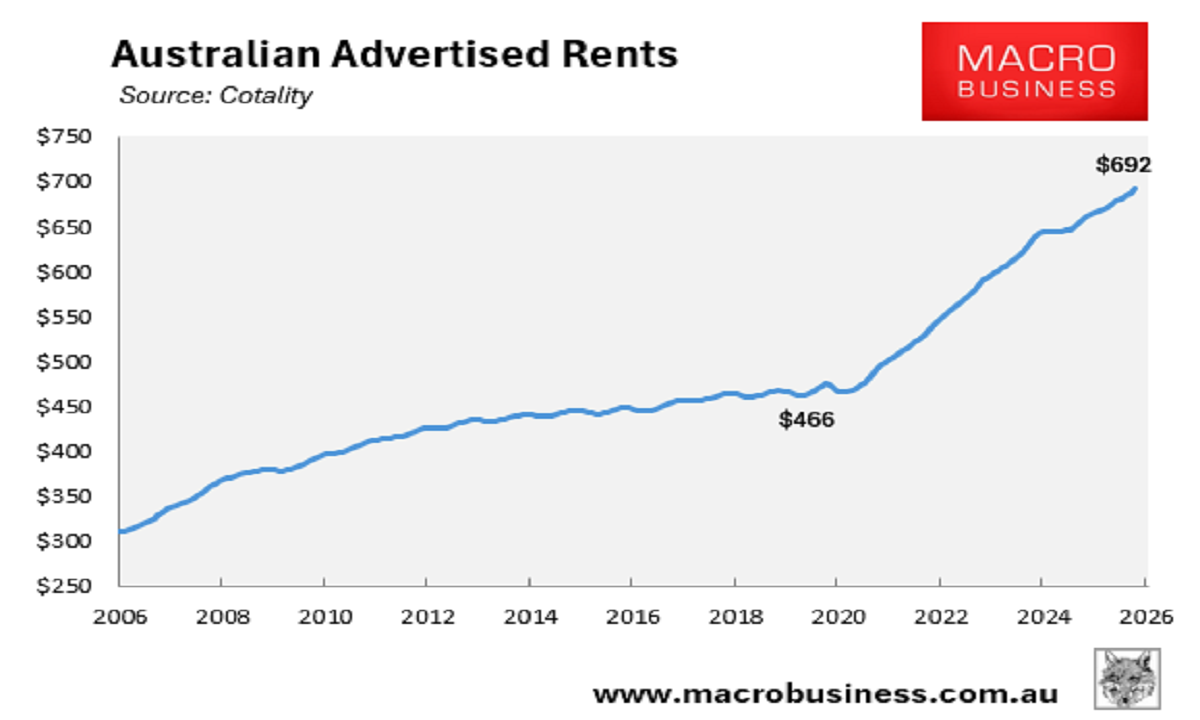
Whereas advertised rents have soared by 48% since the end of 2019, adding roughly $11,700 to the annual cost of renting:
Andrew Leigh holds a PhD in economics, so he knows how to read basic statistics. Instead, he has chosen to lie about migration numbers and their impact on the housing market.
Liberal Senator Jonno Duniam tore Andrew Leigh’s “fanciful claims” apart in an Op Ed published in The AFR.
Contrary to Leigh’s Panglossian claims, Duniam argued that “Australia’s migration system is broken… Standards have fallen, planning has been abandoned, and the result is growing pressure on the quality of life Australians deserve and expect”.
“When migration runs ahead of housing supply, infrastructure and services, the consequences are immediate and wide-ranging. Australians are living them every day – in rising rents, longer commutes, childcare places at a premium, and healthcare systems under strain. These pressures are the direct result of bad policy choices”, Duniam wrote.
“Too many people, too little planning, too few safeguards”.
Duniam’s criticisms are justified. Just this month, the Planning Institute of Australia (PIA) called on the federal government to commit to a National Plan for Australia’s Growth, warning that without better coordination, Australians will continue to face rising housing pressures, longer commutes, and lower living standards.
PIA warned that recent strong population growth “is already placing significant pressure on housing supply, infrastructure networks and cost of living, particularly in major cities like Sydney and Melbourne”.
It warned that, “without better planning, that growth will continue to drive up costs and reduce quality of life”.
Andrew Leigh, the economics professor vs the politician:
In an article written for The Spectator Australia, B.W. Jackson examines the contrast between Andrew Leigh’s current public defence of high immigration and the more candid academic research he published 20 years ago on the social impacts of diversity.
Jackson argues that Leigh’s earlier work acknowledged trade‑offs that he no longer discusses publicly and that these trade‑offs help explain rising support for One Nation.
A 2006 piece Leigh wrote while an ANU economics professor summarised his research on diversity and social cohesion:
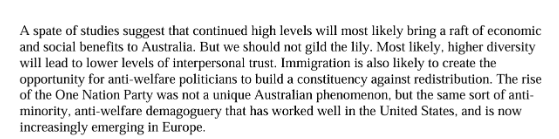
Extract from Andrew Leigh’s 2006 paper
Leigh cited international and Australian evidence showing a negative correlation between ethnic diversity and trust.
He referenced Robert Putnam’s findings that people “hunker down” in more diverse communities.
Leigh also cited examples from the UK, US, and Kenya showing that diversity reduces cooperation or productivity in specific settings.
He drew on research by Alberto Alesina showing that more diverse societies tend to have smaller welfare states.
Leigh argued that Australia’s linguistic diversity helps explain its relatively small welfare sector.
Despite these downsides, Leigh remained committed to high immigration. His proposed responses were vague: building trust in diverse communities and making the case for redistribution.
Leigh expressed hope that divisions would fade over time. Instead, they have grown alongside the explosive population growth.
Jackson’s article concludes that Leigh no longer acknowledges the trade-offs he once wrote about, instead emphasising only the benefits of immigration.
Jackson notes that Australia’s foreign‑born share has risen from 23% in 2006 to 31.5% as of 2024.
The article points to the Scanlon Foundation’s Mapping Social Cohesion survey, which has recorded declines in belonging and pride over two decades, though it acknowledges multiple factors could be involved.
Jackson suggests that voters may be responding to the trade‑offs Leigh previously identified and that One Nation’s rise reflects public concern about these issues.
I will add that dishonest politicians like Andrew Leigh are why Australians distrust the political system and are moving to One Nation. Voters are tired of politicians like Leigh ignoring their legitimate concerns and lying and gaslighting them.
