
Labor quietly reverses course on international student numbers
Last year, the Albanese government increased its 2026 international student planning level by 25,000, to 295,000.
However, it was a loose cap only, with Ministerial Direction (MD) 115 allowing institutions to exceed their caps by 15% before the Department of Home Affairs would deprioritise visa processing for new applicants linked to that institution.
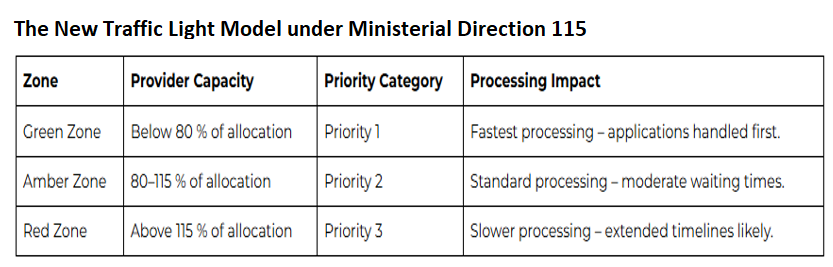
For example, if a university’s allocation is 10,000 places, it could recruit up to 11,500 students without penalty. If universities exceed 11,500, the Department of Home Affairs would slow down visa applications for their students.
Therefore, the 115% cap under MD 115 was a compliance lever only, since it didn’t ban universities from enrolling more students. The 295,000 planning level for 2026 was also a “soft cap”, given that providers were permitted to exceed it without penalty.
Last year, the Albanese government also loosened other requirements, making it easier for institutions to enrol international students.
Students from South Asia received lower risk weightings. This meant applicants from countries like India, Nepal, Bangladesh, and Sri Lanka were considered lower risk, resulting in faster processing and fewer evidentiary burdens (e.g., less financial documentation or fewer English-language test results) when applying for student visas.
In turn, lower risk weightings for South Asian students meant stronger recruitment opportunities at Australian universities.
Finally, under MD 115, around a dozen Australian universities were assigned lower risk weightings for international student recruitment.
Accordingly, students applying to these universities faced faster, easier visa approvals with fewer evidentiary requirements (e.g., less financial documentation and fewer English-language test results).
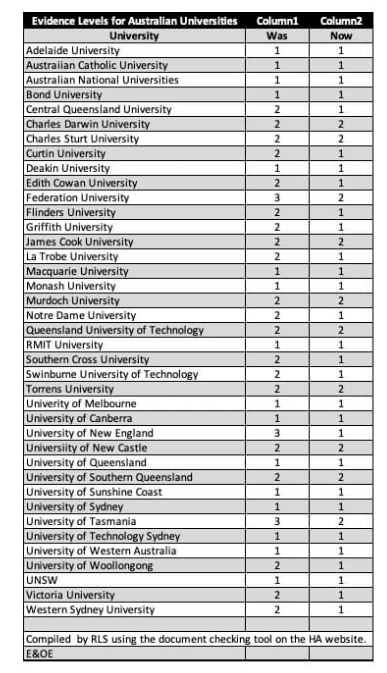
University risk-weightings
Overall, it appeared last year that the Albanese government was intent on accelerating international student recruitment in Australia, in turn increasing overall student numbers and net overseas migration.
The Albanese quietly reverses course in 2026:
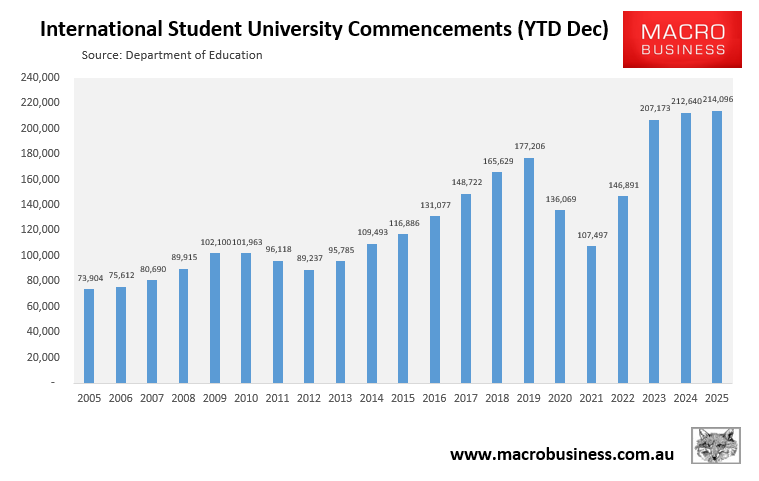
The latest data from the Department of Education shows that international university (higher education) commencements hit a record high of 214,100 in 2025:
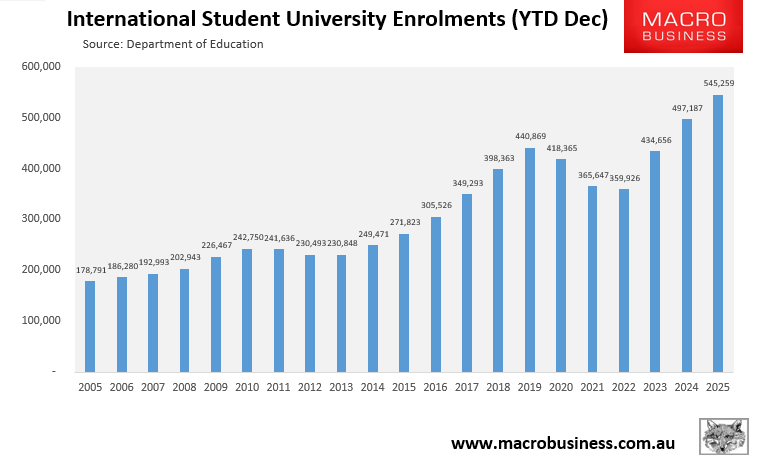
This pushed university international enrolment to a record high of 545,000, well above both 2024 and pre-pandemic levels.
Now the Albanese government appears to be changing course by attempting to stem the flow of international students and, therefore, net overseas migration.
Following integrity concerns, including a sharp rise in fraudulent financial documents and unverifiable academic records, the Albanese government retightened risk weightings to the highest-risk Evidence Level 3 category for countries including India, Bhutan, Vietnam, and Nepal.
Visa consultants in Bengaluru reported a noticeable increase in the submission of fake or unverifiable financial documents for student visa applications.
Officers reportedly struggled to authenticate marksheets and certificates issued by certain institutions, prompting concerns about the documents’ reliability.
Multiple reports indicated a pattern of non‑genuine applicants using the student visa pathway for work migration rather than study.
The policy change was also likely a response to fake degree busts in India.
Graduate visas are a key drawcard for students from the Indian subcontinent, as confirmed by recent research from Jobs & Skills Australia (JSA).
“Nearly 70% of international higher education students reported that the possibility to migrate was a reason for choosing to study in Australia, rising to 77% of Indian and 79% of Nepali higher education students”, JSA reported.
Moreover, JSA noted that over 90% of Indian and nearly 96% of Nepali higher education students cited the ability to work while studying as one of the reasons they chose Australia. “80% of students from South and Central Asia (including India and Nepal) were working during study”.
In an effort to stem the flow of graduate visas, the Albanese government last month doubled the Temporary Graduate visa (subclass 485) application fee from $2,300 to $4,600, making it the most expensive post‑study work visa in the world.
The change took effect immediately, with no transition period, and applies to most applicants except eligible Pacific Island and Timor‑Leste citizens and students who studied in regional areas.
The fee increase was non‑refundable, implemented without prior warning, and the third since early last year.
Finally, the AFR reported over the weekend that the Albanese government has pushed international student visa refusal rates to a 20‑year high, with 32.5% of university‑sector applications rejected in February. The hardest hit students are from India, Nepal, and Bangladesh.
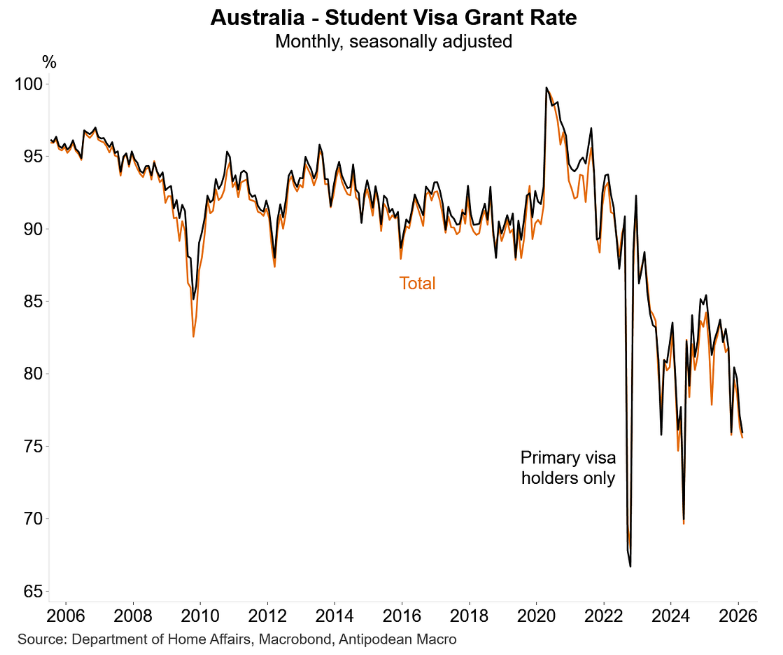
Only 34,000 student visas were granted in January–February, the lowest since 2013 (excluding the pandemic). Refusal rates in February were:
- India: 40%
- Nepal: 60.2%
- Bangladesh: 47.2%
- China: unchanged at 3%
Assistant Minister for International Education Julian Hill says Australia still welcomes “genuine” students, but the government will not back away from strong integrity measures.
The government has introduced a “genuine student test”, but experts warn it is highly subjective, allowing the department to dial up or down refusal rates depending on political needs.
Monash University’s Andrew Norton says the test’s subjectivity means the government can “crank up and crank down refusal rates” at will.
Abul Rizvi argues the test should be replaced with government‑run entrance exams tied to course content.
A better solution is for policymakers to aim to recruit a significantly smaller pool of excellent (genuine) students via the following reforms:
- Significantly raising English-language standards and mandating entrance examinations for prospective students to study in Australia.
- Significantly increasing financial requirements, mandating the payment of funds into an escrow account before arrival in Australia.
- The government is reducing the number of hours that international students can work and severing the direct link between studying, working, and permanent residency.
- Allowing only top-of-class graduates to receive graduate visas.
- Because Australian universities are non-profit enterprises that do not pay taxes, the government should impose a levy on international students to ensure that Australians receive a financial return from the trade.
Australia must prioritise quality over quantity when it comes to international student and graduate visas.
