
Australian house prices have grown strongly for nearly 30 years, save for a few minor hiccups along the way.
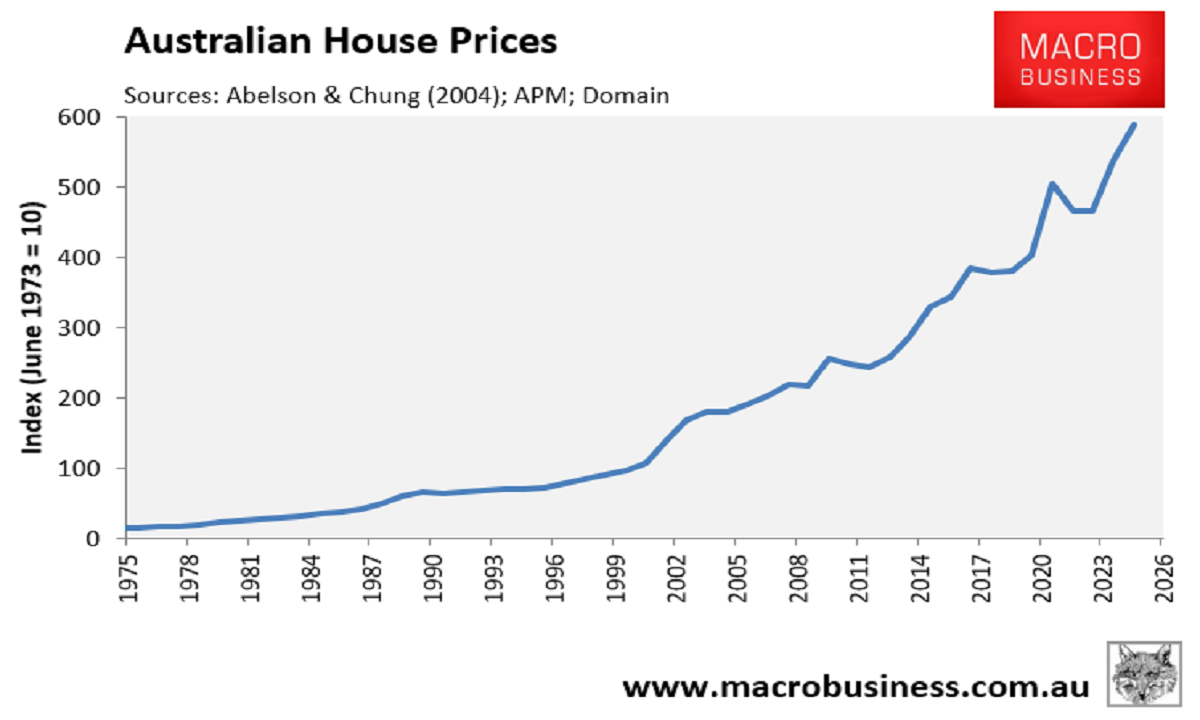
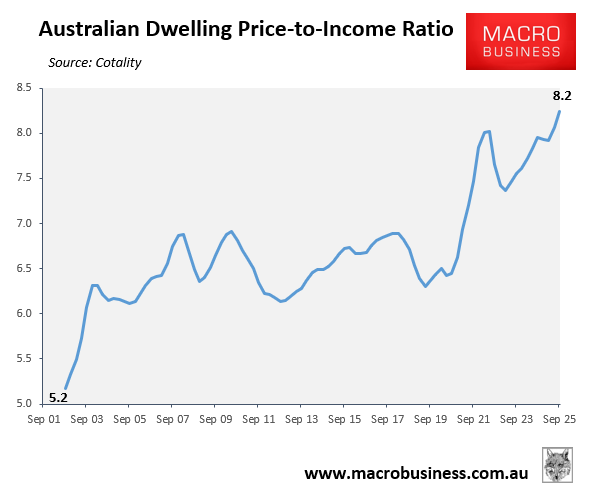
This explosive growth has meant that home prices at the end of 2025 were tracking at a record high relative to household income, according to Cotality.
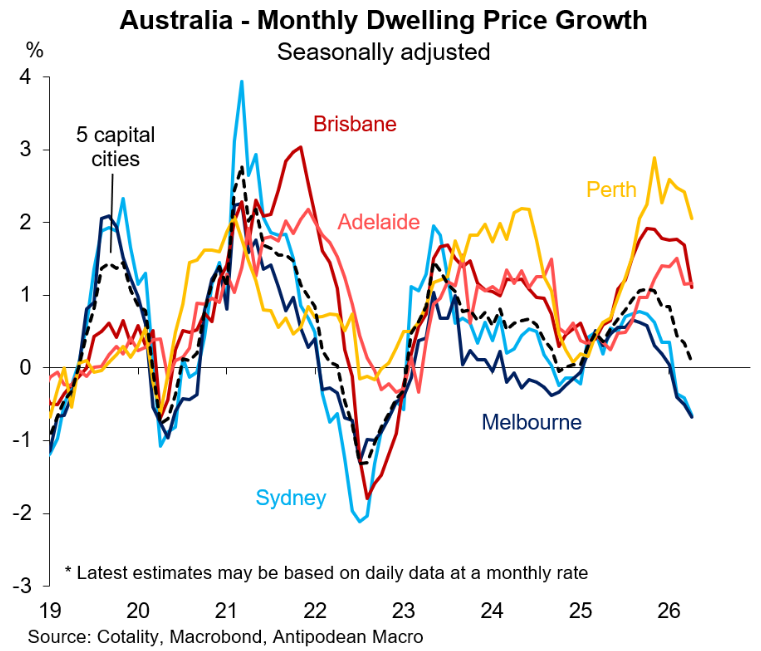
Home prices in Australian capital cities are slowing fast following the Reserve Bank of Australia’s back-to-back rate hikes, led by declines in Melbourne and Sydney:
With financial markets tipping at least another two rate rises this year, alongside pending changes to property tax concessions and a weakening economy, new modelling from Money.com.au, conducted by Primara Research, suggests that dwelling prices could fall by as much as 40% by 2030:
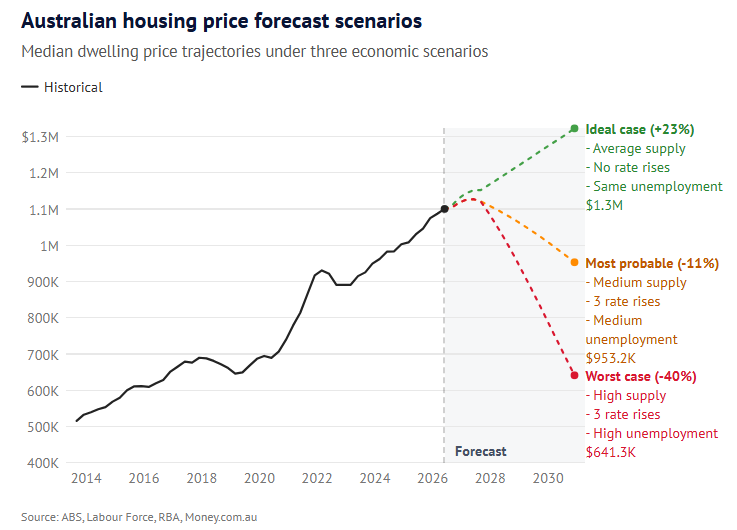
According to Primara’s “most probable” scenario, Australia’s national average housing value will climb by around 4.9% from December 2025 to $1,127,000 by June next year, but then plummet 15.4% from that peak to $953,000 by the end of 2030.
Primara’s worst-case scenario, encompassing three rate hikes, high unemployment, and high housing supply, suggests that home prices could fall by around 40% from a peak of $1.1 million to $641,300 by December 2030.
On the other hand, if the RBA were to deliver no further rate hikes, unemployment were to remain stable, and supply were to remain constricted, home prices could rise by 23% by the end of 2030, reaching $1.3 million.
It is important to remember that Australia’s two most similar economies—New Zealand and Canada—have experienced major house price declines, illustrated below by Justin Fabo from Antipodean Macro:
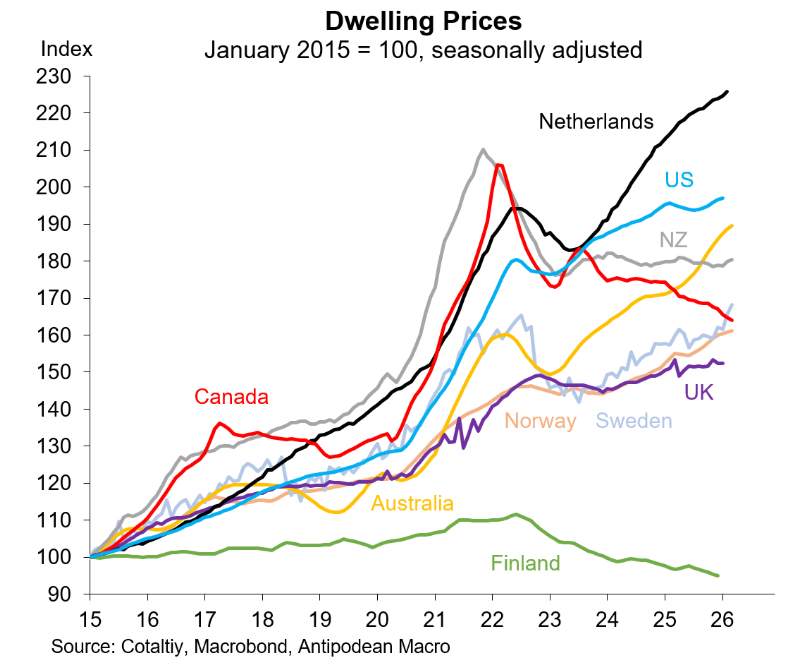
Both markets have declined by around 20% from their latest peaks.
If Australia’s two most similar housing markets can experience severe house price declines, why couldn’t Australia?
Should the RBA deliver further rate hikes and the economy weaken, the ‘fear of missing out’ could easily turn into a ‘fear of overpaying’ as a result of decreased mortgage affordability and borrowing capacity, or a significant increase in unemployment.
This would lead to a significant decline in demand and a sharp price adjustment.
However, one of the most notable differences between Australia, New Zealand, and Canada is that Australia continues to have historically high immigration, which is supporting demand via population growth. In contrast, population growth has fallen significantly in the other two countries (and turned negative in Canada).
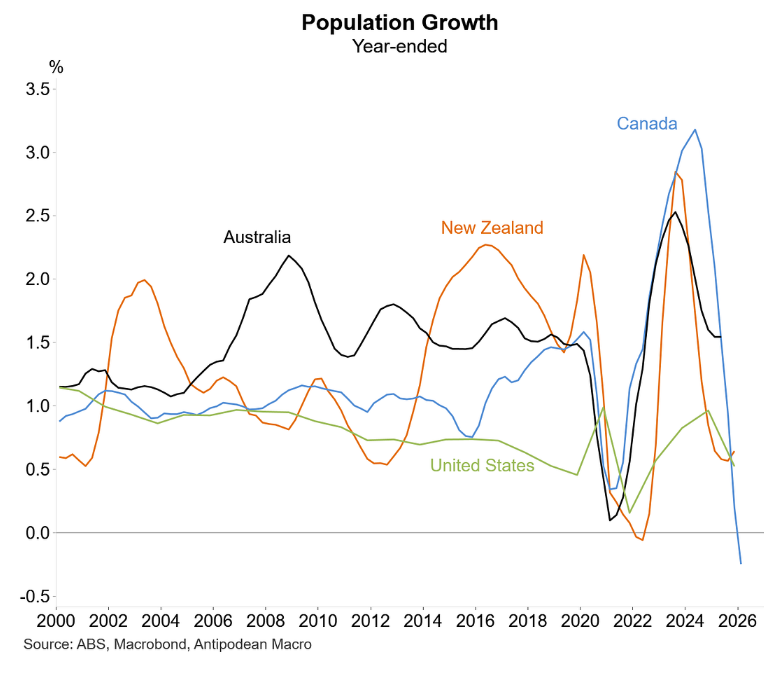
As a result, Australia’s housing market remains structurally undersupplied, whereas Canada’s and New Zealand’s are oversupplied.
Even so, I would be very cautious about leveraging up to invest in Australian property. At some point, gravity will take over.
