
A week or so ago, Japanese PM Sanae Takaichi made the unexpected announcement that she would be travelling to Australia by the end of the month.
Clearly, her visit is part of an intensifying diplomatic frenzy across Asia to secure energy supplies.
Yet, the arrival of Japan’s political gojeerah has special significance for both countries.
There is more at stake for both than in most of the current round of diplomacy because both are energy interdependent.
Australian imports of fuel are not particularly large, at 1% of petrol and 7% of diesel.
But Japan has 470mb of oil strategic reserve. Even a small release of this for Australian use would be very helpful.
Conversely, Japan’s electricity grid is 40% dependent on Aussie LNG to generate power.
It has roughly $60bn in equity stakes across 13 LNG projects, including forthcoming developments such as Barossa, Scrarborough and Browse.
The importance of this energy exchange for both nations is immense.
Today, Australia is finally debating that which should have happened 15 years ago, the application of a gas rentier tax.
The debate was led by MB, of course, but eventually the Australia Institute took it on, and today it argues the time has come.
The Australia Institute supports the introduction of a 25% tax on the value of gas exports, as proposed by the Australian Council of Trade Unions and supported by the Australian Council of Social Services, Ed Husic MP, the Australian Greens, several independent cross-benchers, and the CEO of the Commonwealth Bank, Matt Comyn.
- 56% of the LNG exported from Australia is royalty-free.
- Students pay nearly $4 billion more in debt repayments than the oil and gas industry pays in PRRT. Australians pay more in beer excise, spirits excise, or even the excise on pre-mixed alcohol and ciders than the oil and gas industry pays in PRRT. Farmers pay more in company and personal income tax than the oil and gas industry pays in PRRT. From 2014-15 to 2023-24, nurses paid more income tax than the PRRT and company tax paid by the oil and gas industry. The same is also true for teachers.
- Santos has paid zero company tax on $47 billion in sales over the past 10 years. Wholly foreign-owned INPEX paid no royalties, no PRRT, and only $483.7 million in company tax on $81.3 billion of income between 2013-14 and 2023-24, while exporting more gas each year than is consumed in NSW, Victoria and SA combined. Shell has bragged that it does not expect to pay any PRRT on gas drawn from the huge Gorgon project.
- Qatar and Australia export similar amounts of gas each year, but Qatar collects five times as much government revenue from its gas exports.
- Around 80% of Australia’s gas is exported, yet the gas export industry has repeatedly tried to convince Australians that there is a ‘shortage’ of gas.
- Since exports from Australia’s east coast began, the wholesale price of gas sold to east coast Australians has tripled. High gas prices have led to higher electricity prices.
- The gas export industry burns more gas than any other industry in Australia. The processing of gas for export uses so much energy that the gas export facilities generate more greenhouse gas emissions than all of the gas used by households or manufacturing.
- From 2021-22 to 2024-25, Australia exported $170 billion of royalty-free LNG.
- Gas companies have so far made $112 billion in windfall profits since the war in Ukraine began. Yet PRRT revenue was lower in 2023 than in 2001.
- Since 2015, 10 gas companies have exported $165 billion worth of LNG from Gladstone in Queensland. Six of these companies have paid zero company tax on the profits from these exports up to 2023-24.
It is hard to argue otherwise.
Yet, there are two problems.
First, if, by the time Taikichi Gojeerah arrives, the Straits of Hormuz remain closed, Australia will be on the verge of a calamitous fuel shortage, particularly diesel.
I previously modelled the potential damage this shortage could cause, using a fuel-intensity-to-GDP figure of 0.04% based on IEA models that measure barrels per unit of GDP.
CBA today uses a much lower ratio of about 0.015% to illustrate the potential harm.
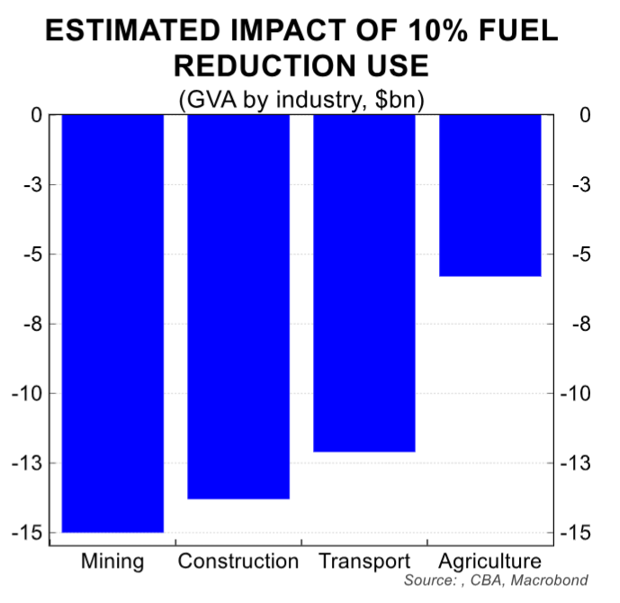
I believe the CBA figures significantly underestimate the situation. Here is my table based on IEA modelling and Okun’s Law for employment.
| Fuel loss | Lost GDP | Unemployment |
| 10% | -3.5 | 6.05 |
| 20% | -7 | 7.8 |
| 30% | -10.5 | 9.55 |
| 40% | -14 | 11.3 |
| 50% | -17.5 | 13.05 |
Either way, given the degree of economic harm, a drop of as little as 10% in fuel availability will cause significant issues for growth and jobs (and the loss of fuel could be much greater if the Trump God doesn’t shift in the meantime), making Taikichi Gojeerah’s visit especially significant.
Japan could virtually backfill any and all Australian fuel shortages.
At, say, half our daily usage of 0.5 mb/d, Japan would hardly notice the drain on its reserve. It does not have much spare refining capacity, but the oil could go to Singapore for that before shipping to Australia.
So, the Australian Institute gas tax push (which I support despite its terrible design) comes at a great time, not because we should do it, but because we could offer it up as the virgin sacrifice to Takaichi Gojeerah in exchange for fuel security.
We need not write the tax off forever. Giving Japan a gas tax reprieve for a few years, if it’s willing to supply us with fuel/oil during this crisis, makes good sense.
The second problem is that the Australia Institute’s tax design is so bad that it will immediately hike the local price of gas by 25%, if not considerably more, because the gas cartel will have nothing to lose again.
Therefore, delaying the tax also provides an opportunity to redesign it as a fixed-price export levy that prevents local gouging.
Takaichi Gojeerah is coming to crush the gas tax. We should let her, in exchange for fuel (assuming the Trump God’s is still blocking the Straits).
