
Former NSW Premier Mike Baird has penned an article in The Australian arguing that Australia is no longer a low-debt country and state and territory governments now account for about half of the nation’s total public debt.
Between 2007 and 2023, Baird argues that Australia recorded the fastest growth in public debt (as a share of GDP) among OECD countries.
As a result, Australia has fallen from third to 13th in the global debt rankings.
Government spending has outpaced economic growth for more than a decade. New analysis from e61 shows that since 2011, GDP has grown at around 2.5% per year, whereas government spending has grown at around 3% per year.
As a result, Australia is on track for nearly 20 consecutive years of deficits by decade’s end.
States now hold around half of all public debt — meaning fiscal sustainability can’t be judged by Canberra alone.
Combined state and federal interest costs now total $48 billion a year, 2.5 times the national policing budget, more than aged care, or enough to build multiple megaprojects every year.
Baird notes that this interest bill represents money that cannot be spent on hospitals, schools, or defence.
Baird contends that the states need to be more accountable for the nation’s growing debt. He wants governments to publish 10‑year fiscal statements, rather than the four‑year budget cycle, to force honesty about long‑term trade‑offs.
Baird says sustainable budgeting requires acknowledging that not every demand can be met without consequences.
“Sustainable government means being clear about trade-offs, prioritising what delivers the greatest public value, and acknowledging that not every demand can be met without consequence”, Mr Baird writes in The Australian.
“We are no longer a low-debt country, and our public finances are now being shaped as much in Macquarie Street, Spring Street and George Street as they are in Canberra”.
“State governments carry around half of Australia’s total public debt, and sustainability across the federation cannot be achieved if accountability remains narrowly focused on the commonwealth”, Baird wrote.
The debt situation at the state level will only worsen amid rising costs from the global energy shock and higher global interest rates.
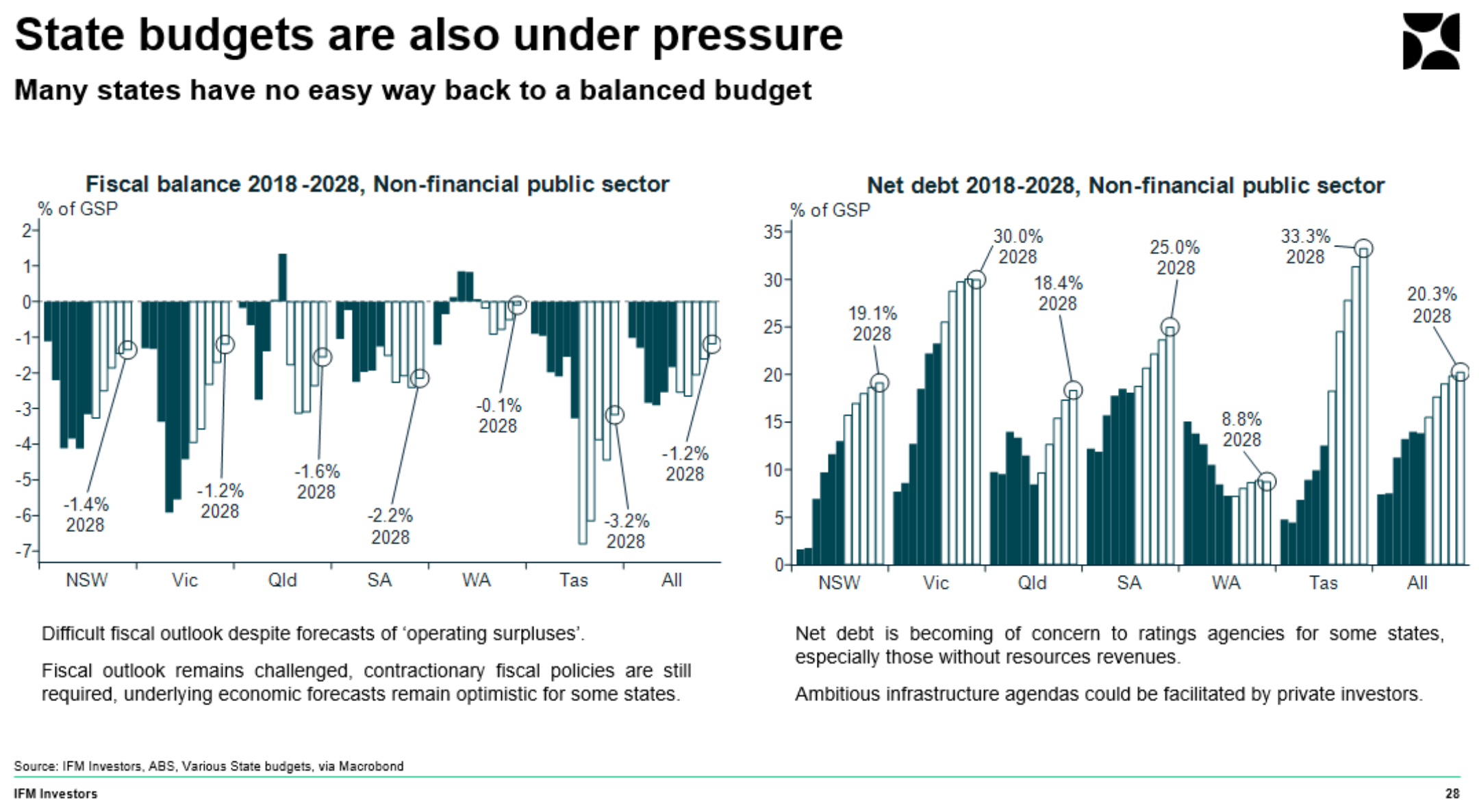
As Alex Joiner, chief economist at IFM Investors, noted on Twitter (X), “significant cost pressures will come via large infrastructure projects”.
In turn, Joiner argues that analysts should focus on ‘headline’ or ‘fiscal’ budget balances rather than operating balances, because these include such expenditures and are what define a state’s debt burden.
