
Australia’s clean‑energy rollout stalls as costs blow out
Australia faces an energy-scarce future, despite being the world’s largest coal exporter, the second-largest natural gas exporter, and holding 30% of the world’s uranium.
To meet the federal government’s 82% renewable energy target (RET), the majority of Australia’s current coal fleet must be retired and replaced with approximately 6–7 GW of new large-scale renewable generation annually, along with several gigawatts of storage.
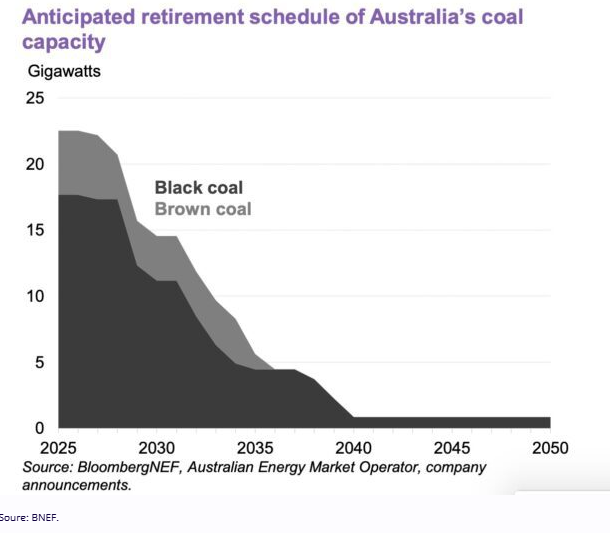
However, Australia’s transition to large-scale renewable energy slowed significantly in 2025, as investment in utility-scale solar and wind fell to less than half of the previous year’s level.
The investment in large-scale solar and wind energy decreased to 2.1 GW, down from 4.3 GW in 2024. This figure is approximately one-third of the 6–7 GW per year required to maintain progress towards 2030.
It was the third-worst year in a decade for final investment decisions.
In late 2025, 12.5GW of the 13GW awarded had not yet reached financial close, despite the federal Capacity Investment Scheme’s (CIS) goal to expedite the development of 40GW by 2030.
Utility-scale solar investment decreased to $961 million, less than half of the previous year’s level.
The following factors are expected to contribute to a 21% decrease in solar installations in 2026:
- development delays;
- competition from rooftop solar;
- declining wholesale solar prices.
This week, the Australian Financial Review reported that the Albanese government’s CIS—its flagship policy to accelerate renewable energy—is struggling to deliver new wind power amid rising costs.
Not one of the 15 wind farms awarded CIS support has begun construction, raising more doubts about Labor’s goal of reaching 82% renewables by 2030.
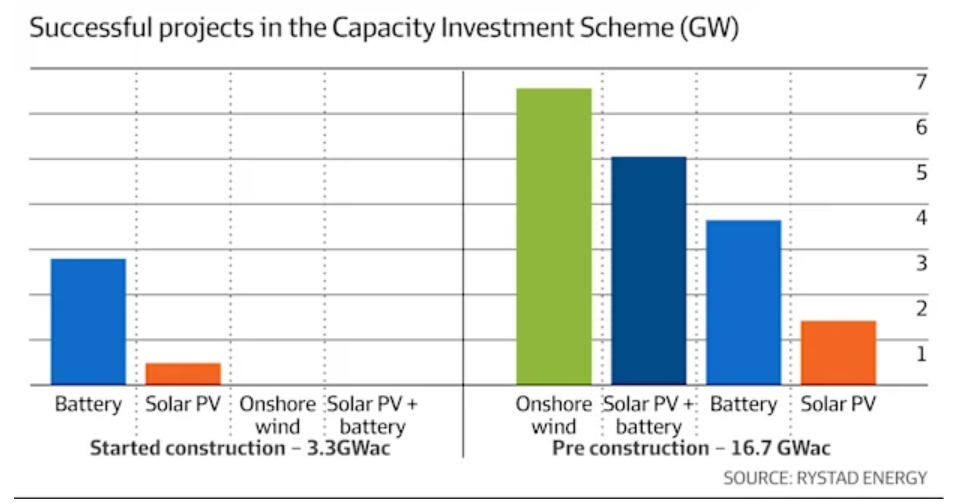
Since December 2023, 69 projects have won CIS support (20 GW total), and only 14 projects (3.3 GW) have started construction. Of those, 12 are batteries, 2 are solar farms, and zero wind farms have broken ground.
Excluding batteries, only 2 of 39 generation projects have begun construction.
CIS auctions were meant to underwrite revenue and unlock investment. But rising costs, planning delays, transmission constraints, and supply‑chain pressures have made many CIS‑backed wind projects uneconomic.
Some developers are delaying signing contracts, hoping for better deals from state schemes. At least one developer who signed is now reconsidering.
Given wind farms take 3–4 years to build, any project not starting by late 2026 risks missing the 2030 deadline.
Federal officials have been in informal talks with developers about fixing the scheme. Options include:
- Reopening auctions so developers can rebid at higher prices (i.e., more taxpayer subsidies); and
- Coordinating with states to improve project economics.
The sluggish rollout of renewables makes sense. After all, why invest in more intermittent wind and solar capacity when you compete with the existing supply glut (reflected in low spot prices) and risk having your returns crimped by future projects?
This sluggish rollout of renewables also contributed to Origin Energy extending the life of the Eraring coal plant—Australia’s largest—by two years to maintain system reliability.
Former Treasury official turned director of Macroeconomics Advisory, Stephen Anthony, warned in February that the foolhardy push to close down Australia’s stable, baseload coal power for intermittent, weather-dependent renewables will drive up costs and make Australia’s energy system less reliable, ultimately driving industry offshore, reducing productivity growth, and harming living standards.
Anthony estimated that, to replace 23 GW of coal, Australia will need:
- 3–4 times more renewable capacity (because wind and solar are intermittent and have low load factors).
- Huge new transmission lines and infrastructure.
- Large areas of land for wind/solar.
- A sevenfold increase in storage (i.e., batteries and pumped hydro).
- Expensive extra equipment like synchronous condensers and “grid-forming” inverters to replicate the grid inertia provided by coal turbines for free.
He warned that the additional economic costs of the renewables-led transition could reach hundreds of billions—or even $1 trillion — in today’s money.
“Properly measured, the extra economic costs of the renewables lead transition could reach hundreds of billions—or even $1 trillion in today’s money”, Anthony writes. “That means lower living standards on average and fewer tax dollars to fund high-priority spending programs like schools and hospitals. It also implies the exit of heavy industry overseas, and the poor or elderly people need subsidies for power”.
At the same time that new electricity generation has stalled, demand continues to rise due to four main factors.
First, dozens of new data centre builds and expansions are in the pipeline across Australia, driven by AI, cloud demand, and hyperscale investment.
CBA summarised the energy and water implications as follows:
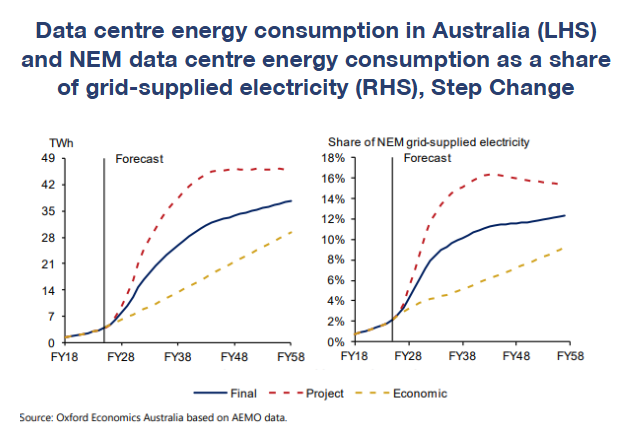
“In 2024-25, Australian data centres are estimated to have consumed 4TWh of electricity, equating to 2.2% of total NEM consumption. This is forecast to grow to 12TWh by 2029-30 and reach 34TWh by 2049-50, representing up to 12% of grid-supplied electricity (chart 11)”:
“In addition, data centres consume decent amounts of water. In Sydney and Melbourne, data centres account for 0.7% and 0.2% of yearly local water usage, respectively. As data centre capacity grows, nationwide data centre water usage is forecast to rise to 17GL by 2030”.
Second, Australia’s population is also officially projected by the Centre for Population to balloon by 13.4 million over the next 41 years to 2065–66, equivalent to adding another Sydney, Melbourne, and Perth to the current population.
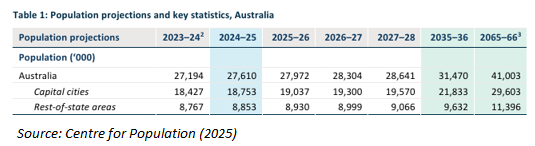
Adding 13.4 million people (nearly a 50% increase) to Australia’s population would obviously require a massive increase in energy generation capacity, even without the added demand from data centres.
Third, large-scale investment in energy-hungry desalination plants will be required to supply water to the growing population and data centres.
Finally, the federal government has set ambitious targets for electric vehicles to replace petrol- and diesel-powered internal combustion engine (ICE) vehicles.
The government has set a target of 50% of all car sales being electric by 2030, whereas AEMO assumes near total electrification of the vehicle fleet by the 2040s.
Such scenarios would obviously require massive amounts of electricity to replace Australia’s oil consumption, which accounted for around 42% of Australia’s primary energy use in 2024:
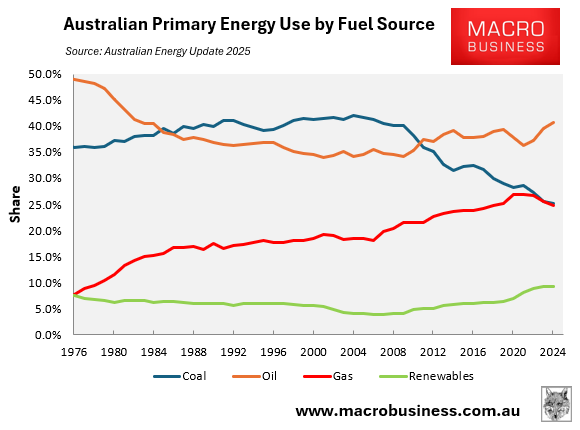
To meet its energy needs, Australia will need to expand its electricity generation capacity rapidly. Otherwise, it will face widespread energy scarcity, soaring costs, and likely regular blackouts.
Instead, the renewable rollout has stalled, while governments still plan to phase out baseload coal—the nation’s only stable 24/7 power source.
With massive planned population growth, the expansion of data centres and desalination plants, and the replacement of the vehicle fleet with EVs, the security of Australia’s electricity supply is threatened.
