
Australia gets played on a break by China & Japan for your electricity bills

Only two days before Donald Trump and Bibi Netanyahu decided on a course that choked off the Straits of Hormuz, the IEEFA issued a report clearly identifying that Japan had been reselling LNG it had contracted for, in windfall profits, for a number of years.
The Institute for Energy Economics and Financial Analysis (IEEFA) first highlighted the growth of Japan’s LNG resales in a March 2024 report, which found that the country’s major gas and power utilities were purchasing more LNG on long-term contracts than was necessary to meet declining domestic demand. Instead, companies were actively developing markets in South and Southeast Asia by investing in downstream infrastructure and pivoting corporate strategies to target growth abroad.
A subsequent IEEFA report in May 2025 found that Japanese companies resold between AUD11–14 billion worth of Australian LNG in 2024, with profits likely exceeding AUD1 billion.
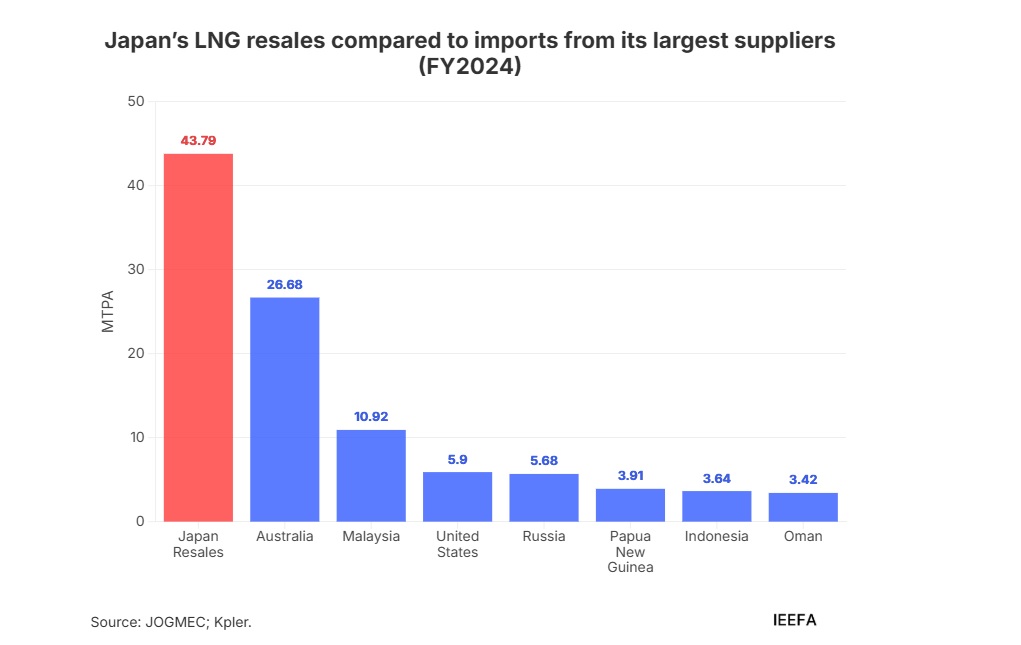
The latest JOGMEC survey reveals that in FY2024, Japanese LNG resales were approximately 1.7 times Japan’s total direct imports from Australia, its largest LNG supplier. Resales amounted to around four times the volumes purchased from Malaysia, Japan’s second-largest LNG supplier.
Just last Thursday came the news that China too was reselling record volumes of LNG it had contracted.
Since the start of the Middle East war, China has been reselling record volumes of LNG to other Asian buyers as its own demand has been tepid and stocks and gas supplies sufficient.
In March alone, China resold up to 10 cargoes of LNG—a record-high for any month ever, according to data from energy analytics firms Vortexa, Kpler, and ICIS cited by Reuters.
Year to date, China has also resold record volumes of LNG, an estimated 1.31 million tons, shipped to South Korea, Thailand, Japan, India, and the Philippines, per data from Kpler. This is the highest on record, too, and more than all volumes Chinese companies resold for the entire 2025 or 2023.
The Reuters report pithily concluded
The LNG reloads contrast with China’s move last month to ban exports of refined fuels in order to preserve supply for domestic use amid war-driven crude oil supply constraints.
If we go back to the IEEFA for a moment, we see that their approach to the entire LNG market has been to turn the market into a casino
Despite falling demand, the Japanese government continues to encourage LNG procurement. For example, the Ministry of Economy, Trade and Industry (METI) instructs companies to procure a combined 100 million tonnes of LNG each year. Targets for Japan’s energy self-development ratio, a metric for Japanese ownership of overseas oil and gas production, advise companies to take controlling stakes in fossil fuel projects abroad.
As a result, Japanese companies continue to procure more LNG on long-term contracts. Over the past year, Japanese companies signed over 10.5 million tonnes per annum (MTPA) of new sales and purchase agreements, with several of the deals extending beyond Japan’s 2050 net-zero target.
Most of the new deals are with US producers, due to the inherent flexibility of US contracts, which allow offtakers to determine the destination market. While traditional LNG contracts impose destination restrictions to prevent resales, Japan’s declining domestic demand increasingly requires such flexibility. According to JOGMEC, 70% of the country’s contracted LNG volumes in FY2035 will not be subject to destination restrictions, up from 25% in FY2015.
The last paragraph brings us to the core of the issue. It is about the flexibility or restriction of resales. Obviously the US doesn’t have any issue with resales of something it has sold to the Japanese; almost all other nations do. That includes the Qataris for whom the issue has been a long-term sticking point.
The difference between the Qataris and the Americans is that the Americans have a diverse economy which does many things competitively, whereas the Qataris have only one game to play and need to make the most of it. You should probably think of Australia as being a lot like Qatar in this sense.
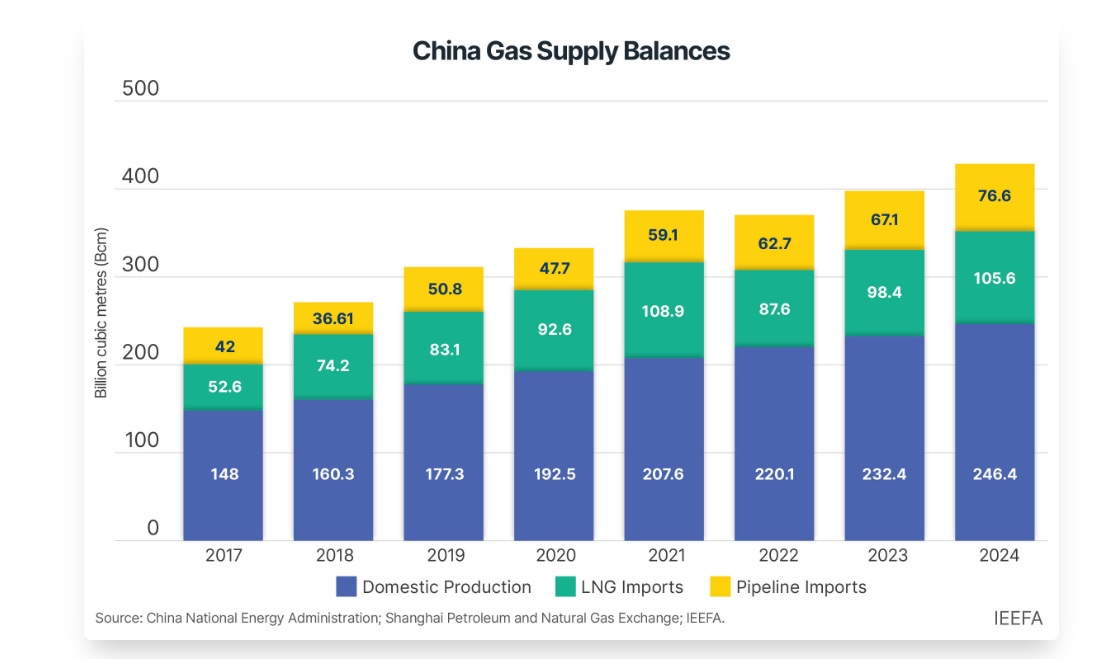
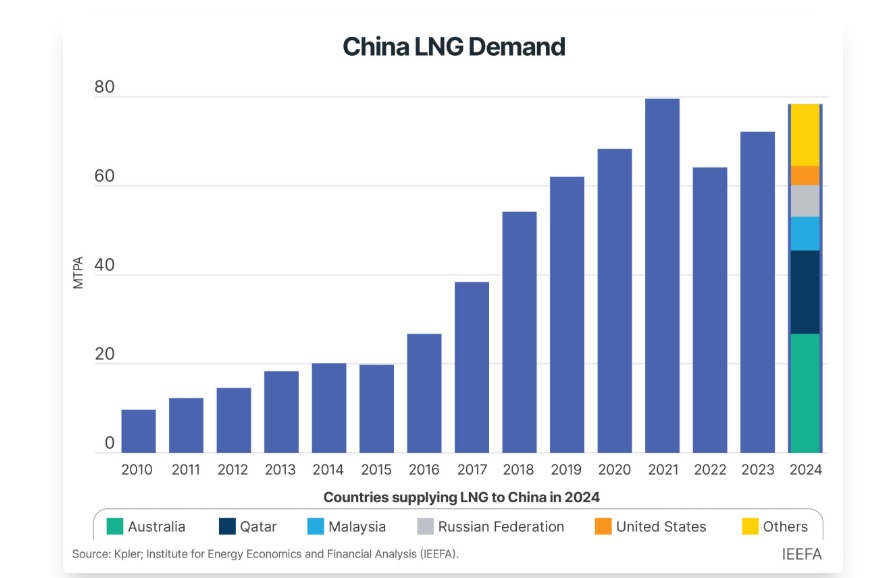
A different IEEFA report from about a year ago highlights both the sources of Chinese LNG imports as well as the role LNG plays in relation to piped exports and growing Chinese gas production. Three good charts tell us all we need to know.
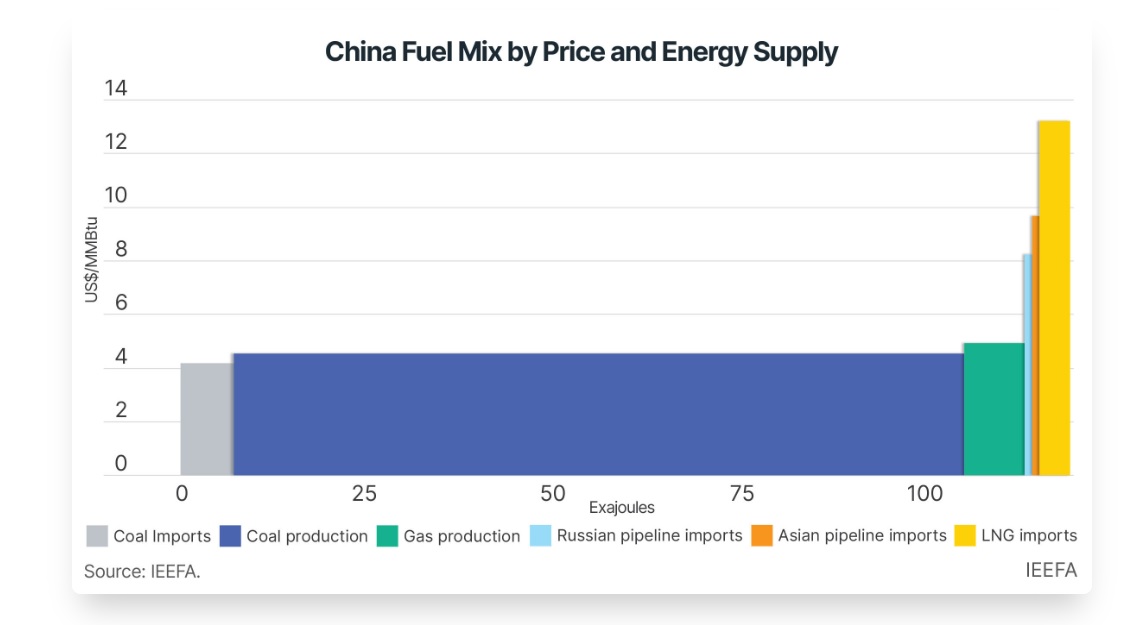
That last chart above is particularly telling for Australians. It shows that LNG imports are the most expensive fuel in the Chinese mix, which certainly explains why China is taking steps to remain out of the spot market.
But for us in Australia that point – the most expensive and the first to be resold if there are more desperate buyers out there for the Chinese – is where Australia’s marginal wholesale electricity cost is often set.
It is a driver of the electricity bill for people on the streets of Australia.
At that point, we should observe that the Chinese and Japanese governments are acting in the interests of the Chinese and Japanese people.
The Chinese are securing their supply by growing their own sources and importing large volumes from Russia, Myanmar, and Central Asia. That provides them flexibility.
The biggest sources of Chinese gas imports are Russia, Turkmenistan and Australia. Most of the Russian and Turkmen gas is through pipelines so it cannot easily be resold. The gas which it can resell is LNG sourced from Australia.
The only other resellable imports are those from the Persian Gulf…and good luck with those.
The Japanese are, by government policy, ensuring that their companies invest wherever they can to ensure excess supply, which they can resell on the global spot market. They too have flexibility.
The only people without flexibility are Australian electricity bill payers. They have had their interests represented by weak politicians and bureaucrats and corporate carpetbaggers for a generation.
While those trading Australian gas make billion-dollar profits, the industry itself contributes less to Australia than the brewing industry
Australians should be outraged and expect their government to act in their interests.
The Chinese ban on jet fuel exports a few weeks ago is in the Chinese national interest. Australia needs to withhold gas and declare force majeure on contracts to underline the point that it will act in the interest of its people.
Australia’s use of its own gas would be only a fraction of what we export.
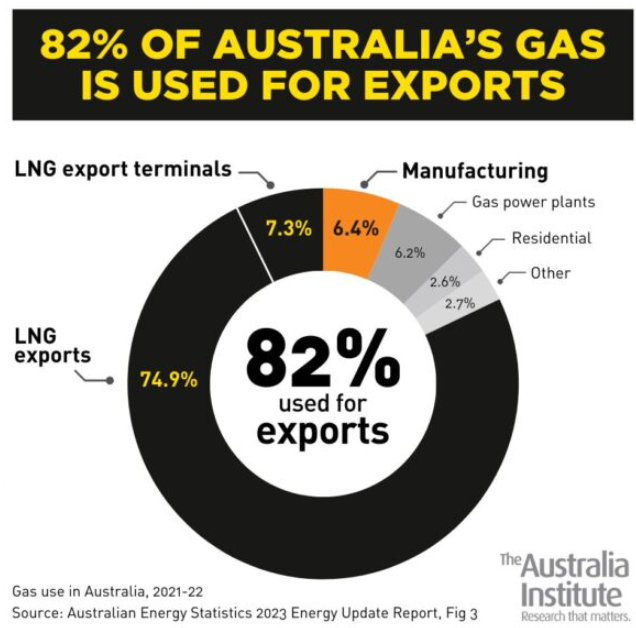
A few coins less on the roulette table of the global LNG market won’t hurt anyone. And it may do absolute wonders for Australian households.