
Wednesday’s national accounts release from the Australian Bureau of Statistics (ABS) showed that government spending continued to be a key driver of GDP growth in 2025, continuing the strong growth experienced since the onset of the COVID-19 pandemic:
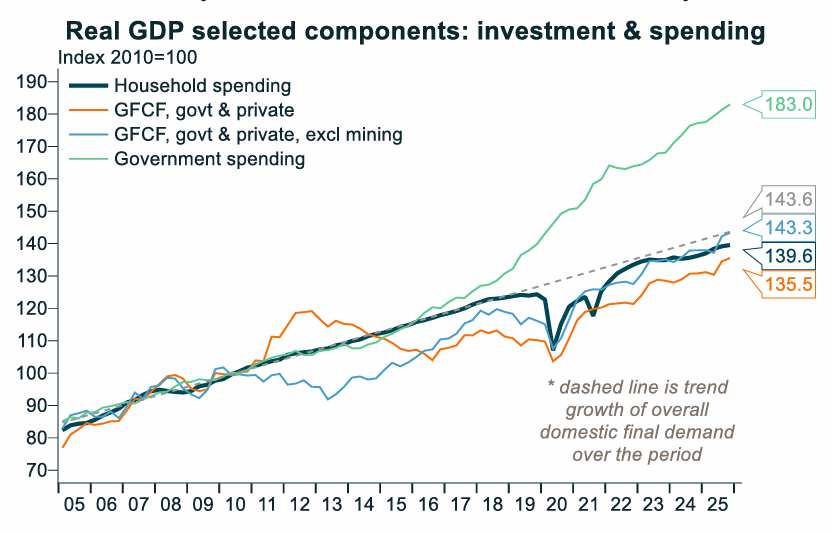
Chart by Alex Joiner (IFM Investors)
The National Disability Insurance Scheme (NDIS) is a key driver of the growth in public spending, alongside the boom in healthcare and social assistance jobs:
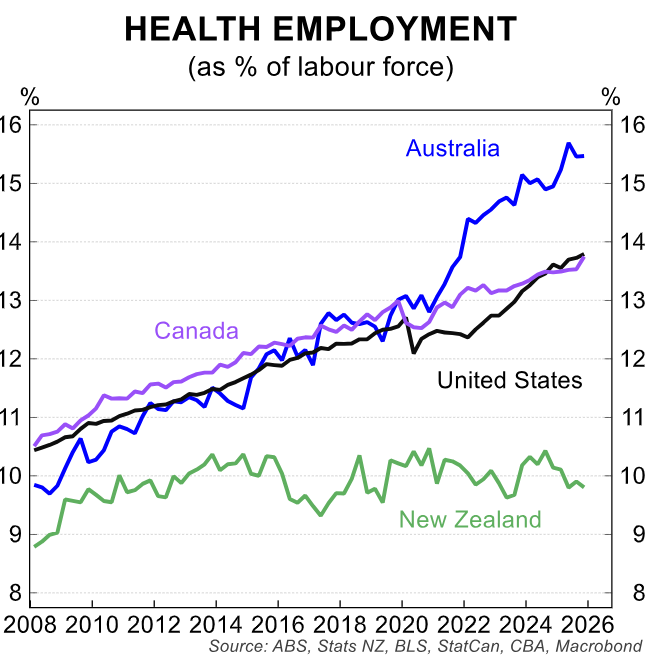
NDIS payments are treated as public demand because they are funded by the government and classified as part of general government consumption.
Wednesday’s national accounts release showed that total hours worked in the non-market (government-funded) sector, which comprises the public service, healthcare & social assistance, and education industries, continued to grow significantly faster than the market (private) sector:
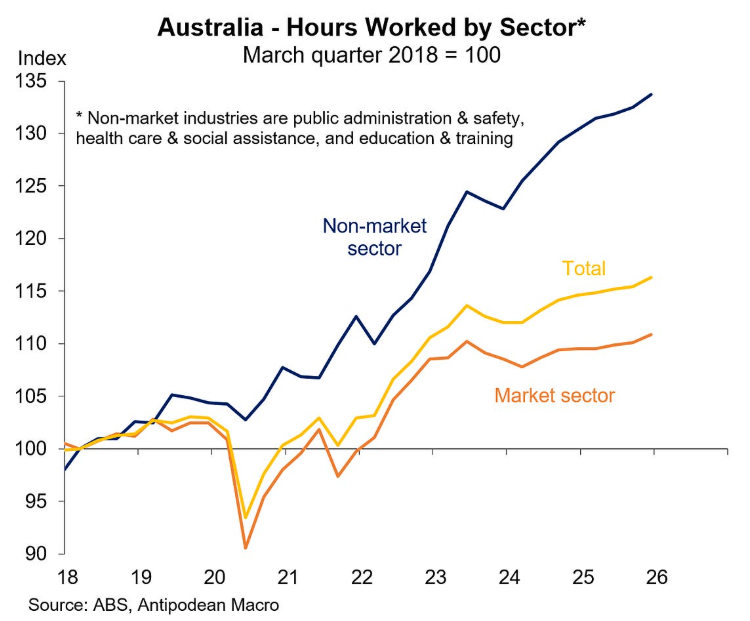
As illustrated above by Justin Fabo from Antipodean Macro, total hours worked in the non-market sector have increased by around 34% since the March quarter of 2018, roughly triple the circa 11% growth recorded across the market sector.
This explosion in non-market sector hours worked has clearly had a detrimental impact on Australia’s labour productivity growth, given that GDP per hour worked in the non-market sector has experienced virtually zero growth in two decades and has fallen sharply since mid-2022:
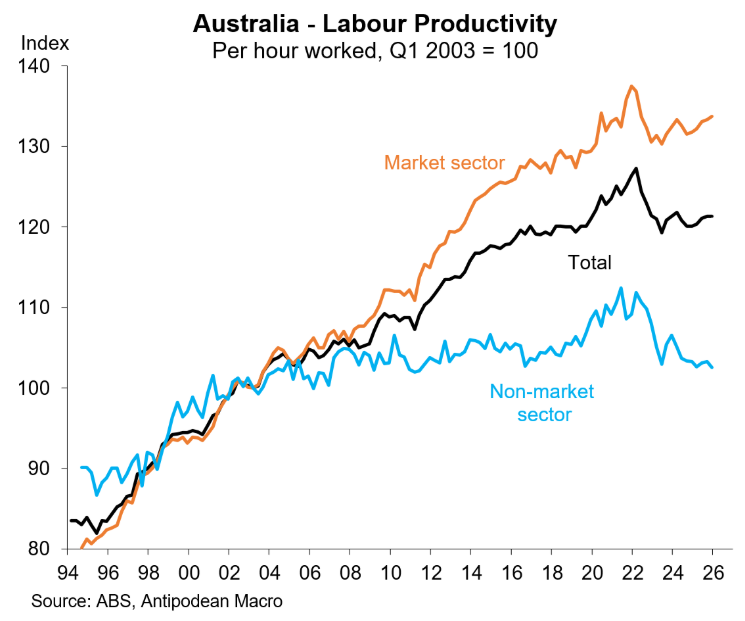
By comparison, GDP per hour worked in the market sector has grown by nearly 30% over the past two decades and rose by 1.5% in 2025, above the total labour productivity growth of 1.0%.
The latest costings showed that NDIS payments made to participants in the December quarter of 2025 grew 16.1% year-over-year:
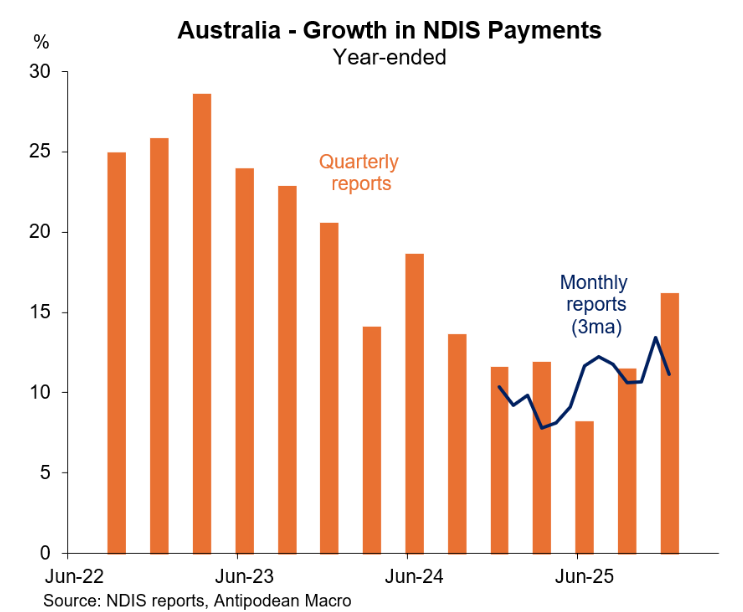
The Parliamentary Budget Office (PBO) last year forecast that the NDIS could hit $100 billion in a decade, more than the Aged Pension:
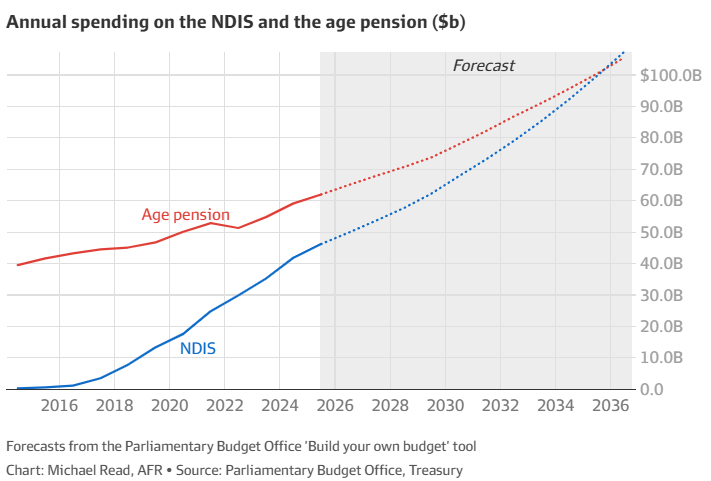
Therefore, unless NDIS expenditure is brought under control, the unsustainable growth in the non-market economy will persist.
More broadly, Australia’s governments need to pull back on their expenditure and stop crowding out the market (private) sector.
