
New data reveals a two‑speed housing market — and it’s getting worse
Australia’s housing market has clearly divided into two distinct blocks: Sydney and Melbourne, where values are now falling and Perth, Brisbane, and Adelaide, which continue to experience strong growth.
Cotality’s daily dwelling values index for March 2026 clearly illustrates these trends.
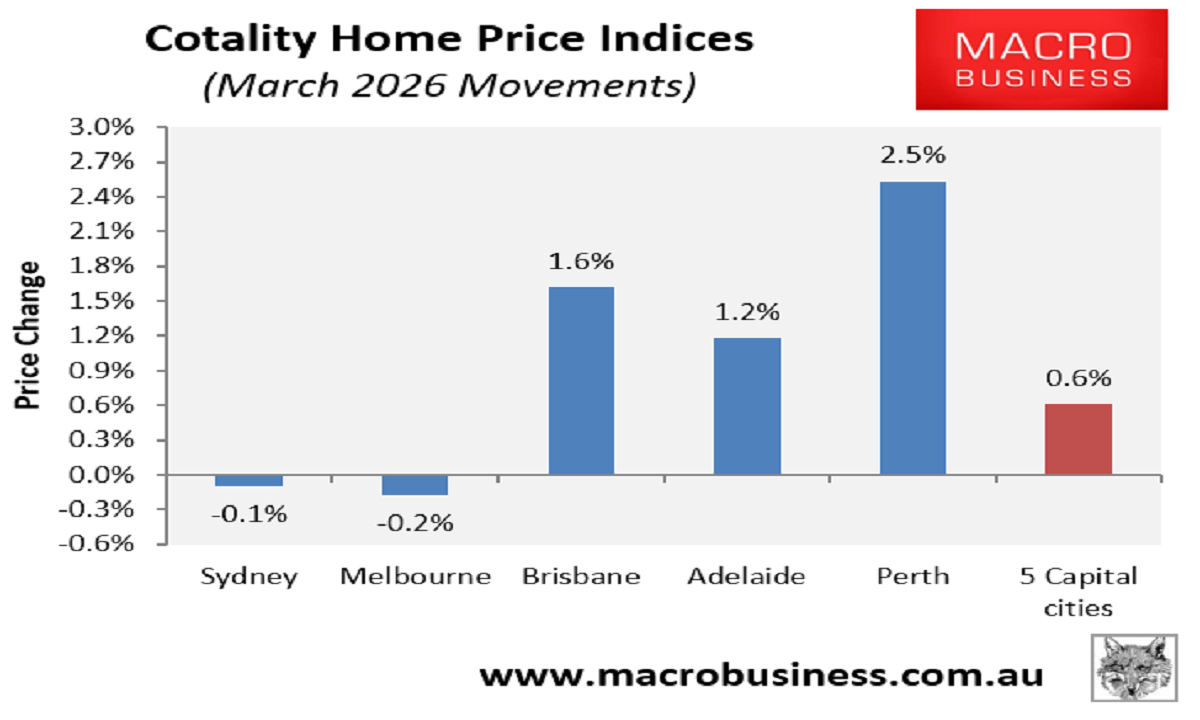
As illustrated below, dwelling values across the five main capital city markets grew by 0.6% in March. However, there was a wide divergence between the markets.
Sydney (-0.1%) and Melbourne (-0.2%) recorded value declines, whereas Brisbane (1.6%), Perth (2.5%), and Adelaide (1.2%) recorded strong growth:
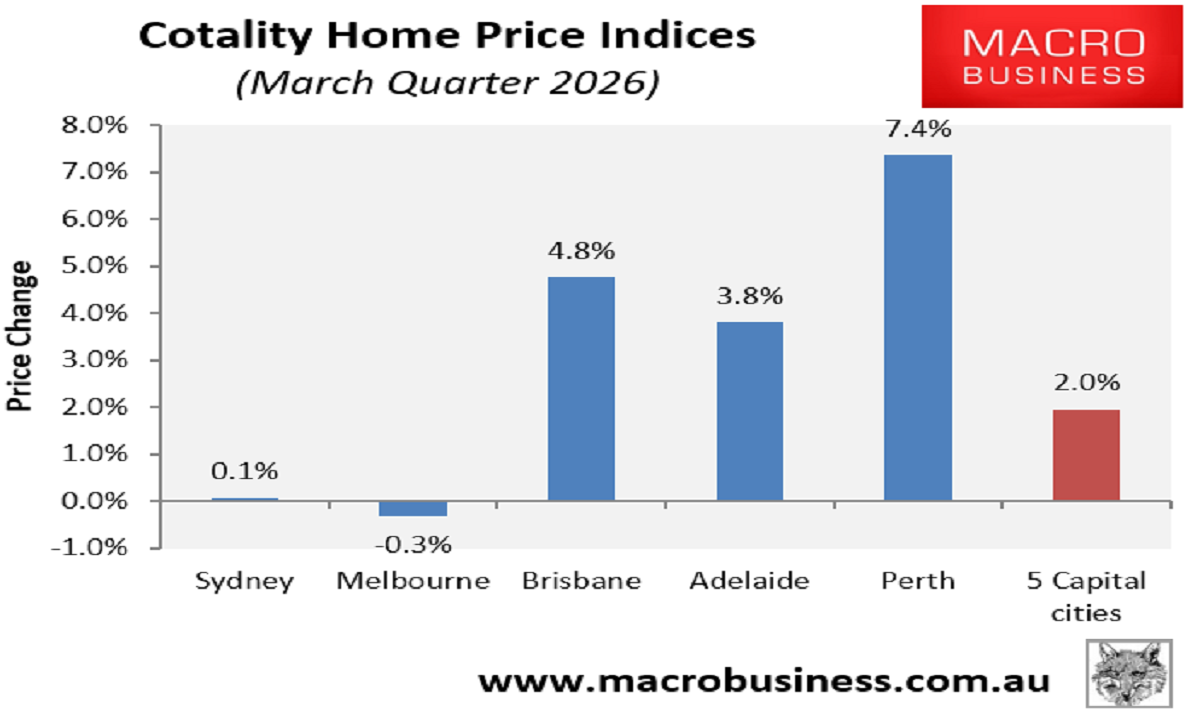
The trends were similar over the first quarter of 2026.
Sydney (0.1%) and Melbourne (-0.3%) recorded flatish growth or minor price declines, whereas Brisbane (4.8%), Perth (7.4%), and Adelaide (3.8%) recorded strong growth:
The following chart plots the striking divergence in value growth on a rolling 28-day basis:
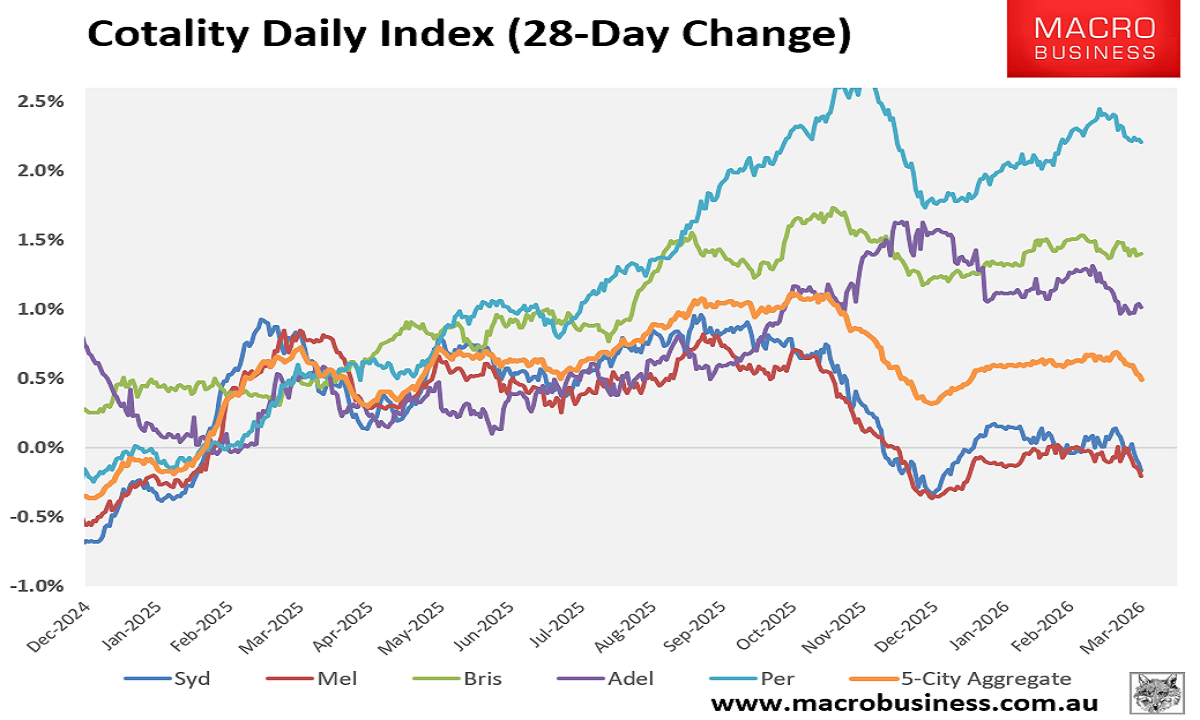
Clearly, Sydney and Melbourne are on a completely different track from the smaller main capital cities.
These trends are likely to persist for the remainder of 2026.
The following table presents the latest dwelling price forecasts from SQM Research for 2026:
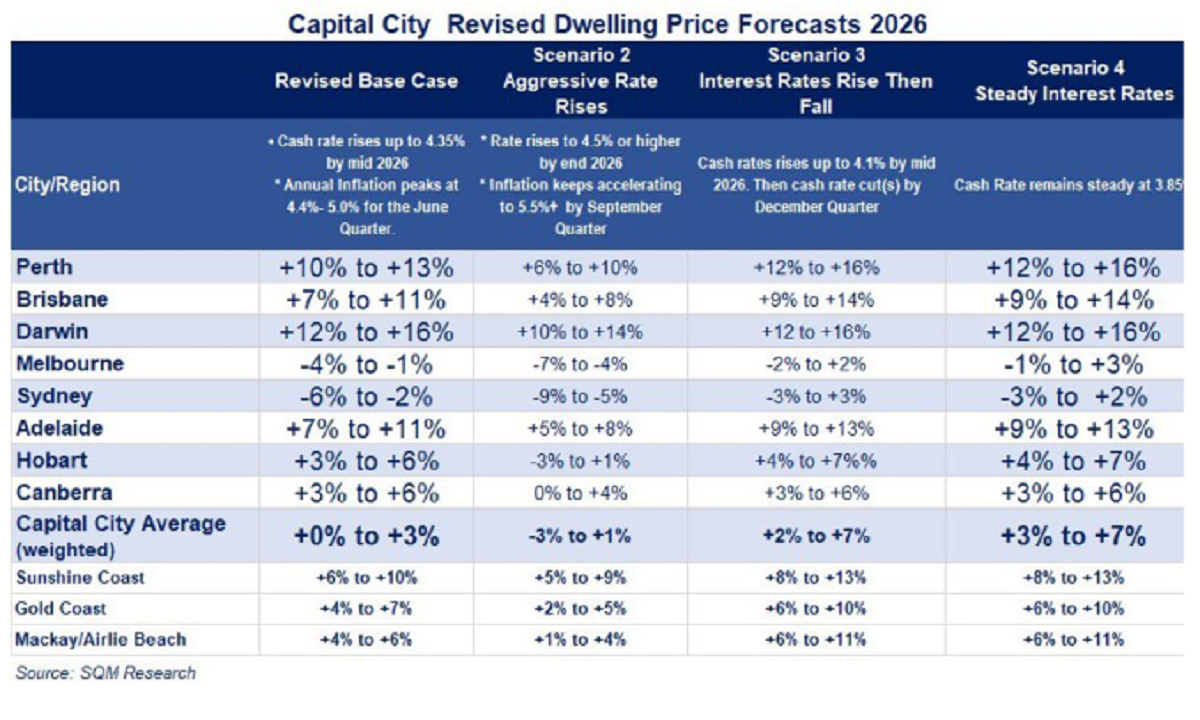
Under SQM Research’s “base case”, Sydney and Melbourne are forecast to record dwelling price declines of between -1% and -6%, whereas Brisbane, Perth and Adelaide are forecast to record price growth of between 7% and 13% in 2026.
However, the interest rate futures market now expects the official cash rate to rise to 4.85% by the end of 2026, bringing “scenario 2” into play.
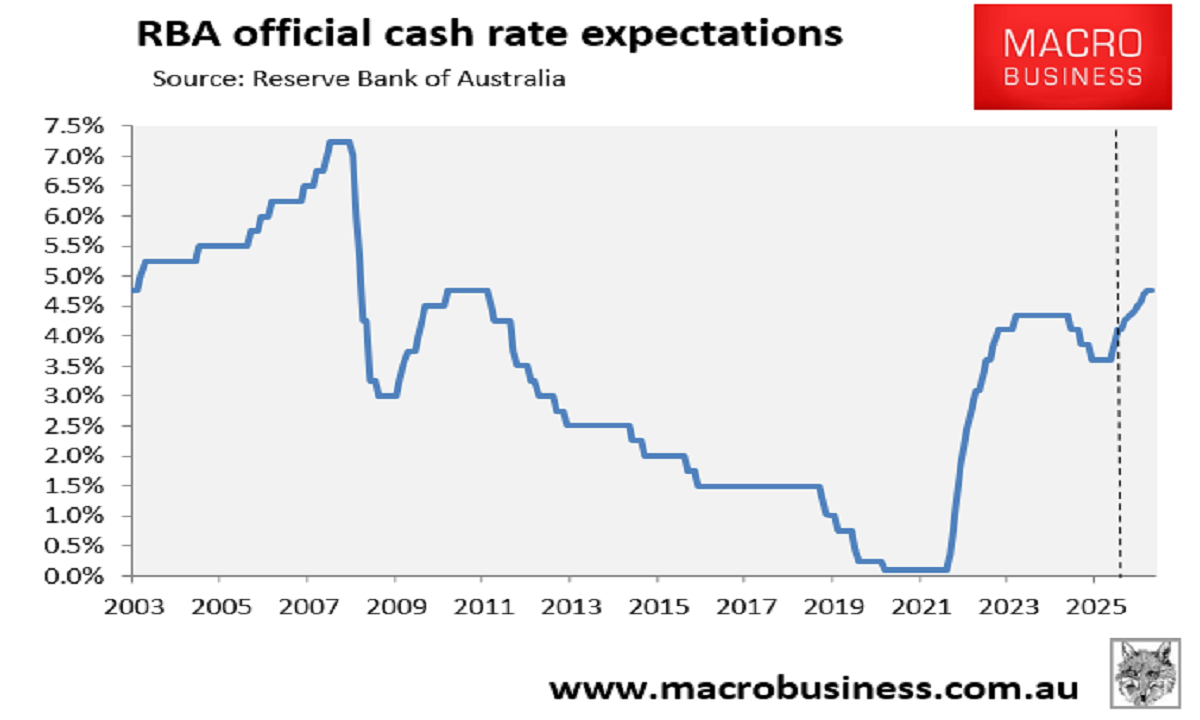
Under “scenario 2”, Sydney and Melbourne are forecast to record dwelling price declines of between -4% and -9%, whereas Brisbane, Perth and Adelaide are forecast to record price growth of between 4% and 8% in 2026.
Thus, under SQM Research’s forecasts, the two-speed housing market will become even more accentuated in 2026.
