
The Australian Bureau of Statistics (ABS) on Tuesday released monthly overseas arrivals and departures data for January, which recorded explosive growth in the number of people arriving in Australia and intending to stay for 12 months or more.
In the month of January, a net 57,270 people arrived in Australia on a permanent or long-term basis, the highest January figure on record.
In the year to January 2026, a net 494,540 people arrived in Australia on a permanent or long-term basis, the second-highest figure on record behind the 498,270 net arrivals in the year to February 2024:
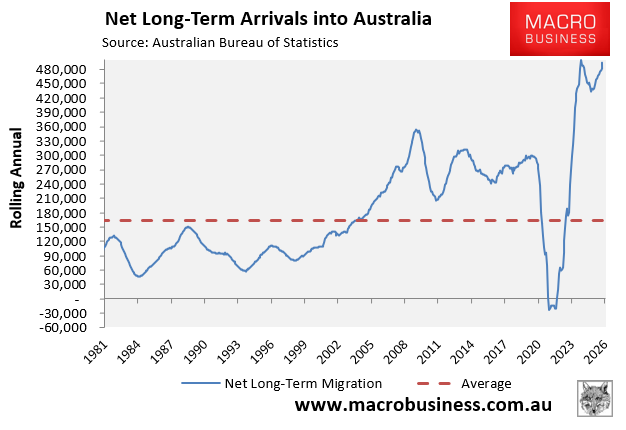
The number of net permanent and long-term (NPLT) arrivals in the year to January 2026 was also 69% higher than immediately before the pandemic in January 2020, when 292,770 people intended to stay in Australia for 12 months or more.
The following chart plots the time series of permanent and long-term arrivals and departures:
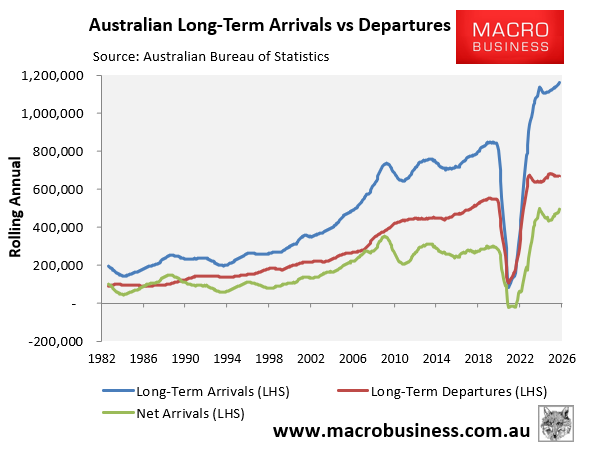
In the year to January 2026, there were 1.16 million long-term arrivals, a record high, which were partially offset by 667,350 long-term departures.
For more than three decades, the NPLT arrivals series maintained a consistent directionality with the official quarterly net overseas migration (NOM), even though the raw numbers varied. This correlation has disintegrated in the past two years:
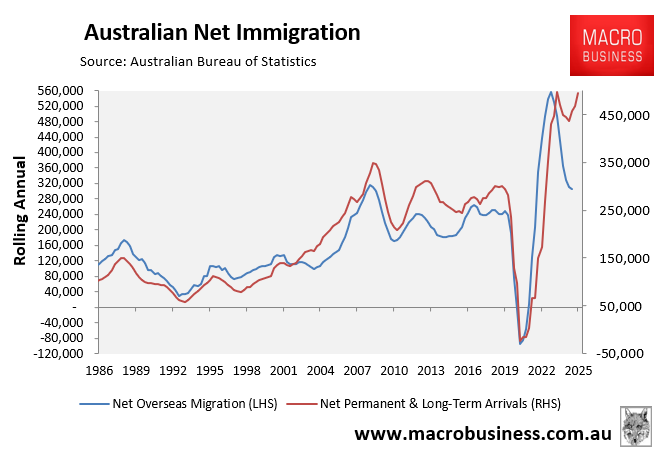
NOM is determined by observed behaviour, rather than visa type or stated intention, and counts individuals who relocate for a minimum of 12 months within a 16-month period.
The NPLT arrivals are determined by the intended duration of stay as indicated on passenger cards, and they are not adjusted for the actual duration of stay.
As demonstrated above, the number of NPLT arrivals annually increased sharply from March 2025, while the number of NOM had decreased to a still-historically high 306,000 as of Q2 2025 (the most recent data available).
The latest ABS national accounts recorded strengthening population growth over the second half of 2025:
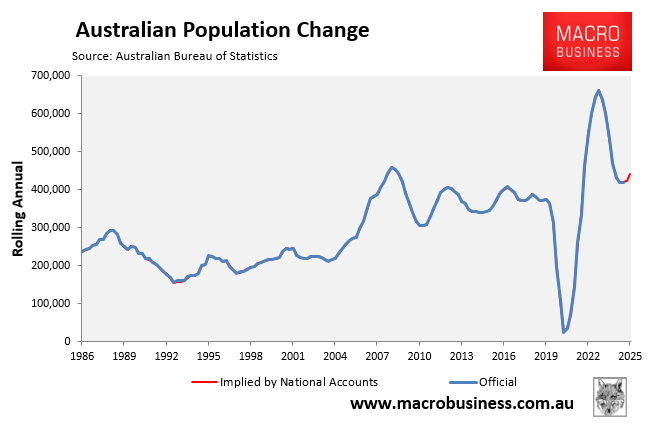
By contrast, the monthly labour force survey recorded flatlining working-age population growth since mid-2025:
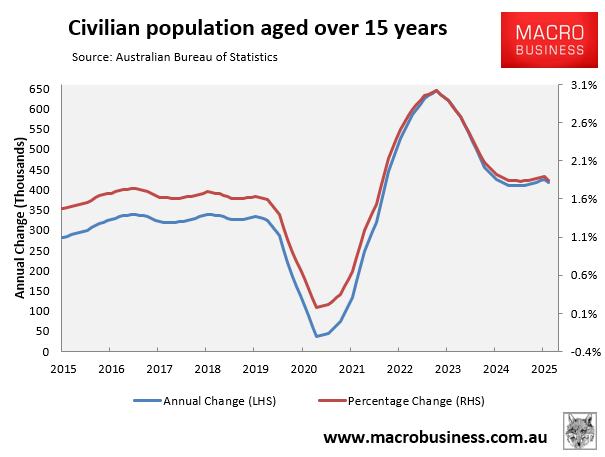
On Thursday, the ABS will release the official NOM and population growth data for the third quarter of 2025.
Will NOM rebound, as suggested by NPLT arrivals and the national accounts? Or will it continue to soften?
Interestingly, Cotality has reported a sharp rebound in annual rental growth, which is consistent with the surge in NPLT arrivals and points to rising demand from stronger population growth:
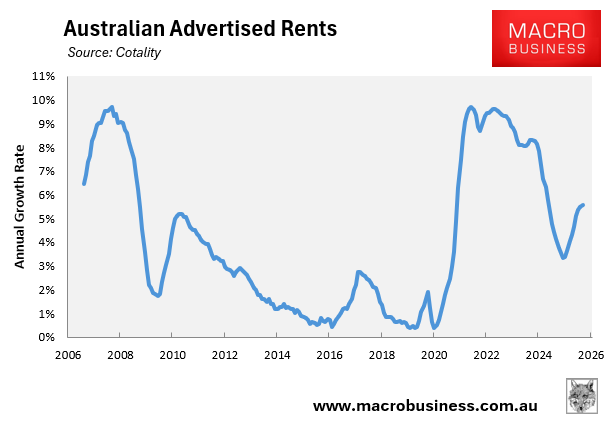
Clearly, Australia’s population is growing faster than the supply of housing, which is pushing up rents.
And that is the key point. It is the number of people in the economy demanding housing, infrastructure, and services that matters, not the official quarterly NOM, which only counts somebody if they have been in Australia for 12 months in a 16 month period.
The Albanese government must slow the flow of people arriving into Australia to solve the nation’s housing shortage and rental crisis, as Canada has done.
