
Melbourne’s water storages have fallen to 69.7%, the lowest level since July 2020 and on a trajectory similar to the Millennium Drought. This has prompted warnings that water restrictions may return if usage doesn’t drop.
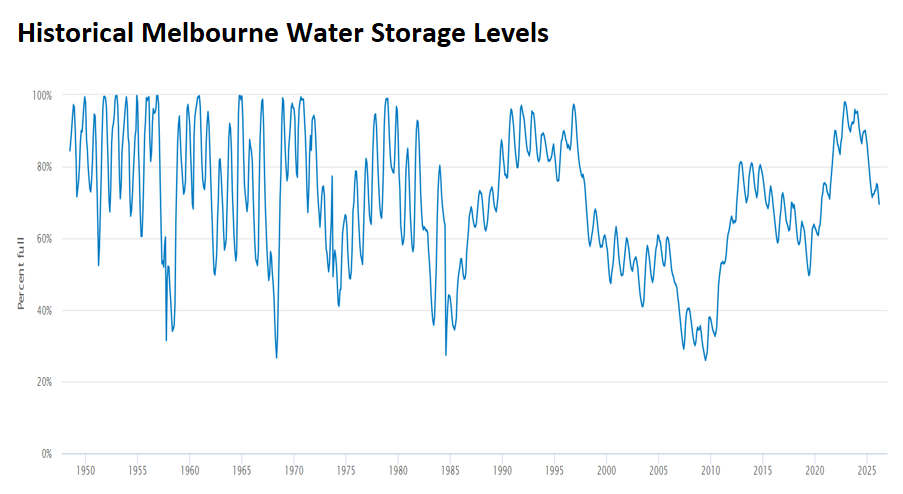
Late January water usage hit 253 litres per person per day, far above the 150‑litre target set by authorities.
In 2024–25, Melbourne used 200 billion litres more than flowed into storages, the steepest decline since the early 2000s drought.
The immediate outlook is worsening, with Autumn forecast to be drier and warmer than normal, increasing evaporation and reducing inflows.
If storage falls toward 60%, the Victorian government may need to impose formal water restrictions, similar to those used in the 2000s.
Past restrictions included bans on watering lawns and washing cars with hoses, with fines of $2000–$4000 for breaches and up to $6000 for water theft.
Experts caution that if usage doesn’t decrease, restrictions might become necessary by next summer.
Melbourne’s long-term water outlook is dire:
The reality is that Melbourne risks permanent water shortages due to rapid population growth, data centre expansions, and potentially diminished long-term rainfall.
The Centre for Population’s 2025 Population Statement estimated that Melbourne’s population would expand by 3.6 million (65%) over the next 40 years to 2065–66, driven by net overseas migration of 2.6 million.
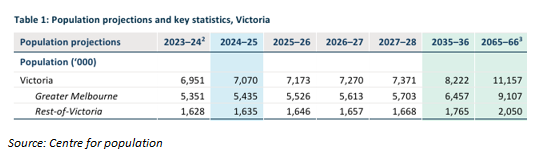
Given that migrants having children drive natural increase (i.e., births minus deaths), and Melbourne’s birth rate is far below replacement, net overseas migration will account for all of the city’s future population expansion.
Melbourne’s 65% population growth implies a 65% increase in household water demand, other things being equal.
Victorian Premier Jacinta Allan has also vowed to be “ruthless” in pursuing data‑centre investment.
Victorian Economic Growth Minister Danny Pearson has:
- Promised light‑touch regulation.
- Highlighted rapid approvals, including a 75‑day approval for a $911 million NextDC centre in Port Melbourne. Other recent approvals were even faster, including AirTrunk Tullamarine (44 days) and NextDC Geelong (28 days).
- Framed data centres as “factories of the 21st century” essential to Victoria’s economic future.
Victoria aims to secure $25 billion in private investment from the sector.
“We are in a race, and I’m determined to make sure this state wins the jobs, wins the investment, so we’ve got the building blocks to create sustainable jobs of the future”, Pearson said.
Data centres require enormous amounts of potable water for cooling and will absorb an increasing proportion of Melbourne’s supply.
The upshot is that Melbourne will require a battery of costly and energy-intensive water desalination plants to supply enough water for the city’s ballooning population and data centres.
These desalination plants, in turn, will increase Melbourne’s energy needs. As a result, water and power bills will inevitably increase.
The obvious solution would be to drastically reduce immigration to ensure that water supplies (let alone housing and infrastructure) can keep up with demand.
Big Australia immigration is a prescription for permanent water and energy scarcity, rising costs, and lower living standards.
The overwhelming majority of Melburnians don’t want the city to grow to 9.1 million people by 2065-66, as projected by the Centre for Population.
They know that a mega-Melbourne will resemble a Hunger Games for water, energy, and housing, alongside reduced living standards.
