
Oil is up 18% at $109 this morning.
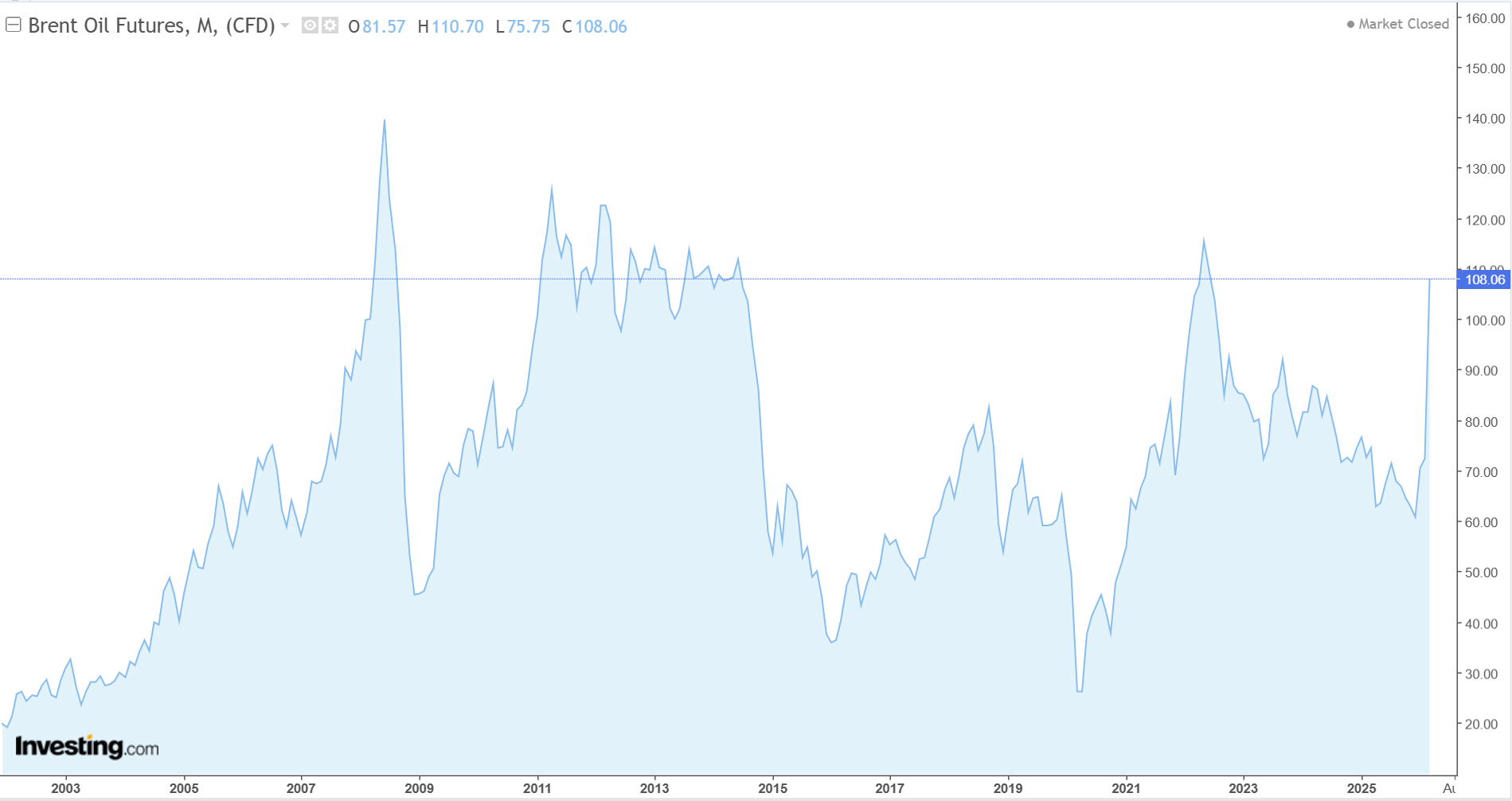
Goldman reckons oil is going higher. The analysis highlights rapidly rising upside risks to oil prices from a severe disruption to oil flows through the Strait of Hormuz.
The base case forecast previously assumed Brent crude in the low $80s in March and the high $70s in the second quarter, based on the expectation that shipping flows through the Strait would gradually normalise. However, recent developments suggest Goldman’s assumptions were wrong.
First, oil flows through the Strait of Hormuz have collapsed dramatically. Current estimates indicate that flows are down by about 18 million barrels per day, leaving only around 10% of normal volumes moving through the Strait.
Second, the ability to redirect oil exports through alternative routes has been far more limited than expected.
Third, industry feedback indicates that shipping companies are taking a cautious approach because of the physical risks in the Strait. The key deterrent is the security risk of operating in the Strait.
Fourth, the scale of the supply shock is unprecedented. The estimated 17.1 million barrels per day hit by Persian Gulf supply are roughly 17 times larger than the peak disruption to Russian production in 2022. Such a large shock could lead markets to price in demand destruction more quickly than in past crises, especially as hoarding behavior and reduced exports of refined products accelerate inventory depletion.
Without progress on these fronts, Goldman reckons oil prices could exceed $100 in the near term and potentially surpass the peaks seen in 2008 and 2022, particularly if disruptions persist through March.
In my view, this is far too optimistic. The all-time peak price for oil was in 2008 at $148. I believe we will reach $150 per barrel within days if nothing changes in the war.
Indeed, in my view, markets are drastically underestimating what is about to happen.
If oil were at $150 over two years, we could address the 17m/bd shortfall through demand destruction and a shift to alternative energy.
But over two weeks, the kind of demand destruction needed to rebalance the oil market after a 17 mb/d shortfall will require a price so high that it will shut down entire economies overnight. I don’t know what this price is. It might be $500 per barrel. It might be $1000 per barrel. It might be $10k per barrel. The needed price is clearly depressionary.
Any sovereign that can avoid this outcome will. That will mean that any sovereign that has enough oil to keep its economy running will keep it at home.
This includes the US.
So trade in oil will collapse in short order as well.
Not only is a scarcity shock about to hit oil, but a sovereign security shock is about to hit it as well.
Australia has one month of fuel reserve. It will disappear much more quickly than that when the hoarding panic starts. We will be at the forefront of global demand destruction.
The $10 petrol price in the title of this post is not a forecast. It is a risk if Trump gets this wrong (which he does more often than not). Equally, it could be a $3 or $35 peak price. But every day that goes by, the price risk goes up exponentially.
Broad analysis today reminds me of the lazy response to COVID in its early days, when markets thought it was a sniffle and authorities would be rational; governments would do nothing, and it would all blow over.
Then, one day, everything shut down, everywhere.
It is imperative for Trump to withdraw from this conflict immediately. He has made a huge mistake because Israel told him to, making the Straits so impassable that he is now considering boots on the ground.
He has put the entire global economy at risk of a shock so large as to be difficult to imagine, potentially leading to 1970s inflation, a job apocalypse, and the crashing of international markets.
The aftermath will begin this week and escalate very quickly as Gulf oil shut-ins accelerate.
The best course of action is to adopt the Kissinger exit strategy, which involves appearing to bomb more heavily than ever in order to maintain face, while actually preparing to withdraw, thereby leaving the Iranian Republican Guard in control of the Straits. So reopening it to all must be part of the secret deal.
Dithering about ideas of running Iran, choosing its leaders, seizing uranium stockpiles are all boys’ own fantasies. They will take too long. In two weeks, oil will have to begin pricing for the apocalypse.
Does the American Madman have this realpolitik advice coming from anybody in his circle of clowns, or is he so in thrall to Tel Aviv that he will abandon this pointless war too late?
Fill your car and jerrycans with petrol, and pull that old shotgun out of storage.
