The Victorian government has introduced a suite of tax increases and new levies that significantly raise holding costs for investors—primarily through lower land‑tax thresholds, expanded vacant‑residential‑land taxes, and new short‑stay levies.
These changes mean more investors now pay land tax, and those who already paid are paying more.
Therefore, holding costs for investment properties have increased significantly, reducing net yields.
Victoria now has one of the most investor‑unfriendly tax environments in Australia, by design. The government has explicitly sought to shift the tax burden toward property owners to fund budget repair.
From a housing affordability perspective, the changes have been highly successful.
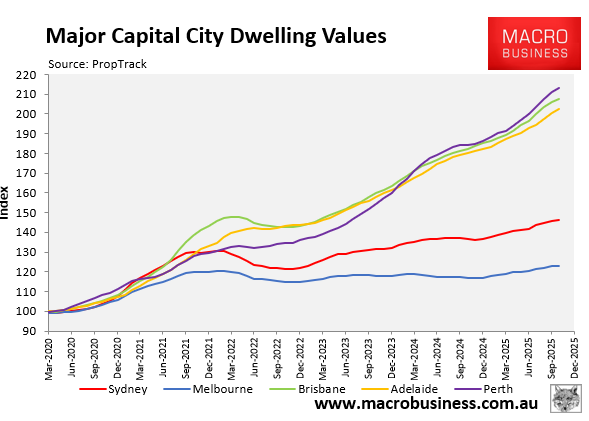
Melbourne’s dwelling values have risen by only 23% since the beginning of the Covid-19 pandemic in March 2020, compared with a 53% increase across the combined capital cities.
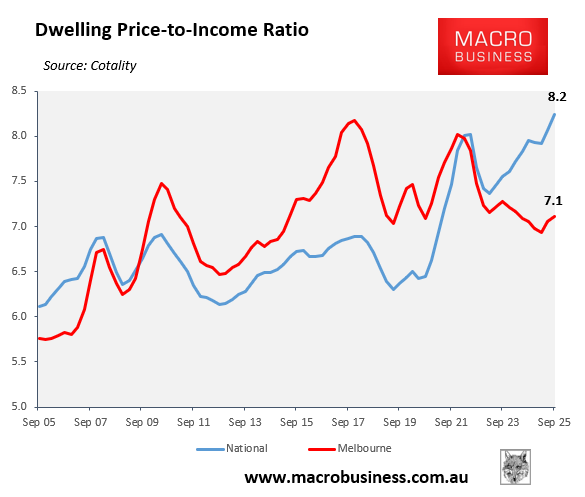
While the other major capital cities have become more expensive, Melbourne’s median dwelling value relative to median household incomes has fallen from a peak of 8.2 in Q4 2017 to 7.1 as of Q3 2025:
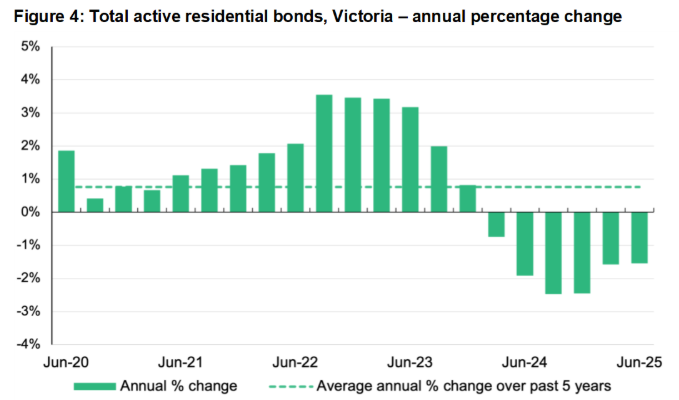
Although Victoria has experienced a steep decline in the number of property investors, as evidenced by the decrease in rental bonds:
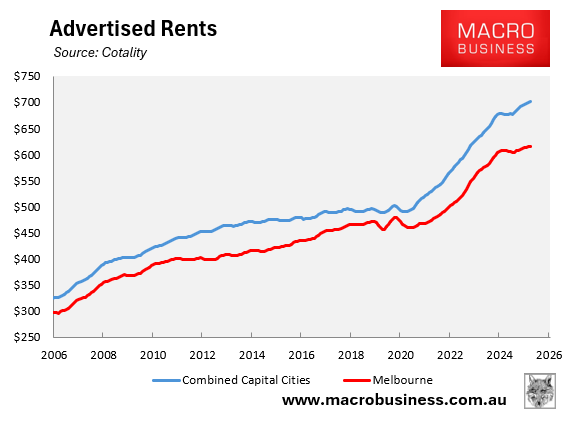
Melbourne’s recent rental growth has been slower than that of the other major markets.
According to Cotality, Melbourne advertised rents grew by 36% in the five years to January 2026, versus a 43% increase across the combined capital cities:
As a result, the amount of income required to rent the median home in Melbourne was 28.1% in Q3 2025, significantly below the national average of 33.4%:
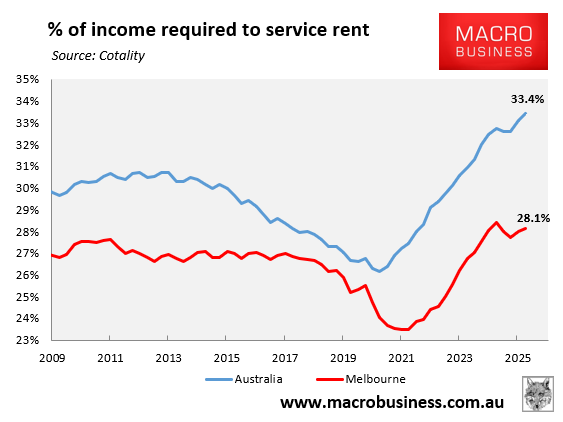
Therefore, Melbourne’s rental affordability is also significantly better than the national average.
However, the situation is far less favourable if you are seeking public housing.
Victoria has cut social housing spending by 9%, from $2.35 billion in 2023–24 to $2.16 billion in 2024–25, during what advocates call “the worst housing crisis in living memory”.
Only 2.95% of Victorian households live in social housing—the lowest proportion in the country, well below the national average of 4.04%.
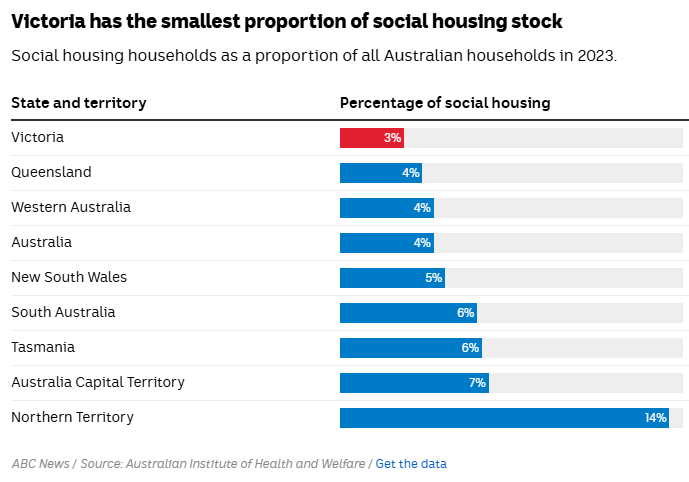
Victoria also ranks last in social housing spending per person.
Homelessness organisations report rising numbers of people being refused help due to overstretched services.
Victoria accounts for one-third of all people seeking homelessness assistance in Australia, despite comprising around one-quarter of the nation’s population.
Victoria also had 34% of all affordability‑stressed clients nationwide in 2024–25.
More than 56,000 people are on the Victorian Housing Register waiting list, 30,899 of whom are priority applicants (homeless, escaping violence, or living with disability).
A quarter of priority households waited 38 months or more for public housing.
Over the past 10 years, the net increase in Victoria’s public housing stock was only 36 dwellings.
Council to Homeless Persons (CHP) CEO Deborah Di Natale labelled the funding cuts “utterly staggering” and a “policy failure, pure and simple”.
Anglicare CEO Paul McDonald said that young people, in particular, are being left behind. He pointed out that while young people constitute nearly 25% of Australia’s homeless population, they only receive 3% of social housing allocations.
Therefore, while overall purchase and rental affordability is better in Victoria than elsewhere, the situation is far worse for those requiring social housing.