Following the Reserve Bank of Australia’s (RBA) decision to lift the official cash rate (OCR) by 25 bps on Tuesday, Treasurer Jim Chalmers was quick to place the blame on the private sector, rather than his own government’s policies.
“The Board’s statement today does not mention government spending. It makes it very clear the pressure on inflation is coming from private demand”, Chalmers said via media release.
“In the Statement on Monetary Policy, the RBA upgraded their near‑term outlook for GDP and said that this was due to stronger private demand”.
“They stated: ‘The near‑term upward revision is driven by private demand’, and the ‘contribution of public demand to year‑ended GDP growth has continued to ease in recent quarters, as expected’.
“In the year to September, annual private demand growth lifted more than five‑fold. At the same time, annual public demand growth was less than a third of what it was in the prior year”, Chalmers said.
Independent economist Gareth Aird, who was the former head of Australian economics at CBA, was interviewed by Sky News, where he was asked “how big a role has government spending played over the past few years with inflation?”.
Aird noted that government spending has “played a big role because up until quite recently, it was really growth in public demand which was driving growth in GDP. Private demand growth was pretty weak”.
Indeed, public demand has risen to a record high outside of the pandemic, relative to GDP .
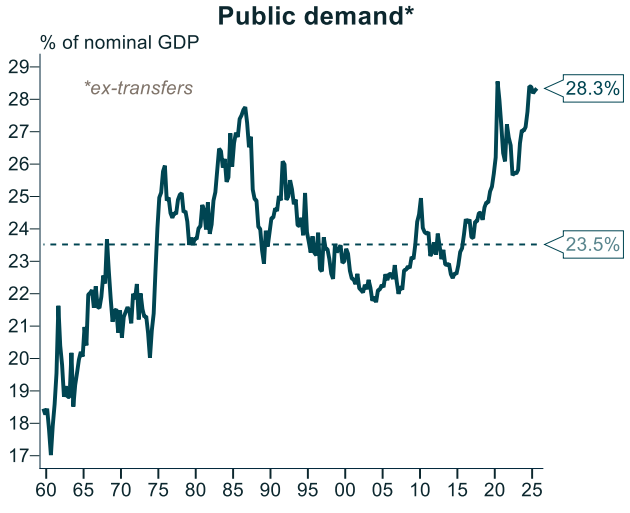
Chart by Alex Joiner at IFM Investors
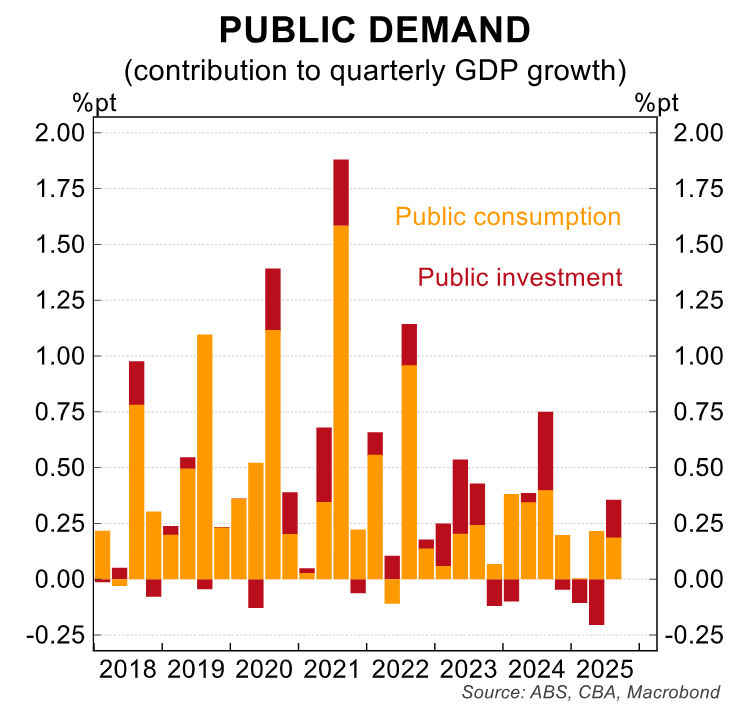
As the following chart by CBA shows, the lion’s share of recent economic activity has been driven by government spending, whereas private demand has been soft, outside of the December 2025 quarter:
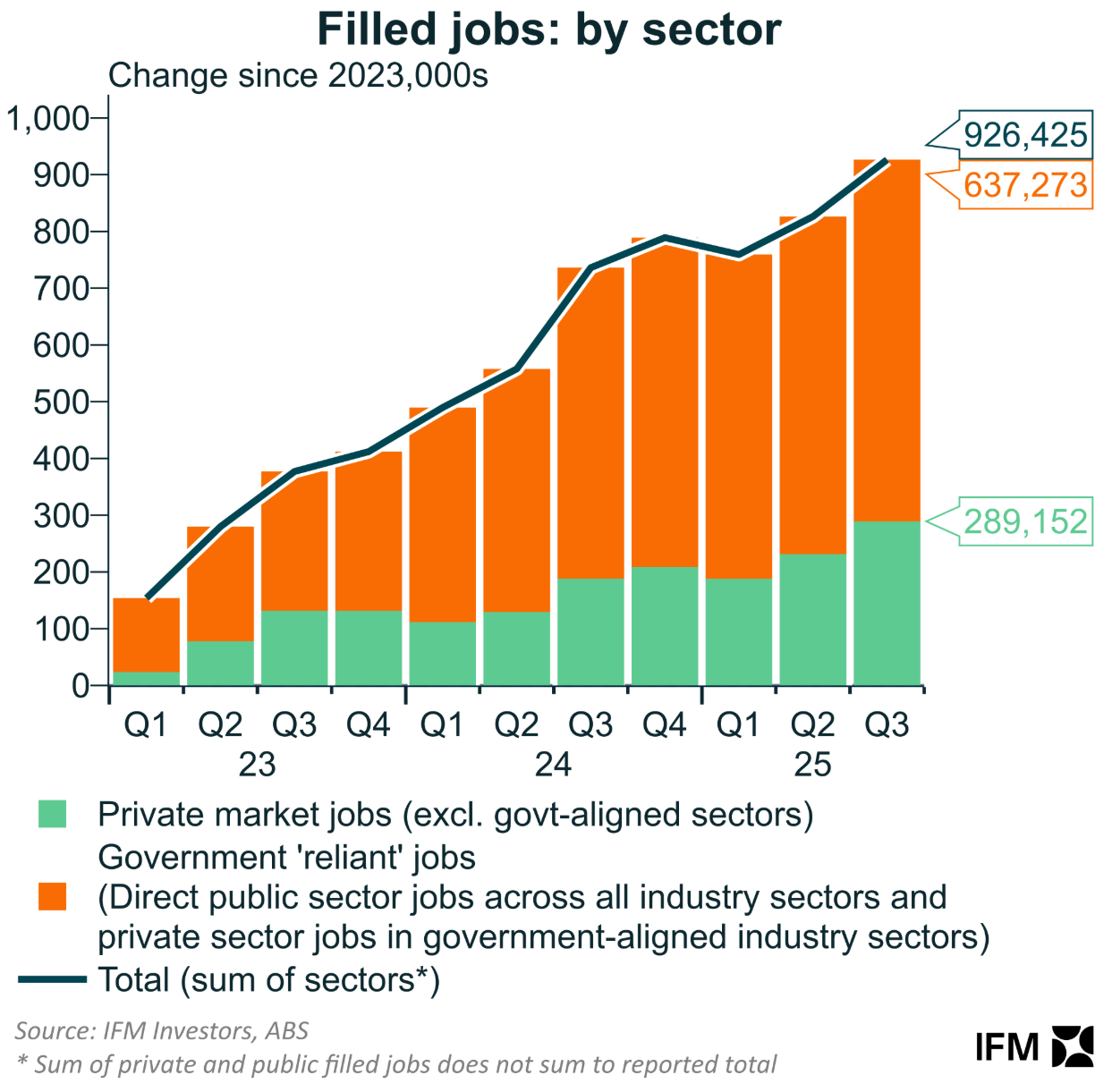
The same can be said for the labour market, where the non-market sector (i.e., public services, healthcare & social assistance, and education), which is primarily funded by government spending, created 69% of the nation’s jobs between Q1 2023 and Q3 2025:
Gareth Aird added that “it’s not just about government spending… it’s more about government policy more generally”, citing energy policy and immigration as two areas that are fuelling inflation.
“You can have a look at policy around energy that feeds through to electricity prices. You can look at government policy around immigration that has an impact on the housing component of the CPI, which is not just the cost of building new home but also rents”, Aird said.
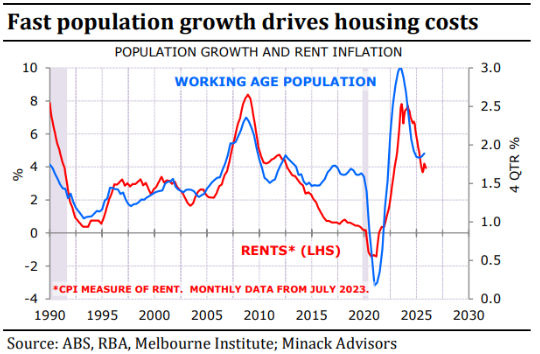
“So there’s government policy in addition to spending which has also influenced inflation outcomes in Australia”.
I will add that direct decisions by governments and regulators have helped push up inflation.
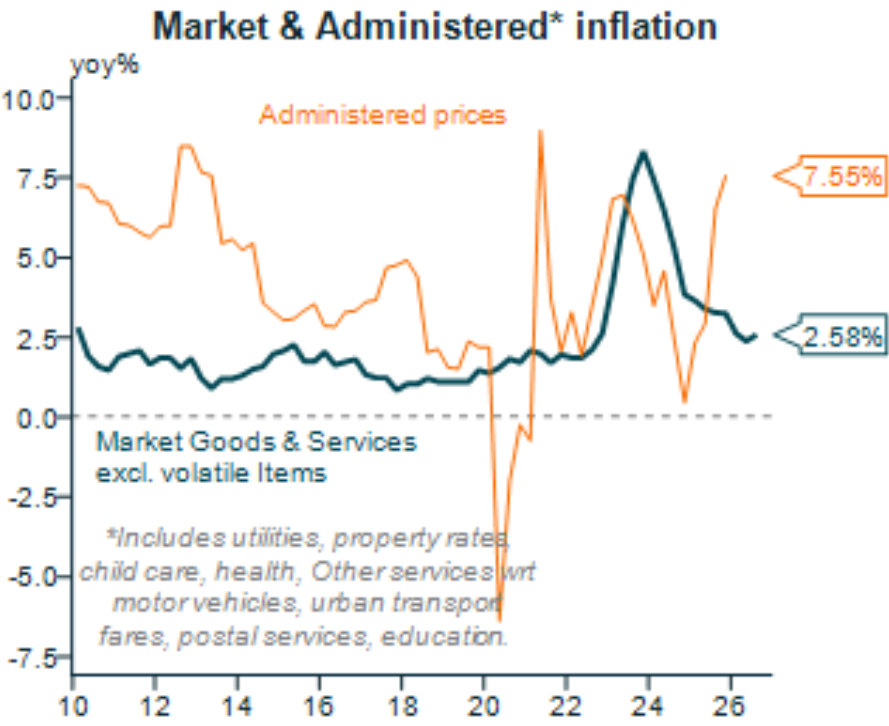
As illustrated below by Alex Joiner from IFM Investors, administered prices like essential utilities (e.g., electricity, water, and gas), council rates, and public transport fares, grew by 7.55% last calendar year, helping to drive up overall CPI inflation:
In the end, Australia’s governments need to help the RBA by abolishing poor policies that push up inflation and crimp the nation’s productivity growth and supply potential, such as:
- Excessive immigration
- Excessive and wasteful fiscal spending
- Gas and electricity market failures
The RBA should also call out poor policy—a point explicitly made by Gareth Aird:
The governor said that the RBA is independent of the government. Therefore, she doesn’t want to tell the government how to run fiscal policy. But I think there’s a way to objectively comment on the role that government has played in the inflation outcomes we’ve got because anyone else who isn’t associated with
government can effectively opine on it.
So if the RBA is independent of government, they should be able to objectively talk about the role that fiscal policy has played in the inflation outcomes that we’ve got.
In other words, it’s time for the RBA to become more vocal and hold our governments accountable.
Governments will have no incentive to behave responsibly so long as they can abrogate their responsibilities for economic management to the RBA via the blunt tool of interest rates.