
One Nation’s gas policies could halve energy bills
The usual suspects are putting the boot in as One Nation has proposed a new royalty on Australian gas production, aiming to raise $10bn–$13bn annually by charging producers $1.70–$2 per gigajoule based on output rather than profits.
Economists say that even though the party says the plan will “end the rort” on natural gas supplies, it could hurt the industry, raise prices for consumers, and make people less likely to invest.
Bruce Mountain, an expert on energy, says that the fee could cut LNG spot market revenues by at least 12%, and longer-term contracts may be hit even harder.
He says that if it were only used on new projects, it would probably completely stop new production.
If it were used on existing output, producers might see it as expropriation, which would make them less likely to explore.
Saul Kanovic, an analyst at MST Financial, said that One Nation’s gas program had some good parts, like cutting down on red tape.
However, the royalty could quickly raise gas prices.
Josh Runciman went on to say that producers on the east coast will be hit the hardest because costs are going up and the supply of LNG around the world is growing, which could make some projects not worth doing.
The party also wants to invest in coal and nuclear power, lift restrictions on gas appliances, and set aside 15% of residential gas.
I would like to say “balls” to them.
Balls to expropriation. If the East Coast gas cartel lied to obtain approval for the projects, as it did, the consequences should be severe.
If the ON royalty charge is retrospective, as it should be, then price rises can easily be prevented by use of the Australian Domestic Gas Security Mechanism. ADGSM, which nobody has had the courage to use.
As for deterred investment, balls again. The gas firms will invest if the ROI is there, and QLD gas is still mighty profitable at $4.50Gj cost + 20% profit.
And let’s not forget this is all-in profit. I don’t know why Australians should pay for their rorting LNG investments. The cash cost of gas is probably $1Gj.
Take the following example.
Gas is produced in QLD at $ 4.50GJ plus a 20% profit and a royalty of $2GJ plus $2.50Gj piping to Melbourne delivers $10gj gas.
If the gas producers whine, then apply “use it or lose it” laws. If they still strike, threaten to increase the royalty to $3Gj. If you have to, expropriate their projects in a National Gas Company.
After all, this is a grotesquely failed market.
This $10 gas is already $3Gj below the current average price on the East Coast.
ON could then use the $10bn collected to subsidise electricity bills forever; all commercial, industrial, and household energy bills would fall by about one-third.
WA might squeal a bit, but its gas will generate the majority of the revenue. But it’ll be getting cheap power instead.
In short, ON could halve the retail price of energy with the current suite of regulatory tools, let alone if it adds reservation.
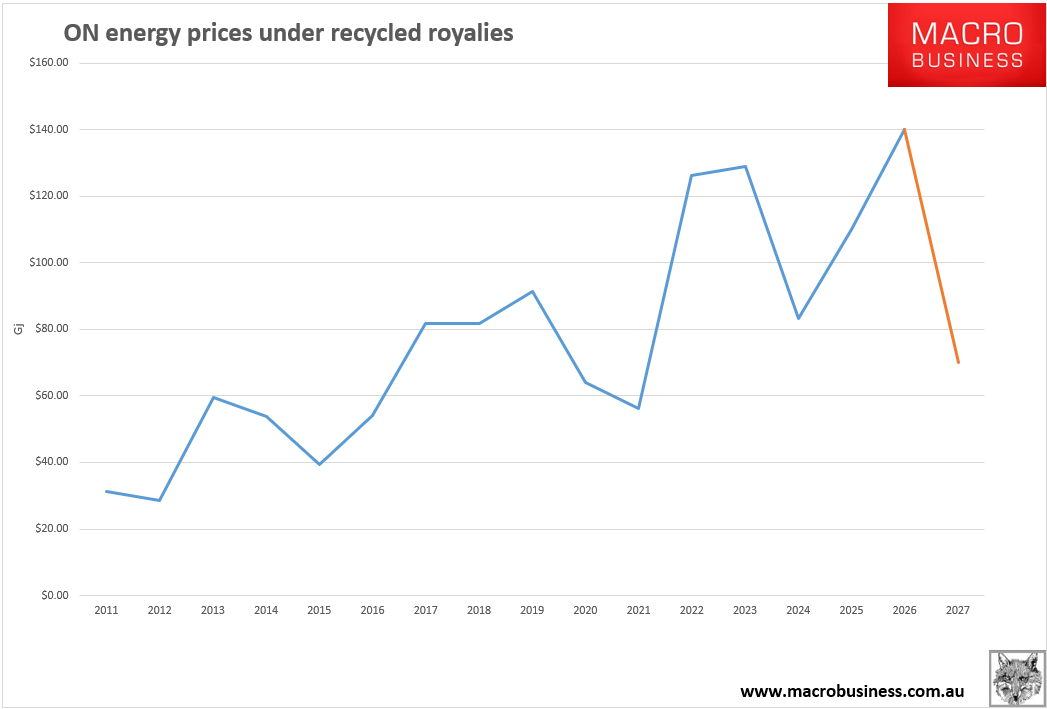
Cheap gas and even cheaper electricity will stabilise the energy transition, and you won’t need coal or nuclear.
These “economists” and “analysts” are far too purist to be useful, or they are on the take.
This is a matter of political will to fix a failed market, not economics.
