
The federal government has set a target of 50% of all car sales being electric by 2030, whereas AEMO assumes near total electrification of the vehicle fleet by the 2040s.
Current sales trends are underwhelming.
The chart below shows that battery electric vehicle (BEV) sales (green line below) failed to launch in 2025, with only 103,355 BEVs sold in the calendar year, comprising only 8.6% of total vehicle sales:
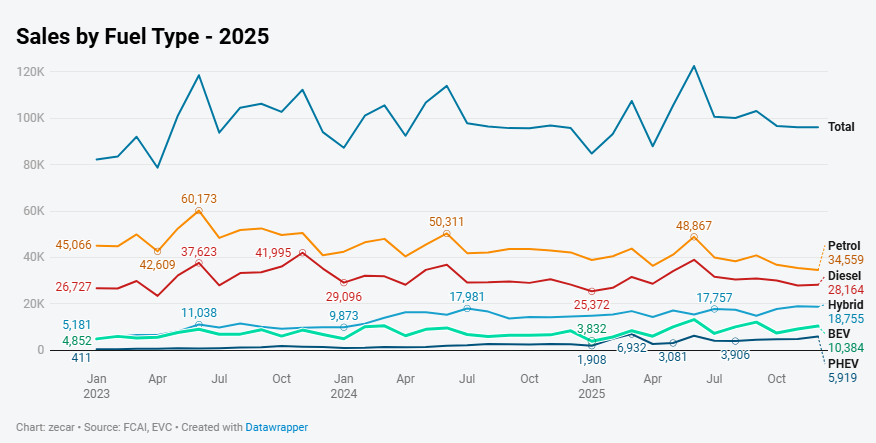
By contrast, sales of hybrid vehicles continued to grow strongly, reaching 252,655 in 2025, accounting for 21% of total vehicle sales.
The stagnation in BEV sales comes despite Australia’s governments offering billions of dollars’ worth of subsidies to entice buyers into purchasing these vehicles, alongside subsidising their running costs.
The fringe benefits tax (FBT) exemption, implemented in 2022, aims to make BEVs more affordable for employees through salary packaging and novated leasing.
The Australian Treasury initially estimated the FBT exemption for BEVs would cost the federal budget roughly $200 million per year. However, the Treasury now expects the policy will cost more than $1 billion in annual foregone revenue.
Nearly half of the tax breaks have gone to those making more than $150,000, raising equity issues.
The Treasury now forecasts that the total cost of the FBT exemption for BEVs would rise to $9.7 billion between 2026-27 and 2029-30 as the number of BEVs increases.
BEVs also qualify for a higher luxury car tax threshold than ICE vehicles. At the same time, several Australian states and territories also provide direct subsidies, stamp duty exemptions, and registration discounts for BEVs.
The operating costs of BEVs are also exempt from road user charges via the 52.6 cents per litre fuel excise, which was increased today as part of the biannual CPI indexation.
With over 300,000 BEVs on Australian roads, the cumulative loss in fuel excise income is estimated in the hundreds of millions of dollars per year. This loss in excise income will only increase as the number of BEVs on Australian roads increases.
Finally, the federal government’s New Vehicle Efficiency Standard (NVES) aims to incentivise Australians to buy BEVs by increasing taxes on new ICE vehicles.
Given the tremendous carrots and sticks governments use, it’s hard to believe that BEV demand is still so low.
However, instead of reevaluating the merits of these subsidies, the federal government continues to double down.
The federal government’s Clean Energy Finance Corporation (CFC) has struck a deal with Hyundai Capital Australia to lower interest rates for buyers of BEVs.
It will allow motorists who purchase Kia or Hyundai EVs priced under the $92,000 luxury car tax threshold to reduce their borrowing costs by up to 1%, with the CFC claiming it will cut upfront purchase costs by more than $1,900 over five years.
The deal will see the CFC spend up to $60 million and aims to help meet the government’s climate targets by increasing EV adoption.
Australia’s governments ought to stop wasting taxpayer money subsidising private vehicle purchases.
Wealthy inner-city residents receive most of these subsidies, exacerbating inequality and costing federal and state governments billions in lost tax revenue as they grapple with mounting debt.
If BEVs were superior, buyers would prefer them.
However, the sales data make it clear that Australians prefer the convenience of hybrids, which aren’t subsidised, to the inconvenience and range anxiety inherent in BEVs.
It’s time for the government to stop providing subsidies and let the market and consumer preferences determine which vehicles are purchased.
The 52.6-cent-per-litre fuel excise is already an effective carbon tax on higher-emissions vehicles.
