
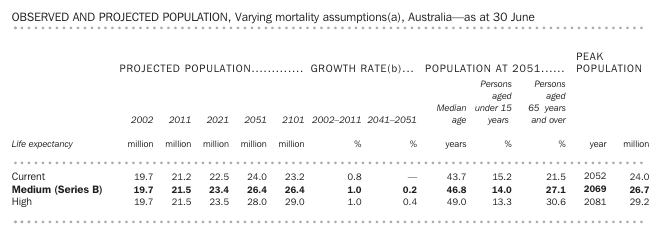
In 2003, the Australian Bureau of Statistics (ABS) released its Population Projections 2002 to 2101, which contained a baseline (Series B) forecast for Australia’s population of 26.4 million by 2051, based on an assumed net overseas migration (NOM) of 100,000 annually.
Source: ABS Population Projections 2002 to 2101
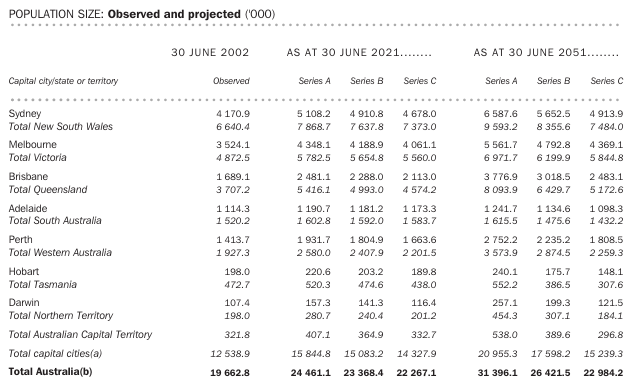
The following table illustrates the ABS’s 2003 population projections for Australia’s capital cities:
Source: ABS Population Projections 2002 to 2101
Sydney was projected to grow to 5.65 million people by 2051, whereas Melbourne was projected to grow to 4.79 million people.
Clearly, the federal government’s decision to dramatically expand NOM led to a massive overshoot in these projections.
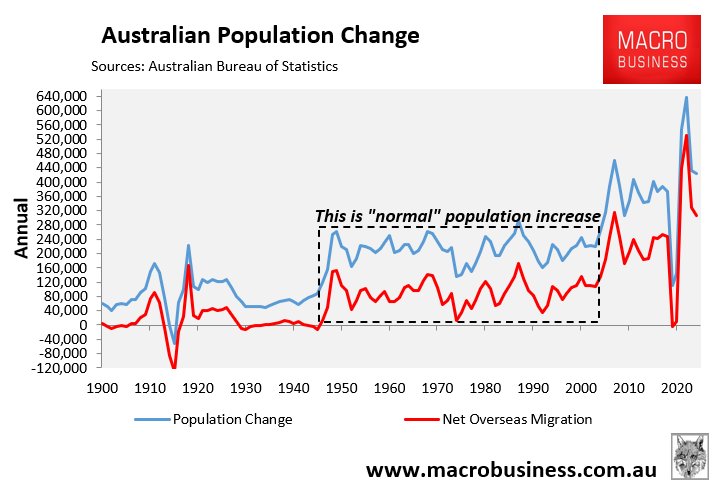
Between June 2004 and June 2025, Australia’s NOM averaged 225,000 annually, more than double the 100,000 assumed by the ABS in 2003.
As a result, Australia’s population has already easily exceeded the ABS’s 2003 forecast for 2051 (i.e., 26.43 million), with the ABS Population Clock recording a figure of just under 27.9 million at the time of writing.
This means that Australia has already surpassed the 2051 population projection by around 1.5 million.
Australia’s capital cities are also far larger than projected by the ABS in 2003, with Melbourne at 5.4 million in 2024-25 and Sydney at 5.6 million.
Interestingly, the ABS in 2003 argued that NOM has little impact on the age structure of the economy:
Net overseas migration affects the size of the population more than its age structure since migrants age along with the rest of the population, although upon entry to Australia they are assumed to have an age structure slightly younger than the Australian-born population.
Even large differences in NOM have a relatively small impact on the age distribution.
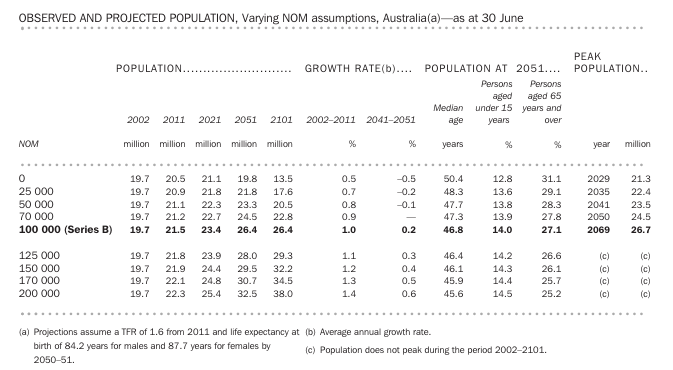
Moreover, the most “extreme” net overseas migration scenario the ABS could conceive of at the time was 200,000 annually, 25,000 fewer than the actual NOM recorded over the past 21 years.
Chapter 4 of the ABS’s 2003 report “previews some more extreme population scenarios”, as illustrated in the below table.
Source: ABS Population Projections 2002 to 2101
Under this “extreme” NOM of 200,000, Australia’s population was only projected to increase to 32.5 million by 2051.
Now let’s turn to the Centre for Population’s latest projections for Australia.
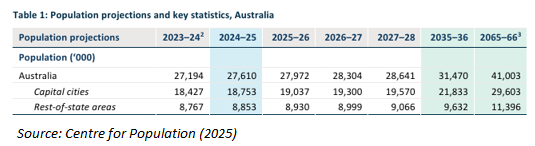
The Centre projects that the nation’s population will balloon by 13.4 million people (nearly 50%) by 2065-66.
This rate of population growth is comparable to adding another Sydney, Melbourne, and Perth to the nation’s current population in just 41 years.
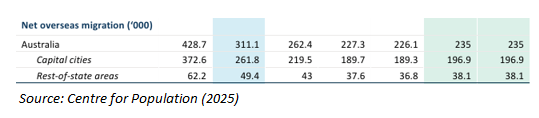
The nation’s extreme projected population growth is projected to come from high NOM, which is forecast to average 235,000 over the 41-year forecast horizon—i.e., 9,000 higher than the 226,000 average NOM recorded during the 15 years of ‘Big Australia’ before the pandemic.
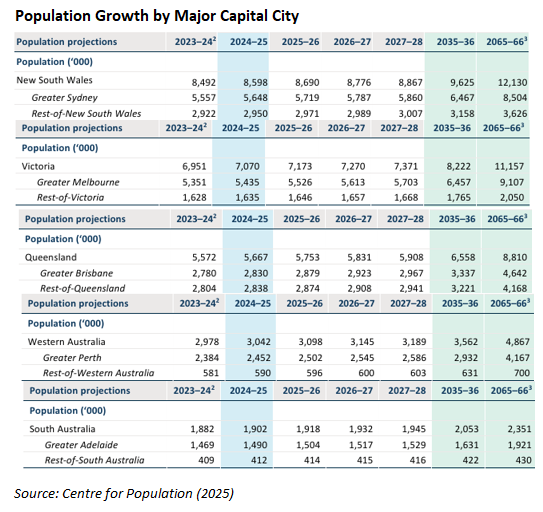
Melbourne (9.1 million) and Sydney (8.5 million) are projected to become megacities by the mid-2060s, with Brisbane also tipped to grow by around 1.8 million to 4.6 million.
In June 2010, former Labor Prime Minister Julia Gillard stated that she doesn’t want ‘Big Australia’, and that the nation should not simply hurtle down the track to a population of 36 or 40 million.
“I don’t believe in a big Australia”, Gillard told Nine News.
“I think we want an Australia that is sustainable”.
“We should pause, we should take a breath, we should just get this right”, she said.
Gillard’s comments were as true then as they are today. Sadly, all subsequent Australian governments since have run a huge migration program, with the support of both major parties, the Greens, and the Teals.
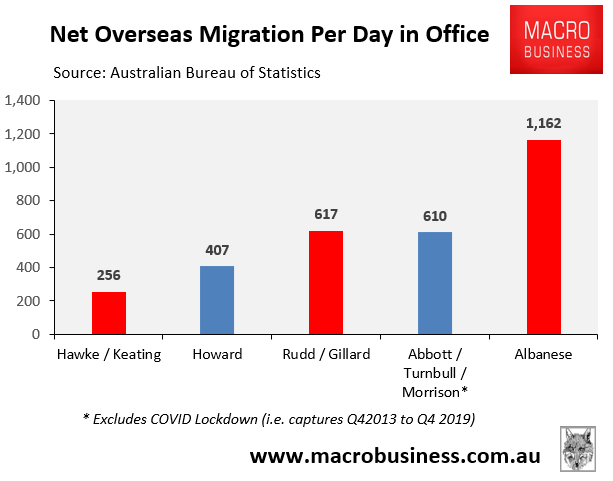
Going by the Centre for Population’s projections, nothing will change. Australia will hurtle past a population of 40 million, regardless of the negative impacts on productivity, sustainability, and liveability.
Australians were never given a vote on this issue. A Big Australia was merely forced down our throats without our consent using the cover of an ageing population, which the ABS debunked in 2003.
