
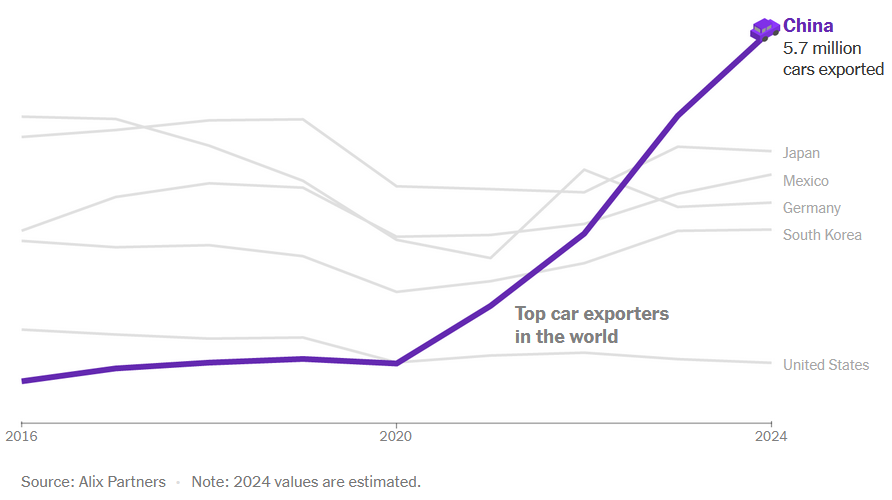
Back in 2020, China exported around 1 million vehicles, well behind the automotive powerhouses of South Korea, Japan, and Germany, and not too dissimilar to where exports stood at the start of the 2010s.
Then in 2021, things began to change extremely rapidly.
The pace of Chinese car exports began an absolutely meteoric rise, rapidly eclipsing rival after rival until the Middle Kingdom achieved the status of top-dog exporter, yet another victory for the “World’s Factory”.
According to estimates from Brad Setser, a Senior Fellow at the Council on Foreign Relations, China is on track to export 10 million vehicles in 2025.
This would equate to slightly under 9 million cars being exported for the 2025 calendar year.
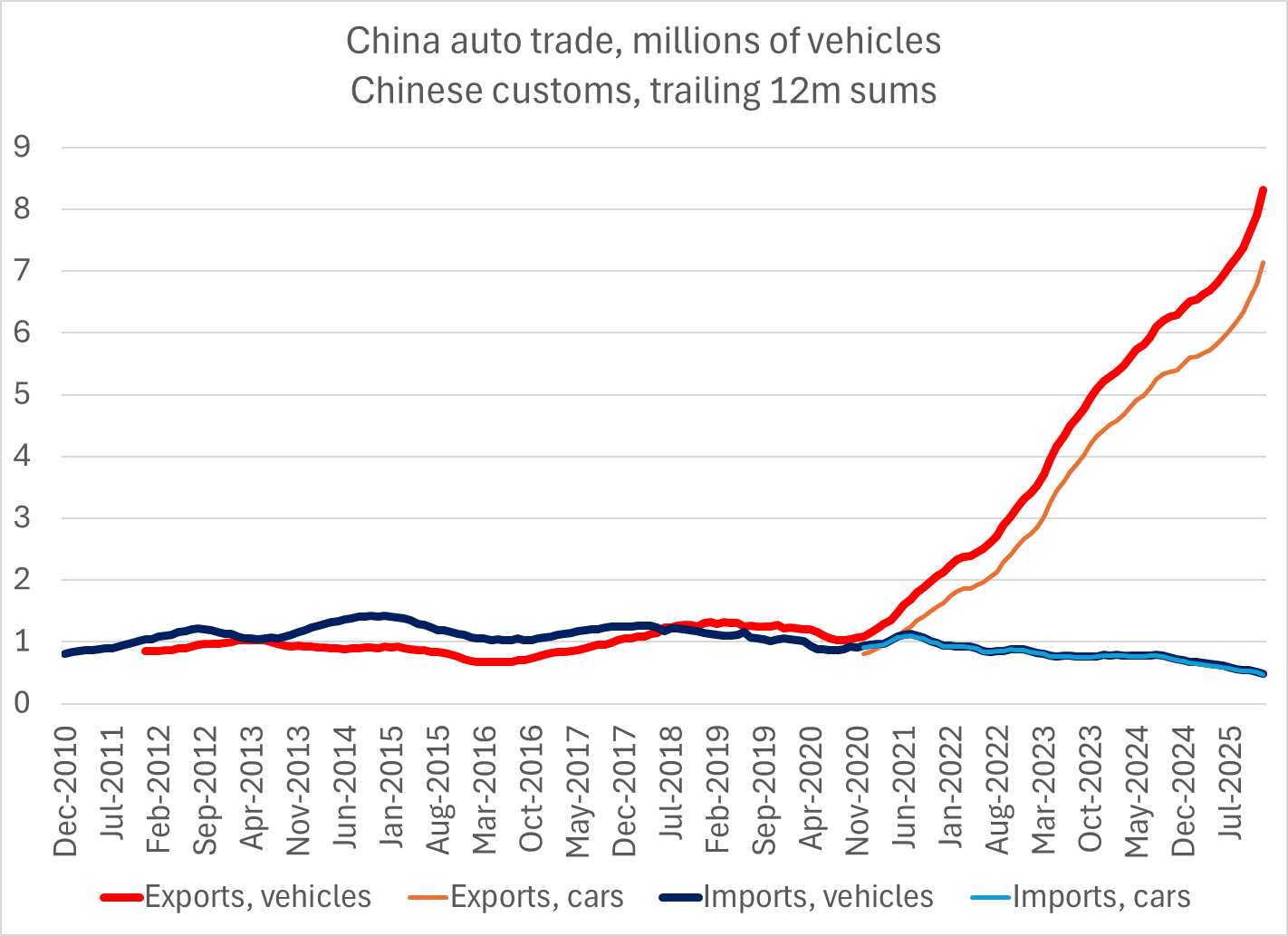
Chart: Brad Setser
To put this figure into perspective, it means China exported more cars than the next two largest automotive exporters combined (Japan and Mexico).
With only a small fraction of the growth seen in 2025, China will soon export more cars than the following three largest automotive manufacturers combined.
Much of China’s meteoric rise as an automotive exporter has been driven by the adoption of electric vehicles (EV’s).
Electric vehicles account for nearly half of all Chinese car exports.
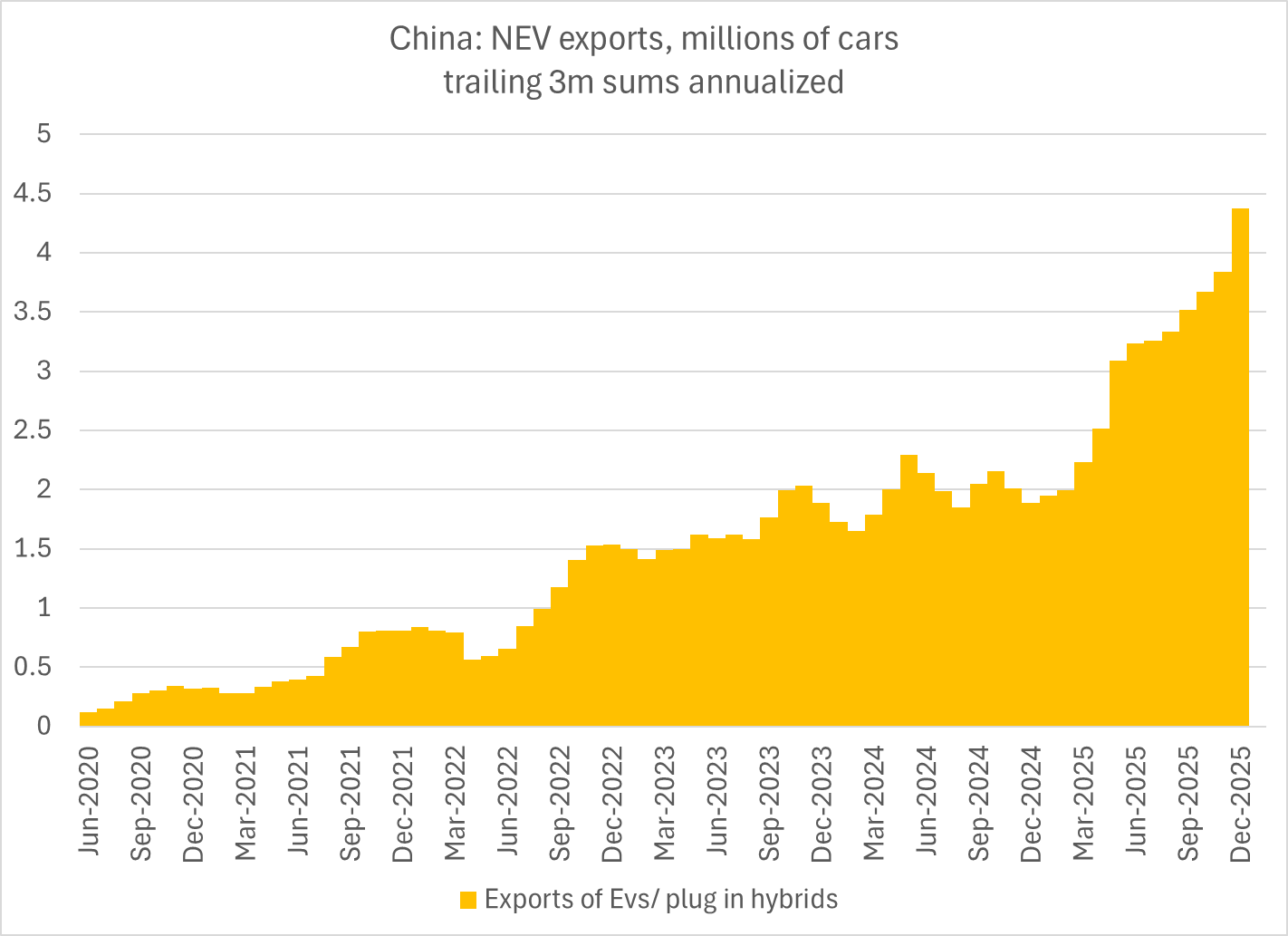
Chart: Brad Setser
However, while the Chinese automotive industry continues to thrive in production, other nations, particularly in Europe, are experiencing the opposite.
In late 2014, Chinese automotive imports peaked at over 1.4 million vehicles on a rolling 12-month basis.
One of the biggest beneficiaries was German automakers, with VW, Mercedes, Audi, and BMW all securing a significant share in the Chinese car market.
At the time, Chinese automakers couldn’t hope to build a mass-market luxury car to rival a top-end BMW or Mercedes.
Today, some of the most technically impressive and luxurious cars in production are made in China.
Looking at a chart of Chinese car imports, it shows.
According to the latest data, Chinese car imports are down over 60% from their 2014 peak.
To put this into perspective, China is now importing fewer cars than Australia, despite having a population over 50 times larger.
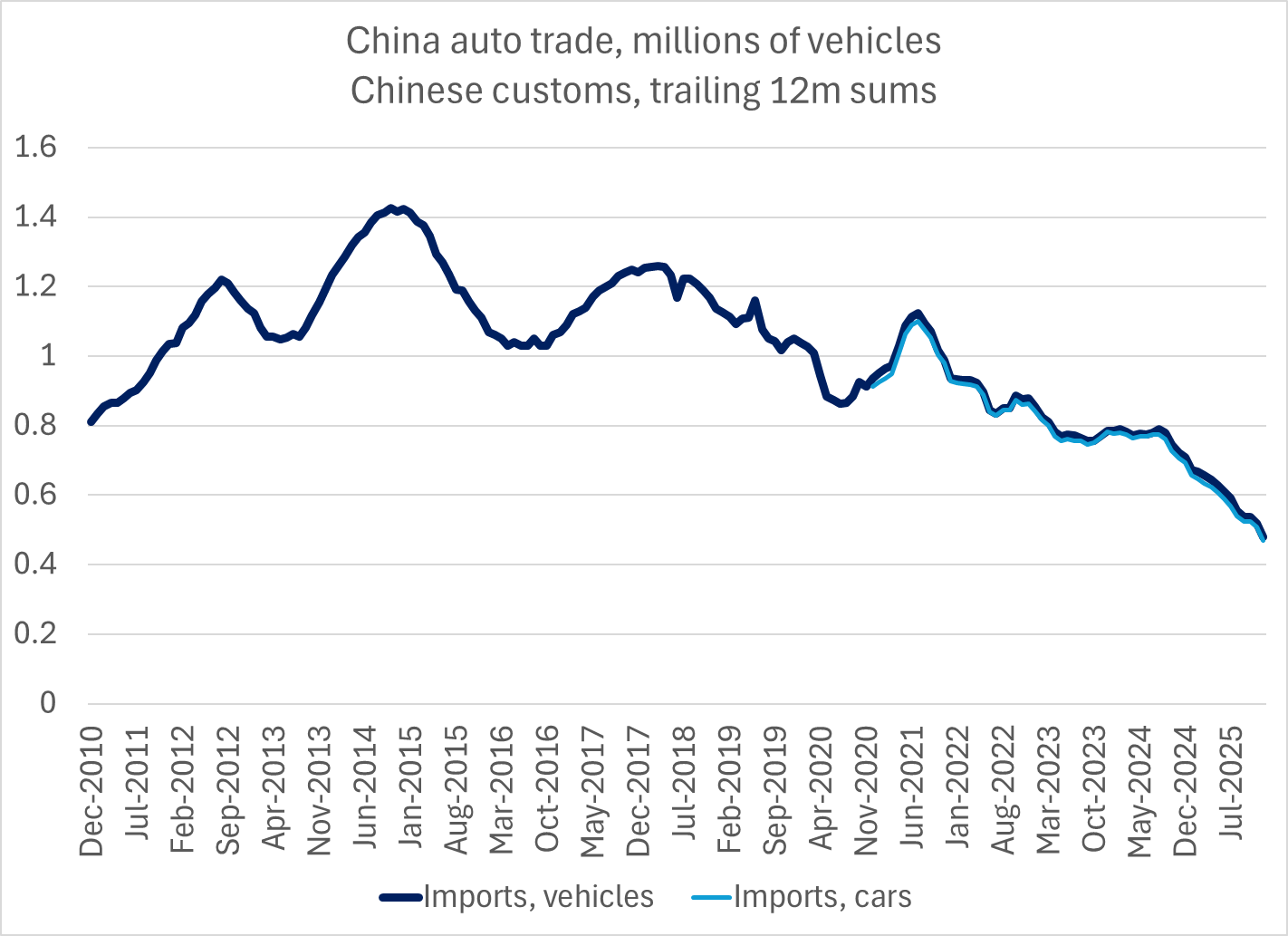
Chart: Brad Setser
Understandably, the beneficiaries of the rise of the Chinese car import market are less than pleased, as they now see vehicle flows not only dwindle but also reverse, with Chinese car makers gaining market share in their own nations.
French President Emmanuel Macron warned that the European Union may be required to take what he calls “strong measures” against China.
This would include potential tariffs and the raising of other forms of trade barriers if Beijing fails to remedy its growing trade surplus with the EU.
“I’m trying to explain to the Chinese that their trade surplus isn’t sustainable because they’re killing their own clients, notably by importing hardly anything from us any more”.
“If they don’t react, in the coming months we Europeans will be obliged to take strong measures and decouple, like the US, like for example tariffs on Chinese products,” Macron said
The Takeaway
China has transformed from a minor player in the automotive industry to the undisputed leader in just 5 short years.
For decades, Western nations have allowed their domestic manufacturing capacity to be shuttered or offshored, as cheaper alternatives in China or elsewhere held a much greater appeal than supporting local manufacturing.
When it was toys or clothing, it wasn’t considered an issue, but now that Chinese industry is targeting high-tech medium- and heavy industries in the West, politicians are at least somewhat waking up to the threat.
The problem with letting another country do your heavy industry is that it’s hard to get it back.
Attempting to rebuild an entire domestic supply chain relating to something like the automotive sector or shipbuilding is a task measured in decades under today’s priorities.
Whether Western leaders will realise the cost of continuing on the current path in time is a matter of great debate, but what is sure is that the stakes are incredibly high.
