Every day, the Albanese government’s Housing Accord target of building 1.2 million homes over five years slips further from reach.
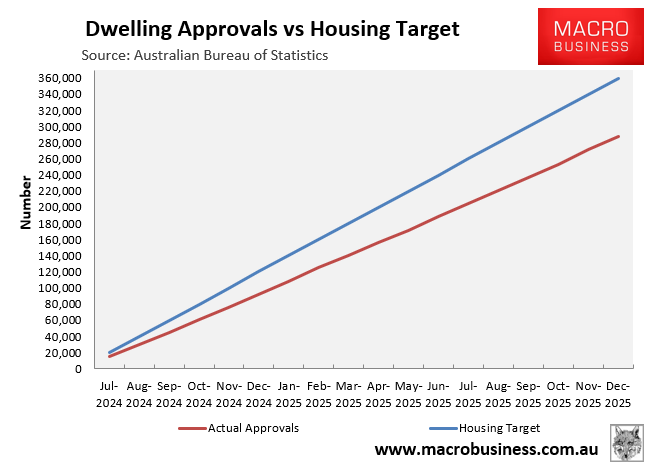
Data released on Tuesday by the Australian Bureau of Statistics (ABS) showed that the rate of monthly dwelling approvals in trend terms stalled at just under 16,500 for the month of December, 3,500 below the 20,000 run rate to meet Labor’s housing target:

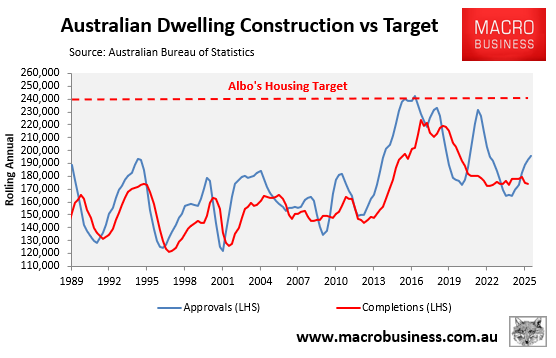
In the 2025 calendar year, 195,700 dwellings were approved for construction, roughly 44,000 fewer than the 240,000 run rate required to meet the Housing Accord target:

Over the first 18 months of the Housing Accord, which commenced on 1 July 2024, 287,200 dwellings were approved for construction, 72,800 (20%) fewer than the Housing Accord target of 360,000:
It is important to remember that the approval of a dwelling for construction does not guarantee its completion.
Over the last decade, dwelling approvals have outpaced completions by 5%. As a result, meeting the target set by the National Housing Accord will be even more challenging than what is inferred by the above approvals data.
As illustrated below, there were only 174,200 dwellings completed in the year to September 2025, 65,800 (27%) fewer than the 240,000 required to meet the target.
Australia’s housing supply is badly constrained by factors including:
- Interest rates are structurally higher, a situation made worse by Tuesday’s rate hike.
- Construction costs soared by more than 40% since the beginning of the Covid-19 pandemic.
- Residential lot values have soared by about 33% since the start of the pandemic.
- Labour shortages and high rates of insolvencies have badly impacted capacity in the residential construction industry.
AMP chief economist Shane Oliver recently estimated that Australia’s cumulative housing shortage is tracking between 200,000 and 300,000 homes, depending on assumptions around household size.
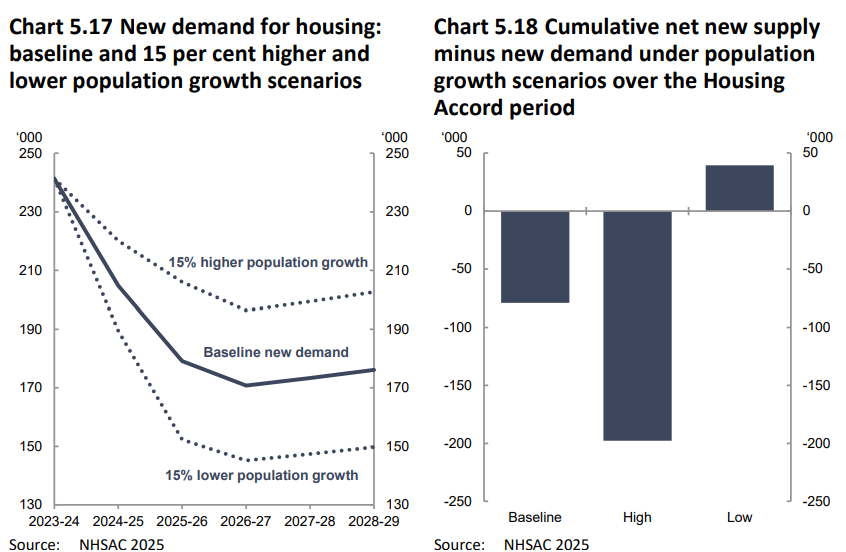
The National Housing Supply and Affordability Council’s (NHSAC) State of the Housing System report, released in May, forecast that demand would outpace supply over the entire five-year Housing Accord period, resulting in a cumulative shortage of 79,000 homes and possibly 200,000 if population growth is 15% faster than Treasury forecasts, which seems likely:
KPMG’s latest housing report likewise forecast a worsening housing shortage as population demand continues to outrun supply:
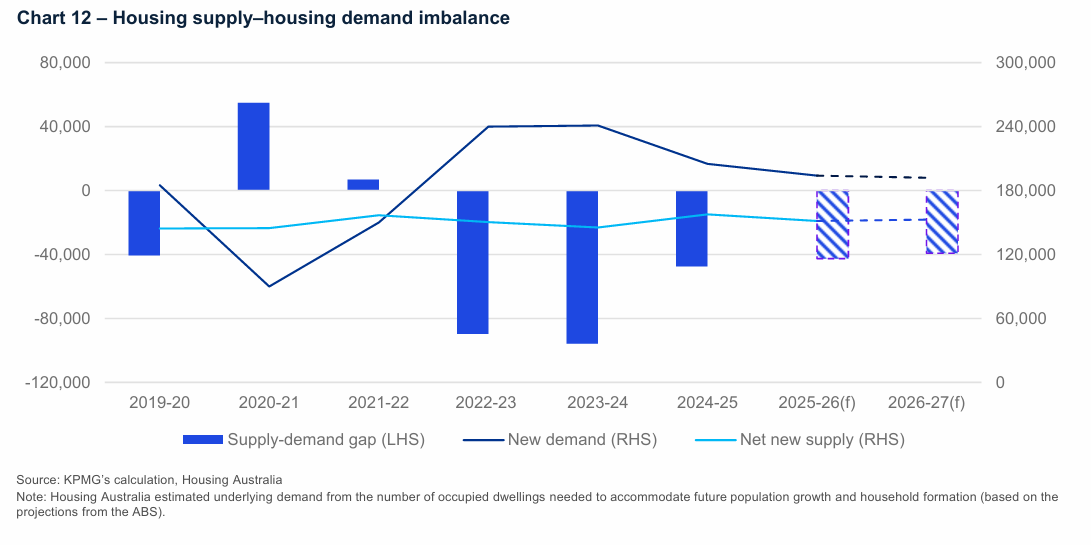
Source: KPMG
As a result, Australia’s housing shortage could double to 400,000 over the five years to 2028–29 if immigration remains strong.
This comes as Australia’s rental vacancy rates are tracking near record lows, whereas rental affordability is the worst on record:
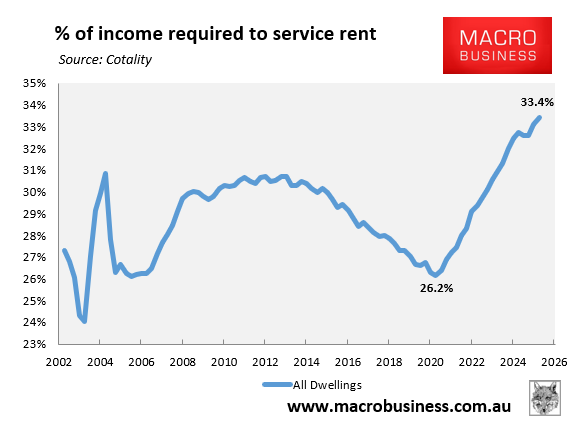
Australian renters will continue to suffer so long as high immigration forever outstrips new housing supply.
The obvious solution is to emulate Canada’s sharp immigration cuts, which have driven a 15-month decline in advertised rents:
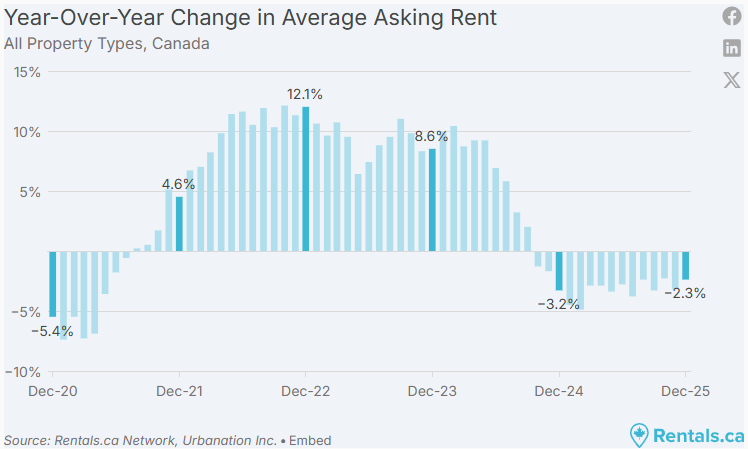
The solution to Australia’s rental crisis is staring policymakers in the face.