
The Reserve Bank of Australia’s (RBA) latest forecasts, contained in the February Statement of Monetary Policy (SoMP), show that real gross domestic product (GDP) is expected to grow by just 1.6% in the year to June 2028.
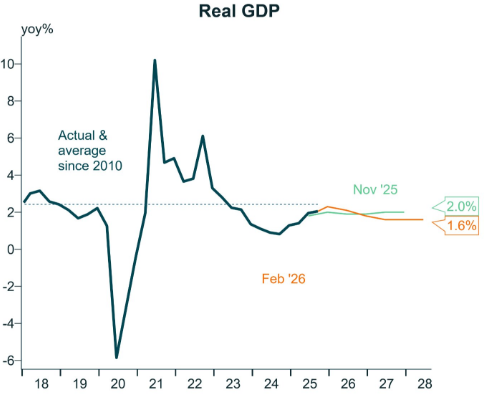
Chart by Alex Joiner (IFM Investors)
This is the central bank’s lowest medium-term growth outlook since it began releasing forecasts in 1990.
Stephen Smith from Deloitte Access Economics noted that this compares poorly against the Treasury’s growth forecast of 2.75% in the Mid-Year Economic and Fiscal Outlook. Smith added that a GDP hit of more than one percentage point would have “fairly material implications” for budget revenue forecasts.
“By 2028 if the RBA’s forecast of 1.6% comes true, that’s more than a full percentage point below Commonwealth Treasury’s forecast in MYEFO of 2.75%”, he said.
“A percentage point of GDP is a pretty significant hit to growth and would have fairly material implications for the revenue forecast with the budget”.
“One [of the implications] is just lower tax take and slower wages growth, all the things associated with a softer outlook relative to what’s anticipated in the budget at the moment”, Smith said.
Alex Joiner, chief economist at IFM Investors, added that the slower growth forecast from the RBA is an explicit acknowledgement that Australia’s poor productivity growth has lowered the nation’s growth potential.
“We’ve been able to fend off a little bit of the [productivity] slowdown because our population growth has been so strong and [labour market] participation has been so strong, but it’s pretty clear that the potential rate of growth now is maybe 2 or a little bit under 2%, and that’s really what the Reserve Bank’s getting at with its forecasts”, Joiner said.
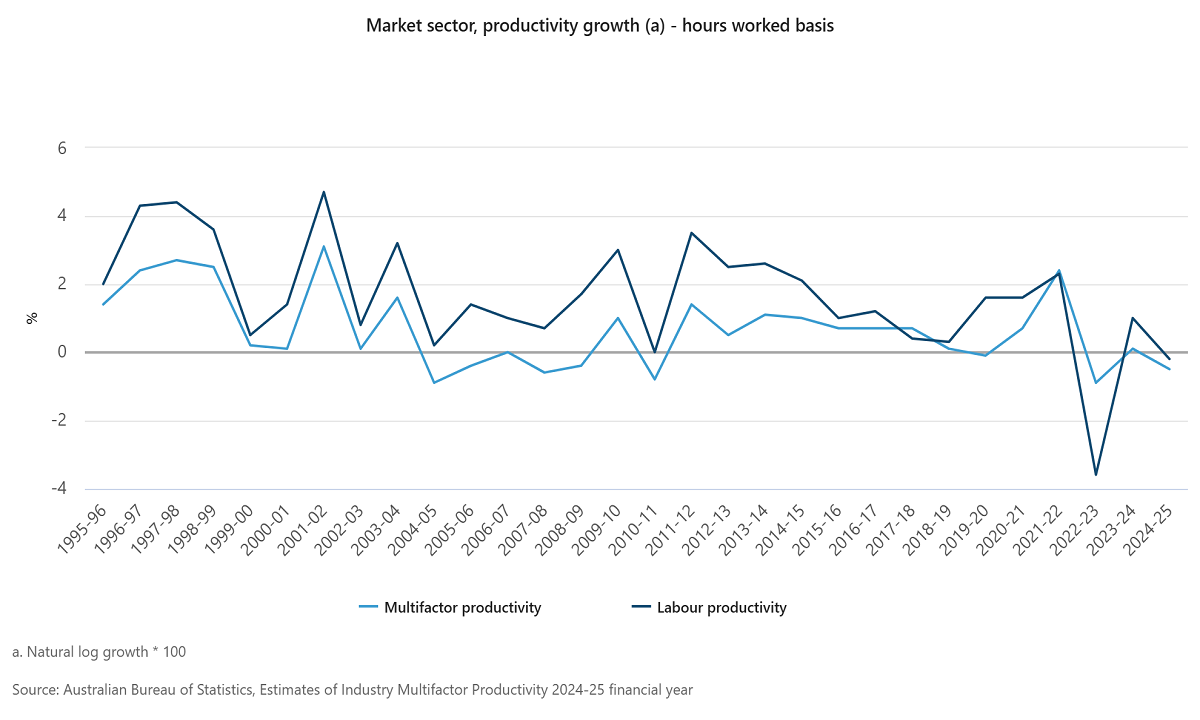
Australia’s productivity malaise was highlighted in last week’s Australian Bureau of Statistics (ABS) release, Estimates of Industry Multifactor Productivity for 2024-25.
As illustrated in the next chart, Australia’s labour productivity and multifactor productivity growth have been on a downward trend for decades, with both measures outright declining last financial year.
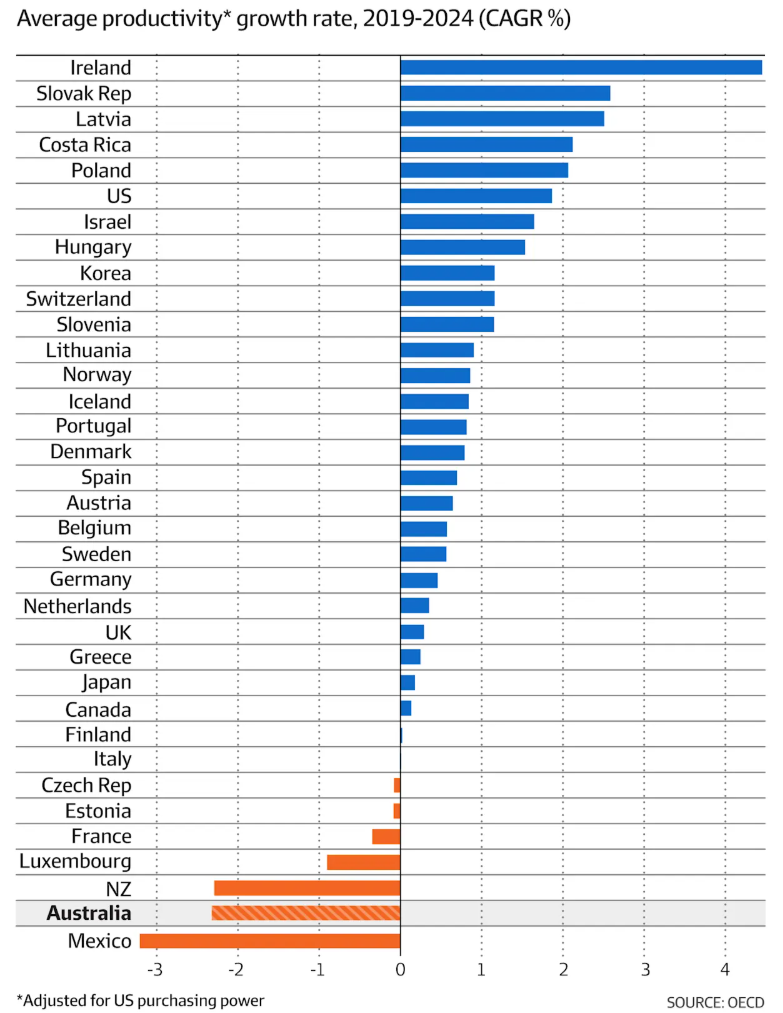
Australia’s recent labour productivity growth has also ranked among the poorest in the developed world:
Ultimately, without productivity growth, the economy cannot expand. This relationship is illustrated in the following long-term chart showing the direct correlation between labour productivity growth and per capita GDP growth:
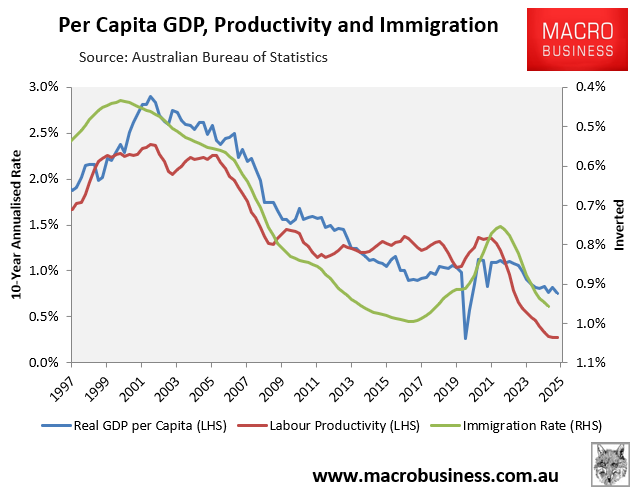
The RBA SoMP also forecast historically low real per capita GDP growth of only 0.4% for FY 2007 and FY 2008, alongside stagnant real wages.
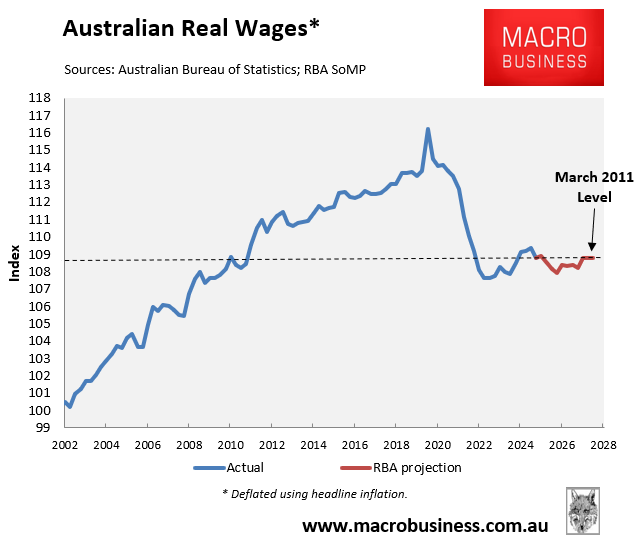
The RBA forecasts that material Australian living standards will stagnate unless productivity growth improves.
