
Albo’s gas dog’s breakfast delivers world’s costliest energy
The ostensible problem with East Coast gas supply is that it has no competition.
The real problem is that energy policymaking has no competition, so there is nobody to hold Albo’s energy butchers to account.
Albo’s half-baked idea for gas reservation is so nebulous that states and regulators are now in crisis, trying to figure out what was supposedly fixed.
The AEMO and VIC governments are cooking up an emergency powers mechanism that will allow the regulator to demand gas from whoever it likes when a shortage hits.
Needless to say, the gas export cartel hates the idea. And now, so do the pipeline operators.
“Governments say they want market-led outcomes yet continue to intervene. By allowing uneconomic projects to be publicly funded to address modelled medium-term shortfalls, this proposal would fundamentally distort commercial incentives and investment signals,” Australian Pipelines and Gas Association chief executive Steve Davies said.
This is vomit. An endlessly mounting multi-coloured pile without definition.
There’s no utilitarian principle, no basic commodity economics. No understanding of markets and market failure. There is no clear understanding of national interests.
We can hardly blame VIC and the AEMO for discussing emergency interventions when structural fixes are beyond the federal authorities’ reach.
At the last election, the Dutton opposition proposed a superbly well-crafted gas policy, which idiot Albo described as coming out of a cereal packet.
Now his chundered reply is so stunk-up and amorphous that everybody is fast approaching panic. I despair of reaching a solution.
Yet as things stand, Australia’s famed luck may return; a huge global glut of gas is bearing down on Australia at speed.
In short, lower gas prices are going to swamp Asia. Goldman.
On net, we still expect 2025-to-2030 global LNG supply growth (+193 mtpa, 45% of 2025 global supply) to far exceed Asia demand growth (+144 mtpa), even taking into account our estimated demand response to low gas prices (>40mtpa from China alone).
We expect this oversupply to take European gas storage to congestion, particularly in 2028/29, leaving a temporary price-driven curtailment of US LNG exports as the likely solver of the imbalance in that period, in our view.
We note that all but one of the supply projects in our balances through 2029 have already reached a Final Investment Decision (FID)
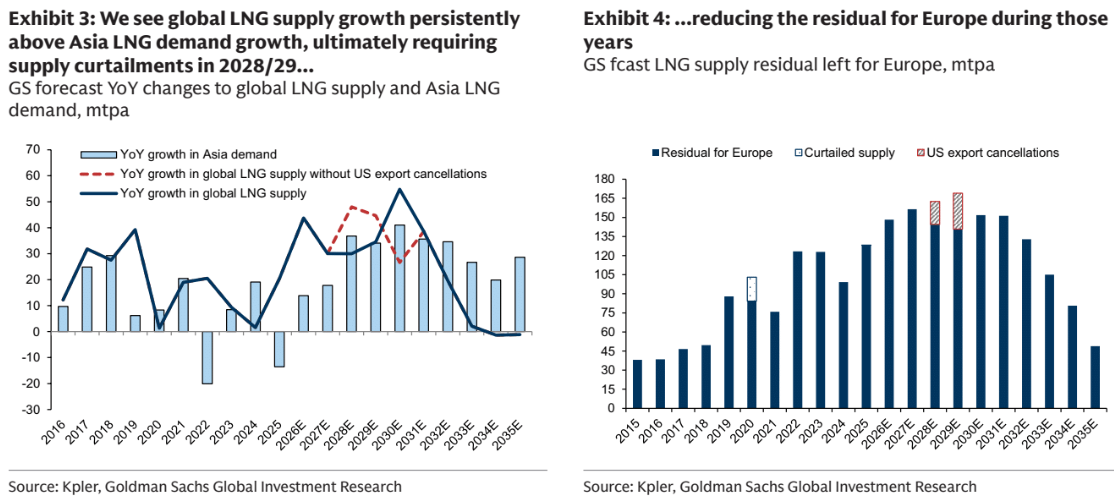
No post-FID project has ever been cancelled.
Goldman expects Asian gas prices in 2028/29 to be AUD6.50.
That is, the net-back price for QLD gas, which should serve as the benchmark for east coast prices under the Australian Domestic Gas Security Mechanism (ADGSM), will be as low as $5GJ within three years and fall non-stop until then.
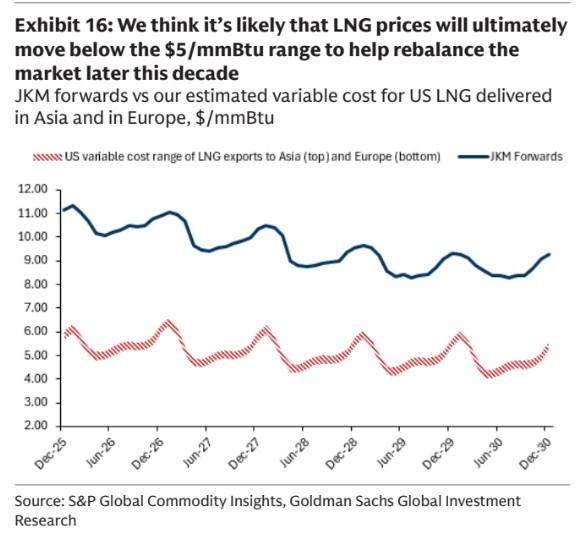
There are risks to this base case, such as the US imposing its own reservation mechanism if AI needs the power, but it is the base case.
All that is needed to ensure these prices are brought to Australia is the existing ADGSM, which simply threatens the cartel with penalties if it fails to meet the benchmark.
If the pipeline that transports gas from QLD to VIC is not fat enough to physically deliver enough gas in winter, then embrace the $2bn APA proposal to expand it.
This would reduce the CPI by 5% over a couple of years.
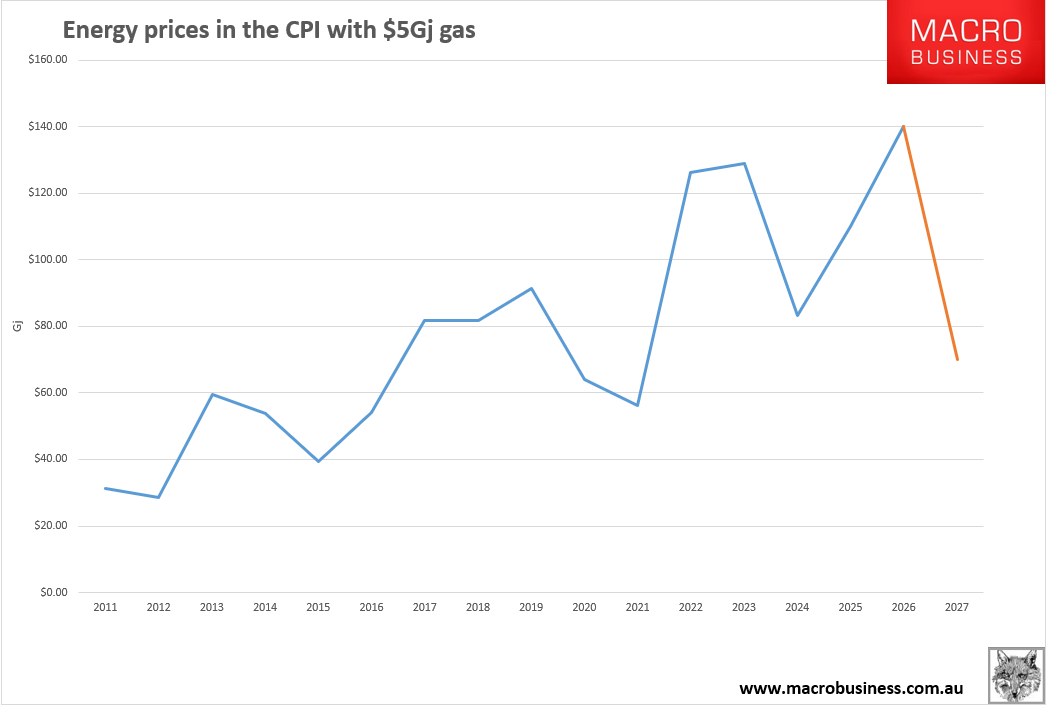
Yet Albo is instead proposing to scrap the ADGSM for his already failed gas reservation spew while doing nothing to boost pipeline capacity.
Labor is on the verge of delivering Australia the world’s most expensive energy.
