
Cotality’s latest chart pack for December showed that Australia’s dwelling stock was valued at $12.3 trillion at the end of 2025, spread across 11.4 million homes.
This meant that as of 31 December 2025, the average value of a home in Australia stood at an astonishing $1,079,000.
Not surprisingly, then, Domain’s house price results for the December quarter showed that the average price of a house across every major capital city market was valued over $1 million:
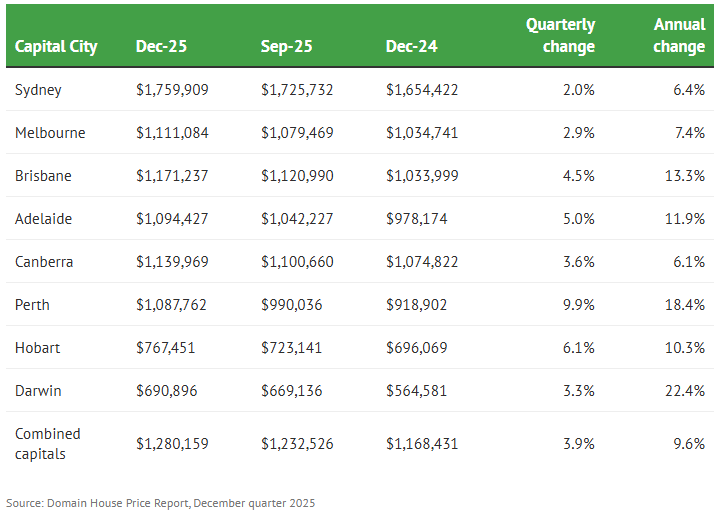
As you can see, Perth was the last major capital city market to cross the million-dollar threshold following an explosive 9.9% rise over the December quarter.
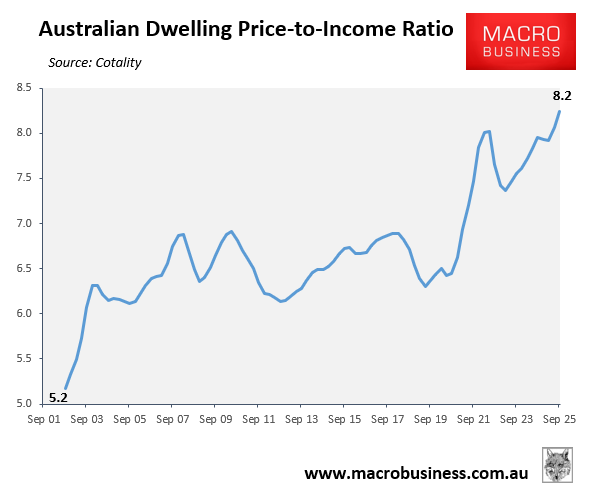
The surge in dwelling values nationally is also reflected in Cotality’s dwelling value-to-income ratio, which hit a record high of 8.2 in the September quarter of 2025:
The following table shows the change in Domain’s median house prices over a five-, ten-, and twenty-year period across the five major capital city markets:
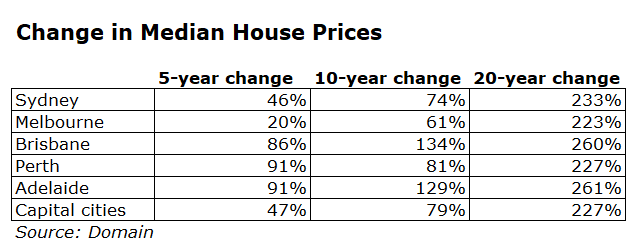
While value growth has differed markedly across the various major markets over five and ten years, remarkably, values have risen at similar rates over two decades.
Given that Australia’s home ownership rate is tracking at around 66%, the $1,079,000 average value of housing explains why the UBS Global Wealth Report consistently ranks Australians as having the second wealthiest households on the planet, behind Luxembourg.
My long-held view is that Australia’s world-leading household wealth is fake since it mostly comprises illiquid and overpriced homes.
Meanwhile, future Australians will be required to sign onto a lifetime of mortgage debt to achieve home ownership to avoid being trapped in the insecure rental market.
The bottom line is that having Australia’s housing markets valued above $1 million is not something to be celebrated.
Rather, Australians would be far better off if the nation had avoided the multi-decade property boom and ranked lower on the world’s household wealth rankings.
