
The AUD has de-anchored.
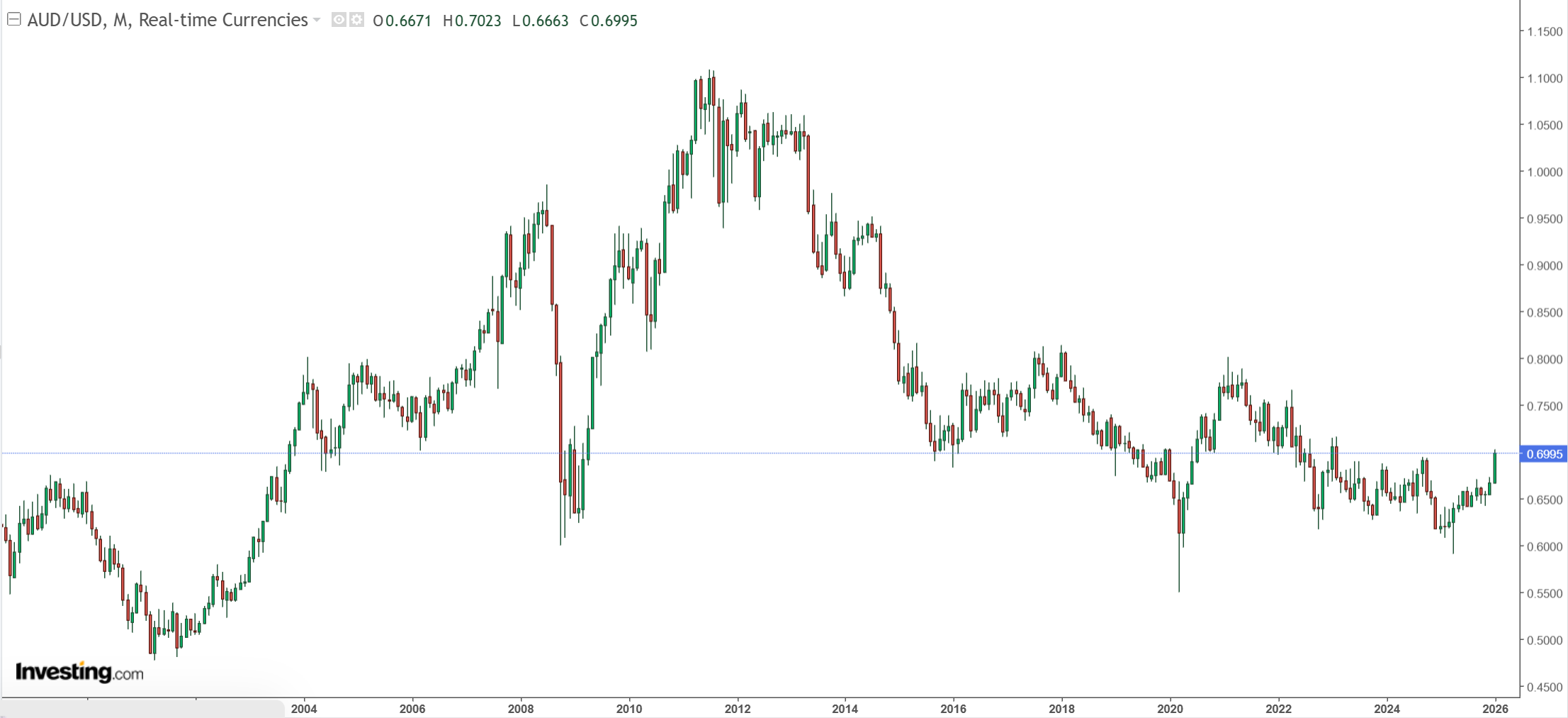
How high is it going to go? First, it is way overbought, so expect a pullback.
More broadly, I put the surge down to five factors:
- Policy risk undermining the DXY.
- CNY and JPY on the rise.
- Local monetary tightening.
- Global growth experiencing an early-cycle rebound.
- The gold bull market.
The first is self-evident. The only guarantee with the American madman is that he will do whatever it takes to make himself the centre of the universe. This will take ever more outrageous ideas.
On the second point, China cannot allow the CNY to depreciate too much. Its economy is in a depression. Its only bright spot is exports. The government is expected to slow the currency’s appreciation before long.
Japan is the opposite. It cannot allow JPY to fall any further, as it seeks to keep modest inflation in balance with rising fiscal spending. It has already started to jawbone, and the trend of intervention will continue.
Following a 0.9% quarterly print in the trimmed mean, an RBA rate hike is now expected. But how many hikes before the economy stalls? Not many.
Growth is picking up globally, which is good for the AUD.
The commodity boom is not a reflation. It is the narrow appreciation of precious and AI metals. Nonetheless, this situation remains bullish for the AUD until iron ore prices begin to decline, which I anticipate will happen this year.
Finally, Goldman offers this little squeezy nugget.
As this unfolds, concerns of unfriendly cross-asset correlations that could prompt an adjustment in FX hedge ratios if they persist has started to come back into focus. One theme that has been getting increasing airtime this week is Australia. In Australia, the super funds on average have historically low FX hedge ratio of around 20-30% (RBA). Last week, the second largest super fund, ART Super, said that they would look to increase FX hedge ratios (for USD denominated asset exposure that is sell USD / buy AUD).
They’re all long, Mag7 unhedged!
In short, AUD is likely to run further (though perhaps not so fast).
The base case is that we head to 75 cents before year-end, then fade as we shift into a mid-cycle slowdown next year and, after Republicans lose the midterms, contain the madman (somewhat).
The bull case is that all commodities increase significantly in value as a combined debasement-and-reflation trade that supports iron ore and energy prices against fundamentals. We could rip to 80 cents and above, similar to the surge seen during the COVID rebound.
The most obvious bear case is that the American madman finally takes an action so foolish that it causes a market crash.
