Find below the full text of the Albanese government’s energy treason cooked up with the East Coast gas cartel precisely as predicted at MB.
It is so nice to see the Indigenous and Aussie Jews acknowledged as their land is leached of its resource endowment on behalf of China while being backfilled with carcinogenic poisons, and Aussie households pay for the lot.
This truly is Albo’s modern Australia in all of its ersatz political ignominy.
The Energy and Climate Change Ministerial Council (ECMC) met today on the lands of the Ngunnawal people in Canberra, to further strengthen protections for energy consumers, improve national climate cooperation and take collective actions to improve the affordability, sustainability and security of Australia’s energy systems. Energy and Climate Ministers closed out the year with a continued focus on reducing consumer bills, improving customer protections, shared climate objectives, ensuring secure and reliable energy for consumers and ensuring the economic benefits of renewables can benefit more homes and businesses.
Ministers acknowledged the horrific antisemitic attack at Bondi Beach. They extended their condolences to all those who lost a loved one, and reiterated their support to all Jewish Australians. They commended the extraordinary bravery of ordinary Australians who in the face of danger ran to help, as well the selfless service of police, paramedics and other first responders.
Delivering reliable and affordable energy
Ministers agreed to progress critical energy market reforms which will deliver reliable and affordable energy to all Australians.
The National Electricity Market (NEM) Review Panel (the Panel), chaired by Associate Professor Dr Tim Nelson, presented its Final Report to today’s meeting of the ECMC. The Panel was tasked to conduct an independent, expert led review of the NEM wholesale market settings to support investment in firmed renewable generation and storage capacity following the conclusion of the Capacity Investment Scheme (CIS) tenders in 2027. The purpose of the Review was to ensure the right market settings are in place to meet growing electricity demand and support a smooth, reliable transition to renewable energy as aging coal-fired power stations retire, which will ultimately maintain downward pressure on prices.
Energy Ministers recognised that unlocking long-term investment in new electricity services and advancing spot market reforms is essential to improving the efficiency, reliability and resilience of the NEM.
Energy Ministers thanked the Panel for its work. Ministers noted the Final Report of the NEM Wholesale Market Settings Review, which is being published today, and agreed in principle to its core recommendations – noting Queensland did not provide in-principle agreement, but acknowledged the good work of the panel so far and recognised sovereignty of jurisdictions to address the challenges they face. These include establishing an Electricity Services Entry Mechanism (ESEM), a Market Making Obligation, and improved visibility of Price Responsive Resources. These reforms will support an orderly transition that helps put downward pressure on prices by establishing a nationally consistent framework for jurisdictions to facilitate investment in crucial electricity services such as bulk energy supplied by renewable sources and firming supplied by sources like batteries, gas-powered and hydro-electric generation, ensuring reliable and affordable electricity for consumers and achievement of state energy targets. The ESEM design developed by the Panel provides for tenders to accommodate technologies that are part of a state government’s energy policy, such as offshore wind and long duration storage. The implementation of the ESEM will be prioritised to enable timely processes to support respective State priorities.
Officials have been tasked to develop a work program drawing on the Panel’s implementation roadmap that will be provided by February 2026, so that Ministers are able to consider detailed design proposals in 2026 that would give effect to these reforms, aiming to have the ESEM in place by end of 2027, as well other recommendations from the Panel. Ministers acknowledged the extensive contribution made by stakeholders to the report and the momentum and goodwill for reform built by the Panel. The next phase of design work will include continued extensive industry engagement to ensure practical and effective implementation.
Gas will continue to play an important role in the energy system, providing firming for renewable energy and supporting industrial processes where no viable alternatives exist. Ministers remain focused on ensuring Australian households and industry have sufficient supply to meet demand. Ministers agreed to release a draft regulatory package for consultation in January 2026 to seek stakeholder feedback on a proposal to provide AEMO with last resort powers in the east coast gas market to help prevent the realisation of structural shortfalls if the market does not respond as a final course of action, noting Queensland did not support the motion pending further work. The package includes a consultation paper, draft bill, draft rules and regulations. Ministers agreed to consider the outcomes of consultation and make a final decision on whether to proceed with these reforms at the next ECMC meeting.
Strengthening energy consumer experiences
Ministers are maintaining their focus on delivering better outcomes for consumers and communities, now and into the future.
Lowering bills and supporting vulnerable consumers remain a continued priority for all Energy Ministers. Senior Officials were directed to bring forward further reforms to enhance consumer protections, including in relation to payment difficulty, embedded networks and consumer protections for new energy products and services. Ministers welcomed work on a potential consumer duty for energy, to ensure good consumer outcomes in a rapidly changing energy market, and noted that further stakeholder consultation will be undertaken in early 2026.
Ministers acknowledged that more Australians are reducing electricity bills by storing their own solar power, with 165,926 batteries now installed under the Commonwealth’s successful Cheaper Home Batteries Program supported by jurisdictional schemes. Ministers remain focused on ensuring consumer energy resources can be effectively integrated into the electricity system, and can deliver benefits to all consumers. Ministers progressed priority reforms under the National Consumer Energy Resources (CER) Roadmap including:
agreeing 18 initial requirements for the interoperability of CER devices, which is a first step towards nationally consistent standards, including for electric vehicle to grid systems and for supporting better options for virtual power plants
agreeing a National Technical Regulatory Framework for CER, with the detailed design to be considered by Ministers in early 2026
finalising responsibilities and accountabilities for the effective and efficient operation of distribution systems in a high CER future
agreeing to develop a National CER Data Management Framework to support system security, emergency management and the effective orchestration of CER.
The Clean Energy Regulator was proposed as the preferred body to take on the new technical regulator functions for CER.
Renewed focus on shared climate objectives
Ministers reaffirmed their commitment to practical collaboration on shared national climate objectives through a National Climate Change Partnership (NCCP). The NCCP is a framework for the Australian Government and state and territory governments to collaborate on emissions reduction, climate adaptation and resilience, working closely with local governments. Ministers welcomed work on initial flagship actions, including delivering a national adaptation action agenda by the end of 2026, and improving work across Ministerial Councils on cross-cutting climate issues, including a focus on decarbonising the transport sector.
Australia’s climate and energy policy objectives are closely intertwined. The NCCP and the National Energy Transformation Partnership (NETP) together translate the strategic priorities of the ECMC into action.
Ministers discussed the Commonwealth’s new 2035 target to reduce emissions by 62-70% below 2005 levels, the Net Zero Plan and six sector plans and reaffirmed their commitment to work together to shape the lowest cost transition to their net zero goals.
Ministers also welcomed an update from the Australian Climate Service on the National Climate Risk Assessment, and committed to supporting and delivering coordinated climate risk management and adaptation responses at all levels of government.
Ensuring secure and resilient energy systems
AEMO CEO Daniel Westerman briefed Ministers on the outlook for the 2025-26 summer season. Summer presents a broad range of risks to energy systems and Ministers welcomed AEMO’s advice on the comprehensive actions that are underway to prepare energy systems for the impacts of potential severe weather.
Ministers discussed the substantial progress that has been made in implementing the National System Security Action Plan agreed earlier in this year. The plan coordinates national efforts to strengthen system security by bringing together jurisdictions, energy market bodies and other key stakeholders to work together to ensure the power systems remain strong and stable as energy systems transitions to higher penetrations of renewable energy.
Since last ECMC the newly formed Electricity-Communications Resilience Forum brought together industry and government stakeholders in October to discuss important data sharing protocols on increasing electricity and telecommunications resilience in disasters, the desire for a set of flexible priority principles for service restoration. Ministers were briefed on disaster preparedness for the upcoming summer season and additional work underway to improve resilience and cross-sector coordination, and will review progress in 2026.
Future industries
Ministers discussed the opportunities and significant challenges of data centre investment and agreed actions to respond to the increased electricity demand from such development. Ministers asked officials to review cost recovery arrangements to ensure data centres cover network upgrade and connection costs; explore options to ensure new load growth is efficiently integrated into the grid, including developing a framework to facilitate demand flexibility and ensuring new firmed generation enters the market as data centre energy demand increases; advance reforms for grid connections; and improve AEMO’s visibility of data centre energy use. Ministers also welcomed the Australian Government’s plan to develop national principles for data centre development aligned with national interests, including energy usage, and committed to work with industry to encourage adoption of the principles once finalised.
Supporting cheaper living
A package of Greenhouse and Energy Minimum Standards reforms was agreed by Ministers, including agreement to the introduction of minimum energy performance standards (MEPS) on heat pump water heaters in Australia and New Zealand, an increase in the MEPS for external power supplies and the Equipment Energy Efficiency Program (E3) Strategic Plan and Implementation Plan to modernise the E3 Program. Ministers endorsed the 2026-27 Trajectory for Low Energy Buildings Implementation Plan, following agreement to an updated Trajectory for Low Energy Buildings in August. The Plan outlines five new areas for collaborative work: promoting efficient electrification, refrigerant reductions, equitable transition, resilience, and embodied carbon reduction. ECMC plans to meet in the second quarter of 2026.
Advertisement
The NEM Review Panel Final Report does not even cover gas reservation policies. But it is 277 pages of unnecessary drivel that repeatedly emphasises the importance of such a policy. To wit.
Gas prices remain highly correlated with electricity prices.21 Global gas prices reflect the opportunity cost of the NEM’s gas-fired generators. These generators will only generate if the value of their electricity exceeds the equivalent value they would receive from selling their gas to the gas market. Gas prices therefore influence electricity prices particularly acutely outside solar hours and during VRE droughts.22 Stakeholders have noted that the price of gas generation is often used as a benchmark for bids by batteries, hydro and pumped hydro, whose short-run marginal costs are the opportunity costs of dispatching at other times.23
In this way, international gas prices sometimes set NEM spot prices even when another form of flexible generation is the nominal price-setter. For example, gas-fired generators contributed only 12% of dispatched energy from 2014 to 2021 but were estimated to have influenced the price of almost 75% of generation.24 Gas generators are likely to continue to do this during times of scarce VRE supply. AEMO expects the NEM to rely on gas as a strategic reserve, particularly during VRE droughts and extreme weather events.
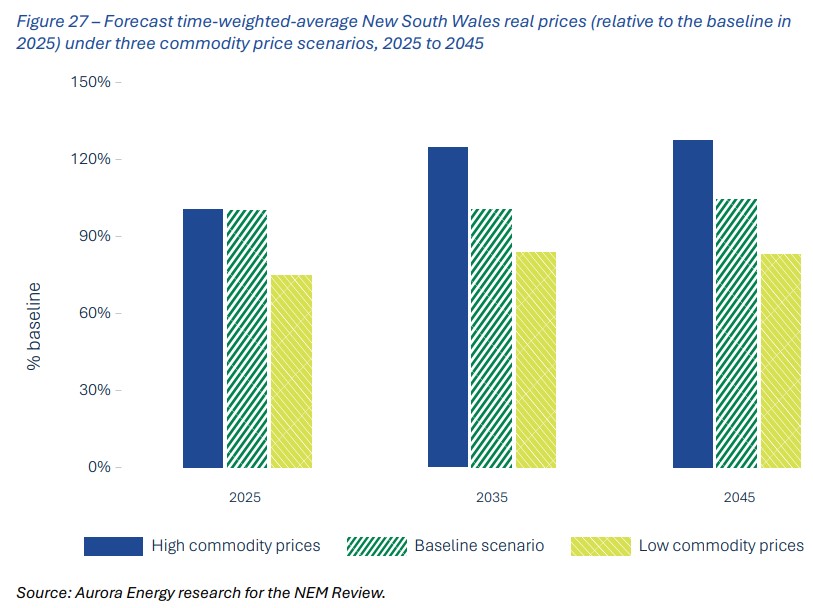
Aurora Energy Research modelling suggests international gas markets may continue to have an ongoing influence on spot prices. Figure 27 compares Aurora’s baseline forecasts, in which the longterm average gas price is assumed to be $14.8/GJ, with alternative scenarios in which gas prices are significantly lower ($10/GJ) and higher ($20/GJ). The effect on NEM spot prices is observable: for example, the modelling suggests electricity prices in the higher gas price scenario would be around 20% more in 2045 than they would be in the baseline gas price scenario. The evolution of the role of CER, storage and demand response (DR) as participants in the wholesale market could impact these outcomes.
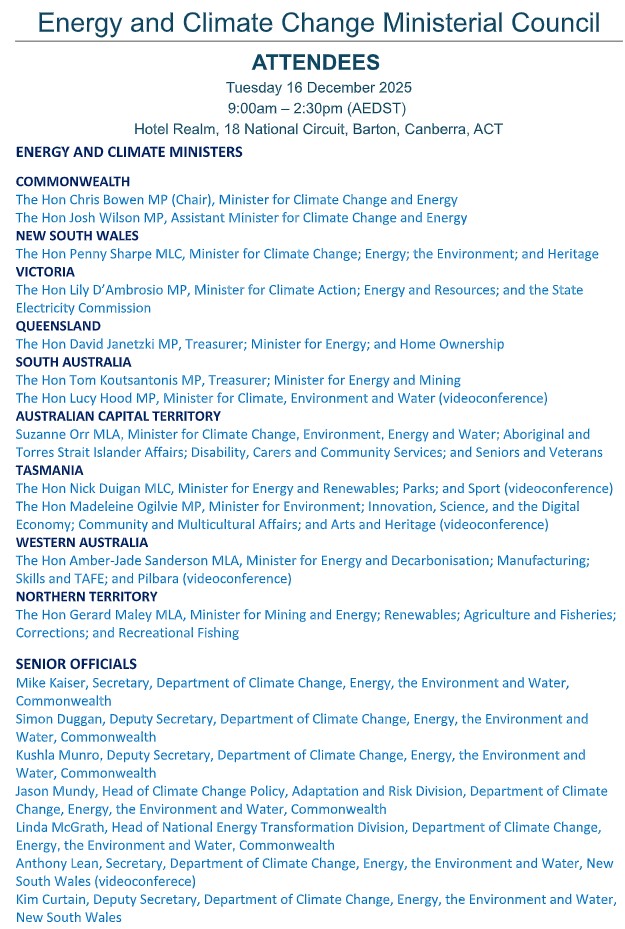
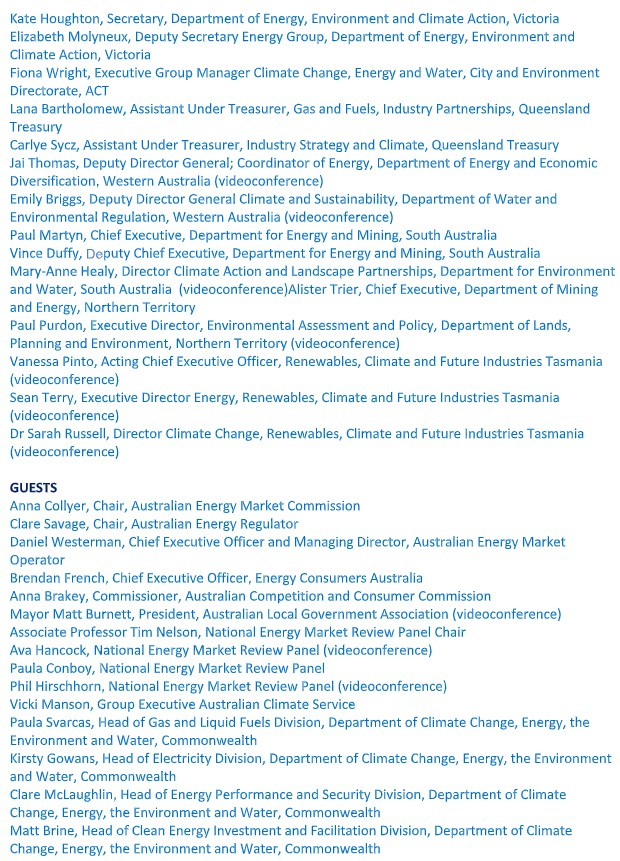
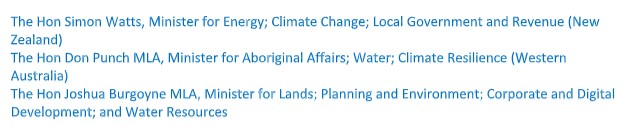
All we need is cheap gas, and instead we get this encyclopedia of balderdash. Here is your list of attendees for the gallows.
David Llewellyn-Smith is Chief Strategist at the MB Fund and MB Super. David is the founding publisher and editor of MacroBusiness and was the founding publisher and global economy editor of The Diplomat, the Asia Pacific's leading geo-politics and economics portal.
He is also a former gold trader and economic commentator at The Sydney Morning Herald, The Age, the ABC and Business Spectator. He is the co-author of The Great Crash of 2008 with Ross Garnaut and was the editor of the second Garnaut Climate Change Review.