
The Albanese government’s 5% deposit scheme for first home buyers, which came into effect on 1 October, has pushed the last of Australia’s affordable housing beyond reach.
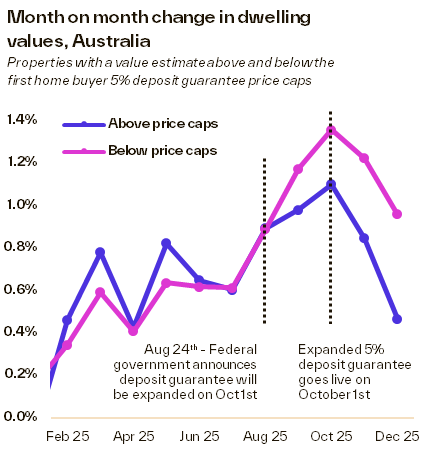
Lower-priced properties, or those covered by the extended Home Guarantee Scheme price caps, have generally seen better growth since September of last year, according to new Cotality study.
Depending on whether a property is above or below the scheme’s price limitations, growth in home values has varied.
In the December quarter, homes under the price cap increased by +3.6%.
Above threshold priced homes: +2.4% over the same period.
This will surprise absolutely nobody and accords with long-standing research that all demand-side stimulus measures do is make housing increasingly unaffordable.
This research reviewed first homebuyer (FHB) assistance programs in Australia and seven comparator countries: Canada, Finland, Germany, Ireland, the Netherlands, Singapore and the UK. It considered to what degree such assistance are effective in expanding access to home ownership to those whose entry would be otherwise delayed or impossible, or in making more affordable and less risky the cost of home ownership.
Current Australian first homebuyer assistance measures primarily act to bring forward first home purchase for households already close to doing so, rather than opening home-ownership access to households otherwise excluded. In doing so, these measures add to demand and hence to house prices…
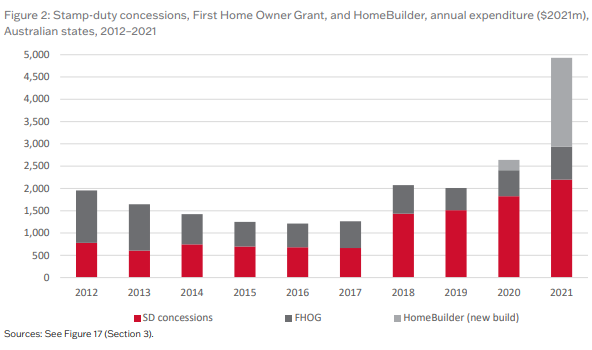
More than $20.5 billion (in $2021) was expended by Australian governments in stamp-duty concessions and cash grants (including HomeBuilder) to first homebuyers in the decade to 2021. Even before the economic stimulus response to COVID-19, these forms of assistance were escalating—up from $1.2 billion to almost $3 billion in the four years from 2016—and new demand-side measures were being added, such as the National Housing Finance and Investment Corporation’s (NHFIC) low-deposit mortgage scheme…
It’s not only that the scheme adds purchasing power to first home buyers, which is immediately capitalised in prices.
It is that investors know this and chase prices higher in the “cheaper” brackets before the scheme even starts.
We all know that this is not a bug in the system; it is the system.
Mass immigration, favourable taxation, demand-side stimulus, shared equity, bank guarantees, and centrally planned inadequate construction are all directed at pushing prices higher, always.
Even after yesterday’s bounce, dwelling approvals remain well below target.
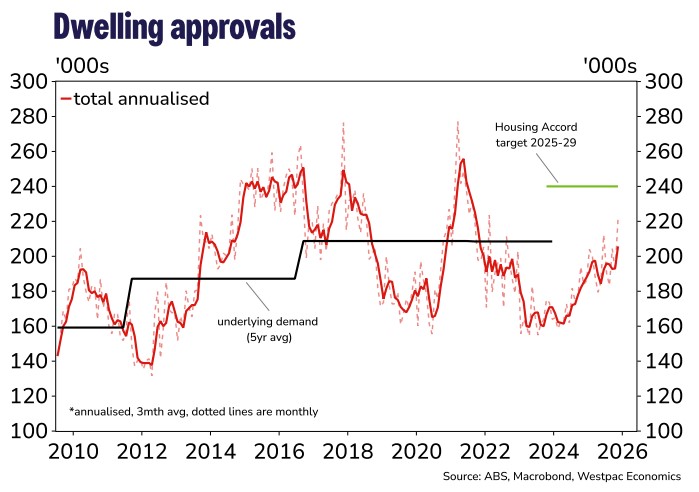
There is a further large gap between approvals and starts at present, owing to the centrally planned energy shock.
For a prime minister who boasts about his upbringing in public housing, it appears he has closed the door behind him.
