
Australia’s budget position is worse than thought
A previously undisclosed $57 billion deterioration in the federal budget outlook has emerged since the election, driven mainly by higher long‑term spending under the Albanese government. The blowout means the budget is no longer expected to return to surplus within the next decade.
Analysis by the office of shadow treasurer Ted O’Brien, independently verified by economist and budget expert Chris Richardson, shows that the federal budget’s deterioration appears after the four‑year forward estimates, beginning in 2029–30 and continuing to 2035–36.
Treasury projections show deficits worsening by $4–11 billion per year across the period.
Two‑thirds of the blowout is due to higher spending; one‑third is due to weaker revenue.
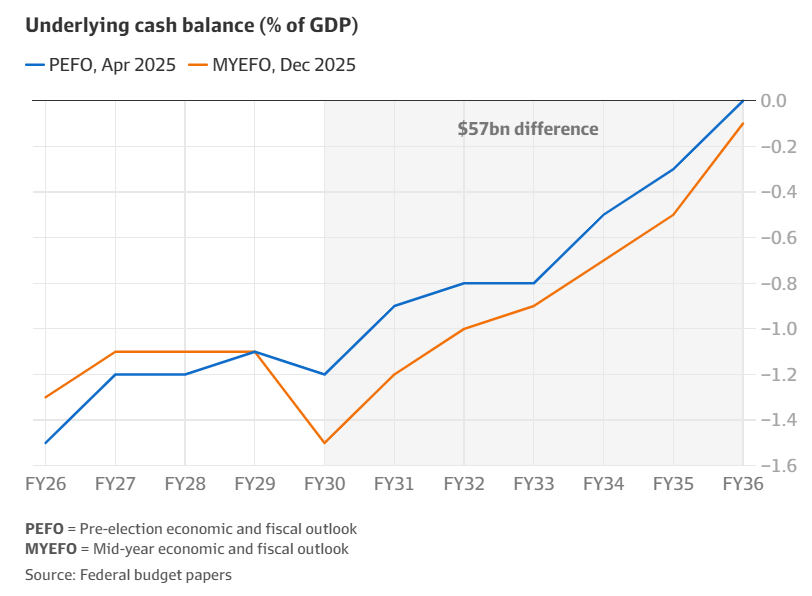
The extra spending was not present in the independent Pre‑election Economic and Fiscal Outlook (PEFO).
Budget expert Chris Richardson says the shift reflects long‑term spending being “swept under the carpet”.
The analysis identifies several likely contributors, most notably the hospital funding deal with the states, which appears to be a major driver of the medium‑term deterioration.
The Commonwealth has proposed lifting its share of hospital funding from 40% to 45% by 2035, with a guaranteed 42.5% by 2030. Originally costed at $17 billion, state wage rises—especially in Victoria—could push the cost to $30 billion.
The Commonwealth has already increased its offer to $23 billion over five years.
Other possible contributors include welfare and social security pressures, higher long‑term health spending, and upgrades to cost estimates for social programs (e.g., home battery subsidies, student debt relief, etc).
Chris Richardson provided more detail via a thread on Twitter (X).
Richardson noted that “our budget rules and reporting are poor, offering loopholes in which politicians can hide stuff. So they do”.
“Budget analysis focusses on cash underlying deficits, and so politicians reduce those deficits by shifting costs off-budget”, Richardson wrote.
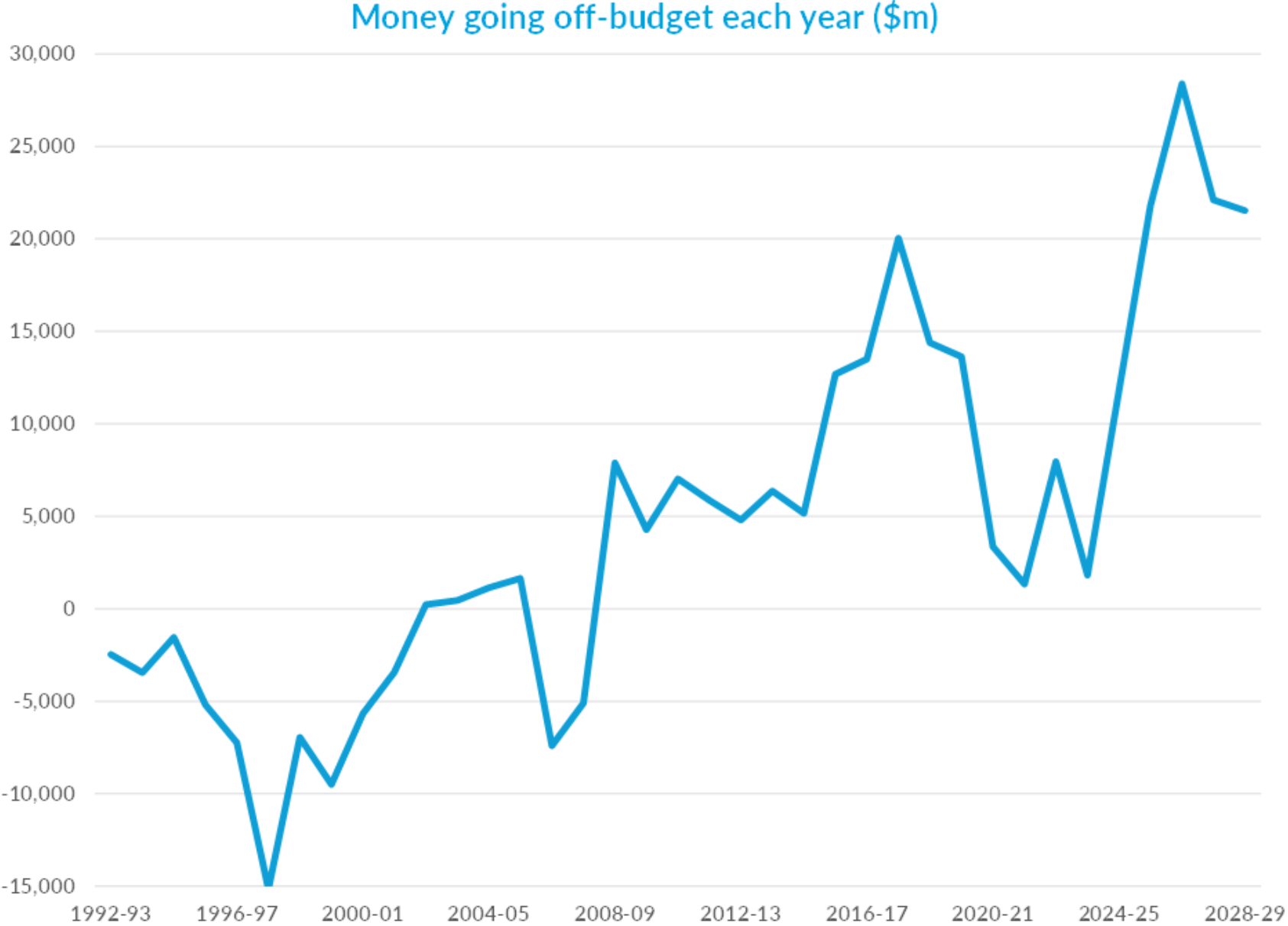
Chart by Chris Richardson
“Budget analysis focusses on the next few years, so politicians also shove costs immediately beyond that. The budget update had $5bn more spending in 2028-29—the last year that gets detailed attention in budget reporting”.
“But I estimate spending was $12 billion higher in 2029-30 and $14 billion in 2030-31”, Richardson wrote.
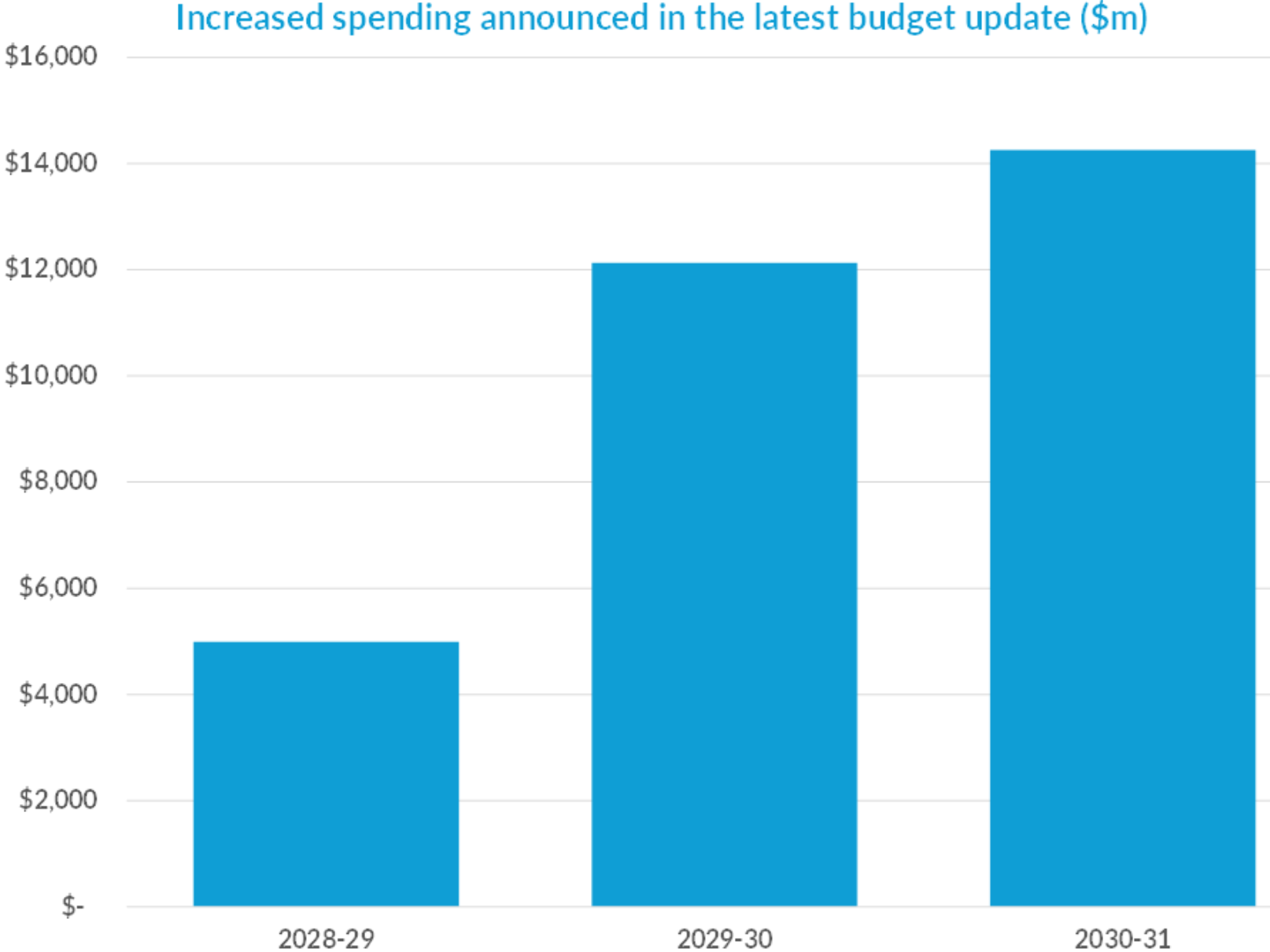
Chart by Chris Richardson
“Similarly, because there’s a focus on how much extra is spent by way of policy decisions, there’s all too little focus on what’s called ‘program specific parameter variations’”.
“Those babies have also soared”, wrote Richardson.
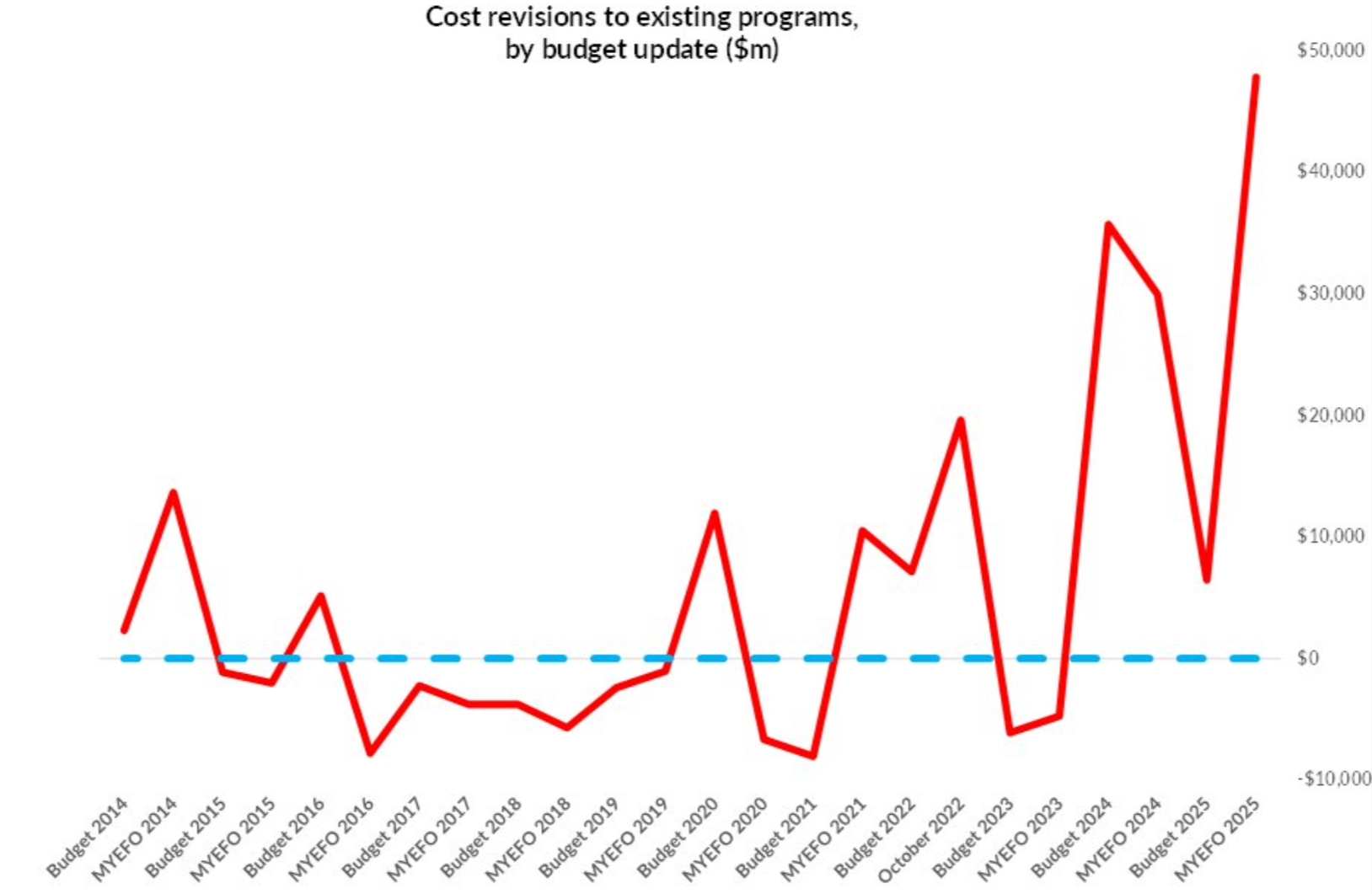
Chart by Chris Richardson
“Or, to put the above differently, the politicians know some numbers get careful scrutiny, while others slide by under the radar”.
“So it’s the latter that becomes the rug under which stuff gets swept”.
“Our budget reporting & rules are easy to manipulate. So that’s exactly what happens”, wrote Richardson.
Regardless, the federal government needs to cut spending as well as embark on fundamental tax reform that broadens the tax base, maximises efficiencies, and rewards productive activities.
