
Once upon a time, there was a country in which you grew up in a good house and played in abundant green space. Occasionally, you visited your grandparents in some suburb near or far. Life was good.
Now the kids will be emptying their grandparents’ Tenna support pants instead.
In an attempt to combat the cost of living and the increasingly unaffordable Australian housing market, building industry insiders say Australian families are resorting to multigenerational living.
The bold new move by some means one home supports up to three generations.
“More than half of our current projects involve some form of dual occupancy, multi-generational living, or a house deliberately designed to become that over time,” Harry Catterns, an architect and co-founder of the design SAHA, told news.com.au.
This is just another symptom of the great mass immigration crush loading, which is the sole economic plan for Australia.
Why is it not working? Labor has lost control of inflation.
Landcom, a NSW government-owned business responsible for developing land across the state for new homes, had since 2021 been planning housing projects for Tallawong and Rooty Hill in the north-west and Austral in the south-west. But, in December, all information on the projects disappeared from Landcom’s website, with the developer posting one final update: “Development not proceeding.”
After “technical investigations and feasibility assessments”, Landcom said in its update that it had decided to “instead focus on opportunities at other sites in metropolitan Sydney and regional NSW that can support the NSW government’s housing agenda”.
Its decision not to proceed with the large-scale low-density housing projects highlights the growing difficulties developers are facing when building in western Sydney. It underscores a central irony of the government developer’s task to build homes in areas that require more housing and to make a profit on them. Often, the reason those areas have a limited housing supply is that developers don’t build there because they cannot make a profit from it.
This is directly the result of the Albanese government’s refusal to fix the East Coast energy crisis by regulating the gas cartel.
Building materials are highly gas- and energy-intensive to make, and the end result speaks for itself.

Add the cost of land inflation driven by land banking assured by population flows, and you get the perfect storm for builders’ margins.
The Albanese government’s answer is to have the government build, but that only inflates tradie wages and worsens the problem through crowding out.
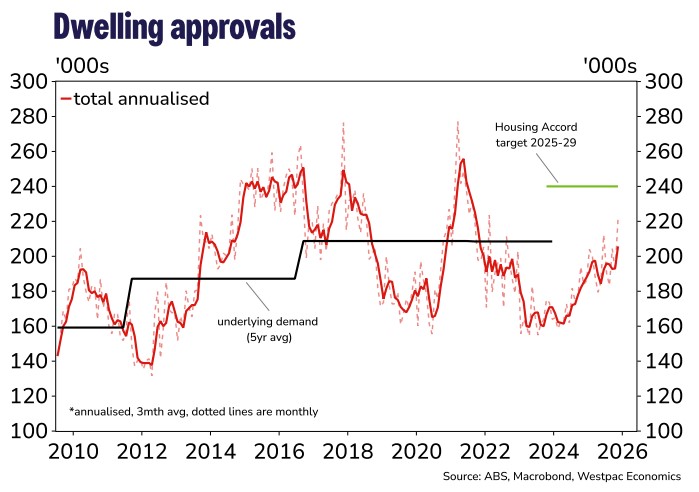
The Albanese government also protects trades from mass immigration to ensure they don’t fight against it.
The upshot is that the only thing that is built quickly is the propaganda that comes with the failure.
In just two years, Victoria has rolled out so many reforms aimed at getting millennials into their own homes that even those advocating for them are stunned.
“We’ve seen, in many respects, a planning policy revolution in Victoria,” says Brendan Coates, the director of the Grattan Institute’s housing and economic security program.
“I don’t think anyone in their wildest dreams would have expected that a state government would go as far as they have.”
And what has it produced? Victoria is approving the same number of houses it did in 1985. Units are better, but the total is the same as that reached 25 years ago.
And these days, many fewer move to start because there is no profit for the builder.
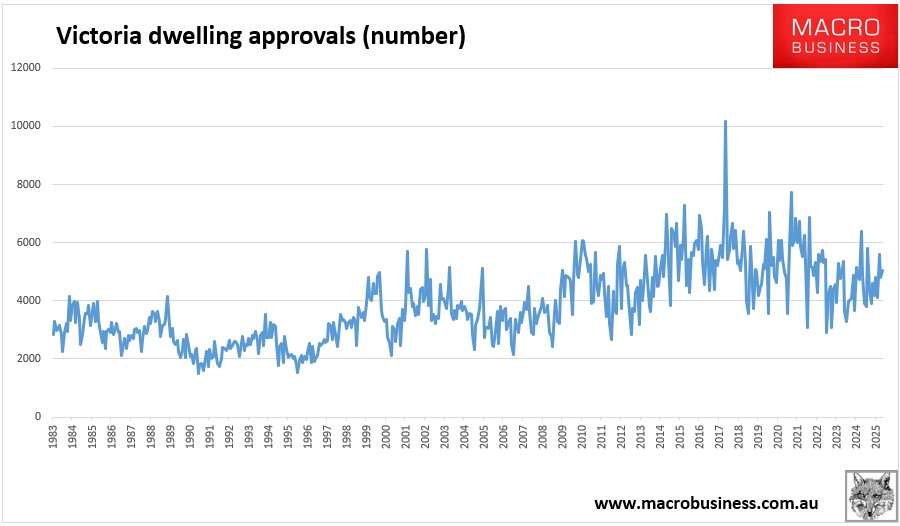
All as immigration rages on.
It is deeply unethical for outfits like the Grattan Institute to cheerlead the dehousing of Australian youth so that sponsors like the Scanlon Foundation and Melbourne University can benefit from an ever-growing population.
