
This is my fourteenth year of working from home. I brew my coffee, and when I need a hit while driving, I almost always purchase a cheap $2 coffee from a service station or convenience store.
While travelling around New South Wales and regional Victoria over the Christmas break, I visited several cafés and was shocked to pay $6.50 for a cup of coffee.
Such price inflation makes it challenging to understand how so many Australians are still willing to purchase café-made coffees each day.
Upon returning home in January, we learned that the latest monthly CPI report from the Australian Bureau of Statistics (ABS) revealed that coffee prices in Australia have surged more than five times faster than overall inflation, driven mainly by a global shortage of coffee beans.
Coffee, tea, and cocoa prices jumped 15.3% in the year to November 2025, making them one of the strongest contributors to inflation in Australia. By comparison, overall CPI rose by 3.4% over the same period.
Reduced global coffee bean supply drove the price spike, pushing up costs for roasters, cafés, and consumers.
Major producing countries (especially Brazil) have faced poor harvests, climate volatility, and supply disruptions, pushing up the global price of green beans.
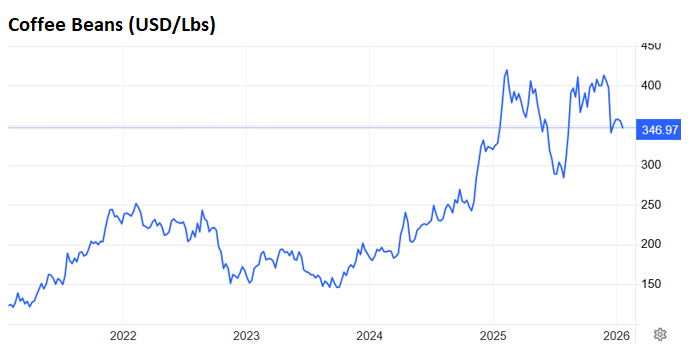
Industry reports show bean prices have surged dramatically, forming the core cost pressure for Australian roasters and cafés.
Café owners have also faced higher wages, rents, utilities, and general food‑service costs, all of which have been passed into the price of a cup, alongside other menu items.
Several industry sources in Australia have cautioned that the price of coffee could reach $7 per cup in 2026 “just to break even”.
Mike Brabant is the chief executive of Single O, one of Australia’s largest coffee importers, roasters, and wholesale distributors to more than 300 cafés or wholesale partners.
Brabant told the Nightly that cafés have little choice but to bite the bullet and pass on the rising costs.
“If you look at Singapore, London, New York, the coffee is already a lot more expensive there”, he said.
“Australia is actually one of the cheapest countries in the world, so we still think there’s a long way to go to make up for those price increases, and I do think prices are going higher”.
The prospect of charging $7 or more for a cup of coffee poses a significant threat to Australian cafés, which have experienced rapid expansion in recent decades.
IBISWorld’s Cafes and Coffee Shops in Australia industry reports estimated that Australia had around 27,000–28,000 cafés and coffee shops operating nationwide as of 2025–26.
Competition is fierce, with multiple cafés often operating in the same locations. However, with prices of coffee and food soaring, there is insufficient consumer demand to support them, and large numbers of cafés have closed.
Consider the following fact: one $7 cup of coffee a day would cost someone more than $2,500 a year. Double it for two barista-made coffees a day. Such expenditure is simply unaffordable during a cost of living crisis where everything is going up in price.
At some point, Australians will be unable to afford or refuse to pay such exorbitant coffee prices. They will instead bypass cafés for cheaper options, including brewing coffee at home or automated coffee from service stations and convenience stores.
The café industry will then experience demand destruction, business closures, and job losses.
At the end of the day, barista-made coffee is a discretionary purchase. Australians can easily seek alternatives or go without.
The two-decade boom in cafés is coming to a close. Next comes the bust as numbers shrink to meet the slowing customer demand.
