
In the early 2010s, the federal Labor government made the ill-fated decision to allow liquefied natural gas (LNG) exports from Queensland without requiring gas companies to first supply Australians.
Gary Grey, the then-Federal Resources Minister under the Gillard/Rudd Labor governments, claimed that domestic gas reservation would cause uncertainty and discourage investment, placing the government against Australia’s struggling manufacturing sector, which desired cheaper gas.
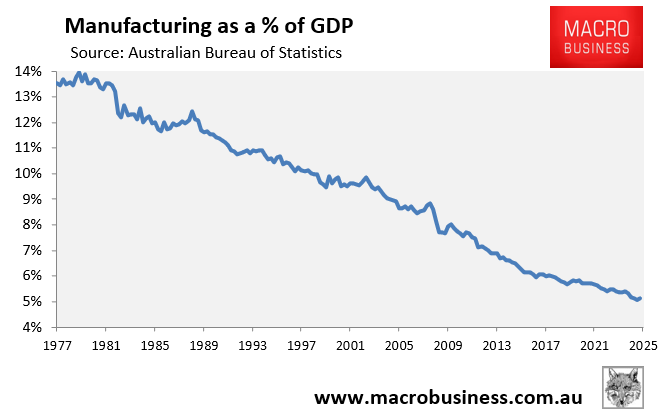
“The Australian Government does not agree that domestic gas reservation would keep gas prices down or put more gas into the market”, Gray said in his opening address to the Australian Petroleum Production and Exploration Association conference in Brisbane on 27 May 2013.
“In our view, it would create uncertainty and deter investment in new gas supply”.
Gary Grey restated his objection to the East Coast domestic gas reservation in July 2013.
“Let me say very clearly, a reservation policy could not lead to lower gas prices or more gas”, Gray said.
“Calls for intervention in the market only serve to dampen any appetite for the very investment that’s needed to bring on new gas supplies”.
“We must allow our markets to respond as they are intended to do”.
Federal Labor’s anti-reservation stance pitted them against then-Western Australian Premier Colin Barnett, whose state government has implemented a domestic reservation scheme that requires big offshore gas projects to reserve some of their gas for the domestic market.
“As a result, the Chevron-led Gorgon and Wheatstone projects are building domestic gas plants in conjunction with the bigger and more lucrative LNG operations while Woodside Petroleum is under pressure to build a domestic operation alongside its Pluto LNG plant near Karratha”, reported The West Australian in May 2013.
“Local manufacturers led by Alcoa have been instrumental in driving the WA Government to implement the domestic gas policy as a way of trying to ensure lower gas prices, and a similar push is under way in eastern Australia”.
The rest is history. Gladstone LNG export terminals became operational, and East Coast Australia currently exports nearly three-quarters of its gas.
Gary Grey retired from politics in 2016 to become the general manager of external affairs for Mineral Resources, a Western Australian mining business. Grey had served as an advisor for Woodside Petroleum before entering federal politics.
While East Coast gas output has doubled since exports began, the domestic market now receives 25% less gas.
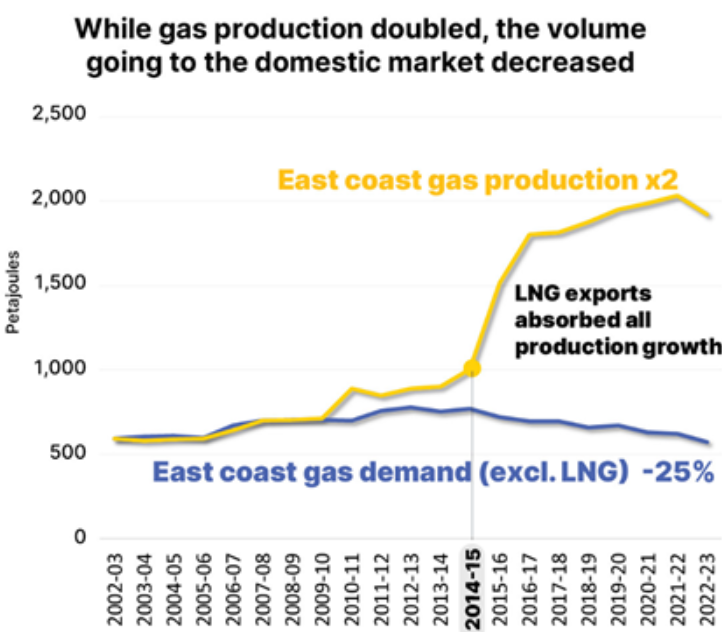
The consequent domestic scarcity nearly tripled East Coast gas prices:
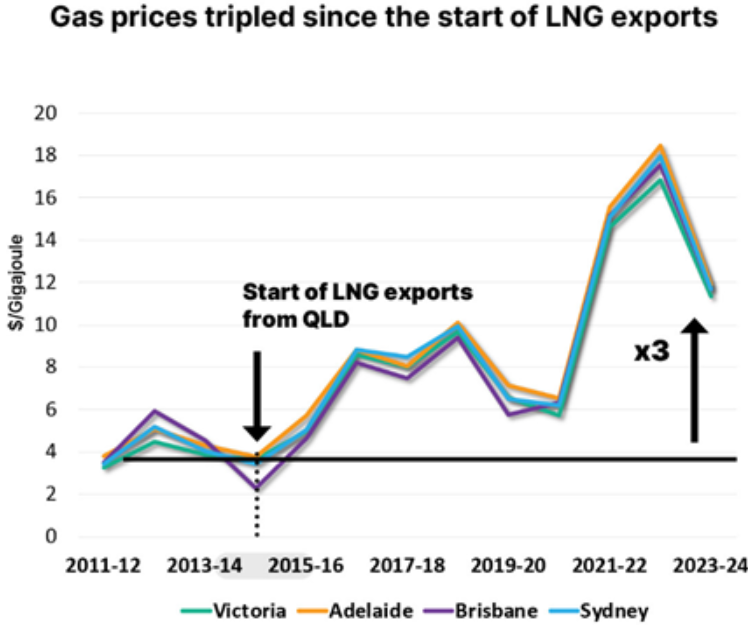
Given gas’s critical role in firming and setting marginal prices in the wholesale power market, the tripling of gas prices has also raised electricity costs.
Despite being a major LNG exporter, East Coast Australia is now facing the frightening prospect of having to import gas. Importing LNG would result in considerably higher gas and electricity prices, as the East Coast gas price would reach import-parity levels (export pricing plus liquefaction, transportation, and regasification).
To its credit, the Turnbull Coalition government established the Australian Domestic Gas Security Mechanism (ADGSM) in 2017, granting the federal government the right to impose reservation in the East Coast gas market.
However, when Russia attacked Ukraine, the Albanese government failed to use the ADGSM, resulting in East Coast gas and energy prices rising, which was then papered over with more than $5 billion of taxpayer ‘Bill Relief’ subsidies.
To worsen the situation, the Morrison government released a gas reservation options paper shortly before the 2022 federal election.
However, the newly elected Albanese government prevented its public release, claiming concerns that it might upset Asian gas consumers in Australia.
The federal Department of Industry, Science, and Resources (now DCCEEW) said that “gas reservation acts as a tax on gas production, paid as a subsidy to domestic gas users”, as if Australians were not their main priority.
Fast forward to 2025, and the Coalition promised during the federal election campaign to implement an East Coast gas reservation policy if won, which would supply $10 per gigajoule gas by requiring uncontracted (spot) gas to be channelled into the domestic market.
The Coalition’s policies would have eliminated the need to import LNG.
The Coalition also committed to investing $1 billion in a Critical Gas Infrastructure Fund to increase gas pipeline and storage capacity.
Extra pipeline capacity and storage are required to ensure gas flows to Victoria during the peak winter months, when the north-south pipeline is at full capacity.
Madeleine King, Minister of Federal Resources, called the Coalition’s gas reservation proposal a “thought bubble”.
Labor then won the federal election, consigning the Coalition’s gas reservation scheme to the dust bin of history.
After opposing reservation for more than a decade, Labor finally released its East Coast gas reservation policy.
The scheme, working through permits, will only affect new contracts. Although it will apply to all new contracts from now on, the plan will not begin operating until 2027. Consultations on details will start in the new year.
Under the plan, Australia’s largest exporters would set aside between 15% and 25% of gas production for domestic use.
The principles that will guide detailed design include:
- Existing contracts should be respected – both domestic and international contracts. Any contracts in place before today’s announcement will be considered existing contracts. Any contracts signed after today’s announcement will not be considered existing contracts.
- The reservation scheme should have capacity to be national in scope, working in tandem with federal, state and territory gas market mechanisms.
- The reservation scheme is intended to commence in 2027.
- The reservation scheme should increase domestic supply as existing contracts expire, to drive downward pressure on price.
- Under the preferred export approval model, exporters will need to meet domestic supply obligations first.
- Producers should have flexibility to meet domestic and export obligations through a variety of standard commercial/market-based arrangements, including contracting with exporters or domestic producers so long as supply obligations are met.
- The reservation scheme should encourage long term domestic gas supply contracts to support investment decisions which rely on gas as an input, including C&I users and supporting gas infrastructure providers.
- The reservation scheme should provide long term certainty for commercial production and investment, including by clearly setting domestic supply requirements well in advance of establishment and minimise impact on Australia’s LNG trade partners and their energy security.
While certainly better than doing nothing, there are three fatal flaws with this policy that significantly hinder its effectiveness.
First, the reservation scheme will not take effect until 2027, which means that Australians will be burdened with expensive gas and electricity prices for another year at least.
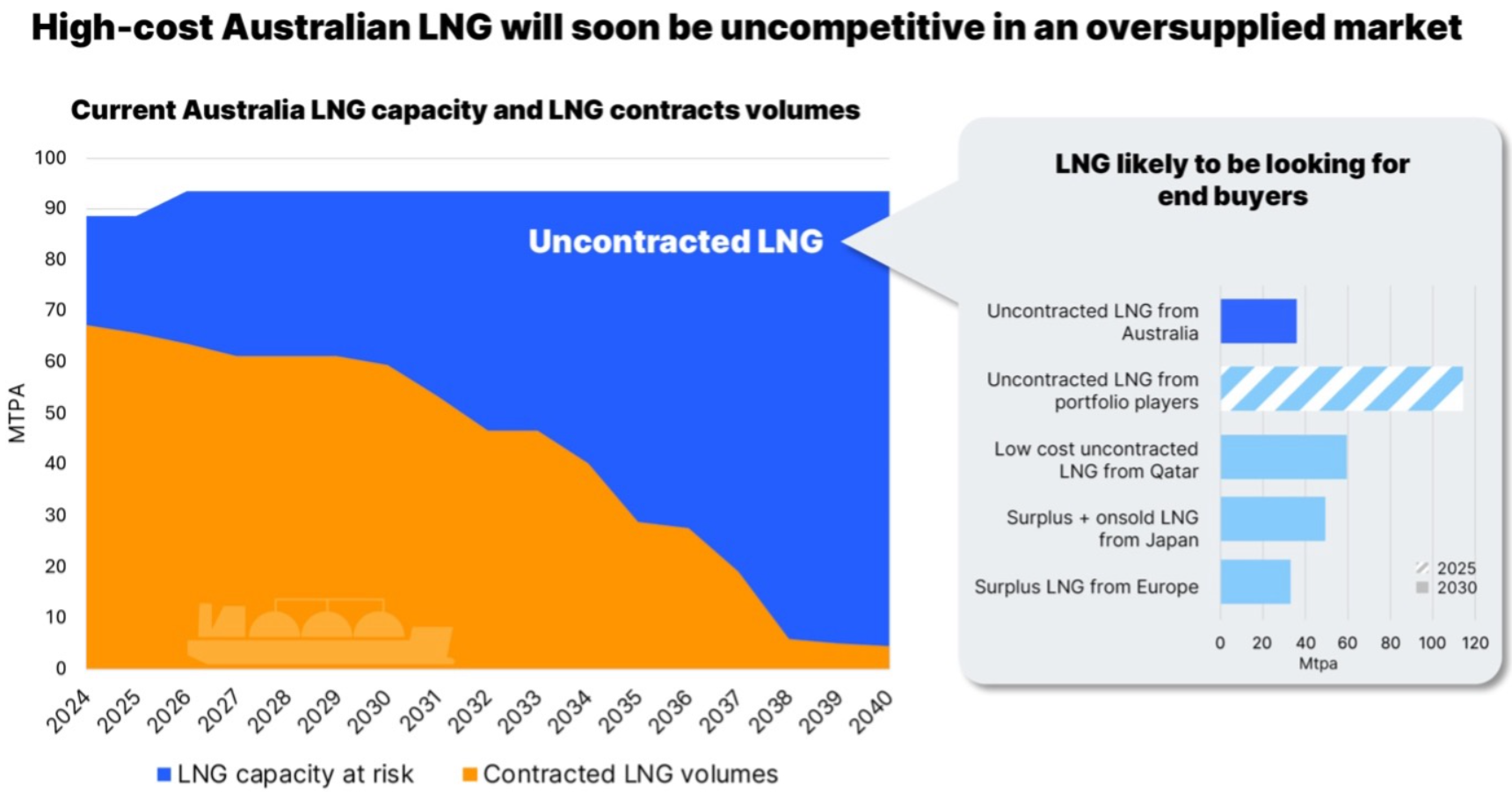
Second, and more importantly, the policy only applies to new contracts. Therefore, any extra gas supplies will only arrive when new projects are finished or when existing contracts roll off from 2030:
Third, the reservation policy says nothing about stopping the gas cartel from exporting uncontracted (spot) gas. Why hasn’t Labor also implemented export levies on spot gas to force it to be sold on the domestic market?
Implementing export levies on uncontracted gas would increase supplies immediately, alleviating shortages and lowering prices. Any spot gas that is still exported would also raise budget revenue, which could then be recycled into bill relief for consumers (paid for by the cartel).
Labor should therefore bolt on the Coalition’s gas reservation policy taken to the last election to its policy. Then it would have a genuinely excellent and effective reservation policy.
As it stands, Labor’s gas reservation policy is too little, too late, and won’t alleviate supply and price pressures for at least five years. This is simply too long to wait.
I discussed these issues with Radio 2GB’s Trent Nikolic on Monday evening:
