
Australians experienced one of the world’s largest declines in real per capita household disposable income after the pandemic, reflecting soft nominal wage growth amid high inflation, tax increases, and rising interest payments.
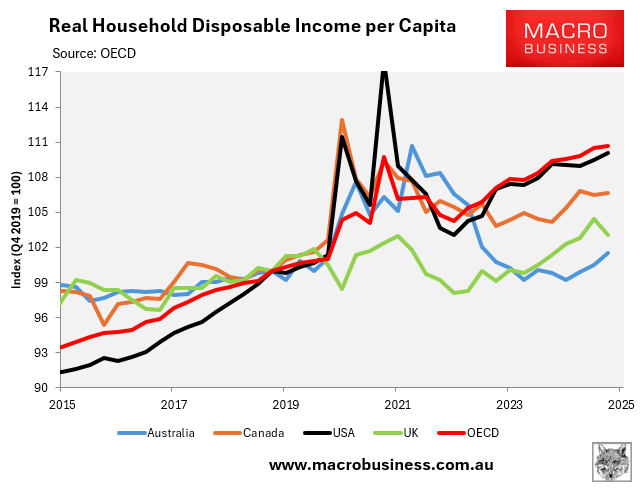
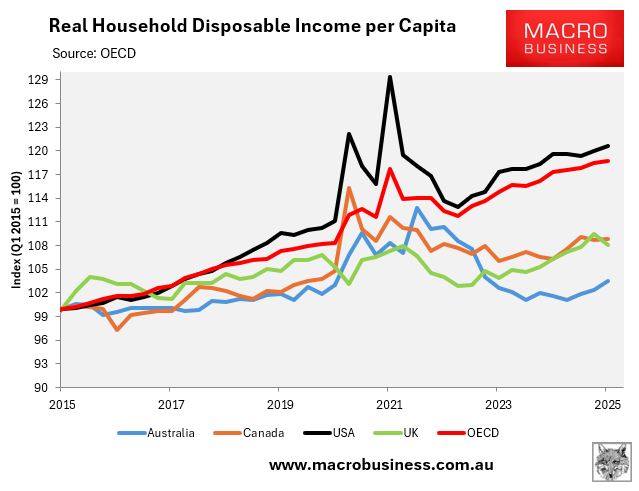
Australia’s growth in real per capita household disposable income has also been among the softest in the world over the past decade, according to the OECD.
The good news is that last week’s September quarter national accounts release from the Australian Bureau of Statistics (ABS) revealed that household disposable income is rebounding.
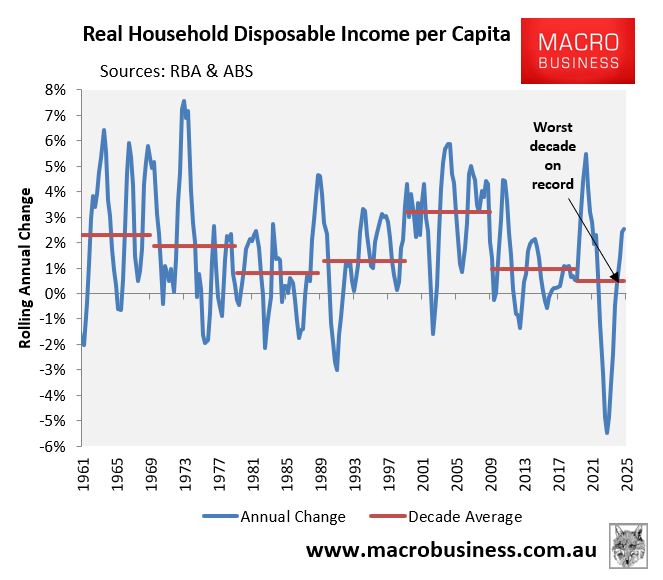
Real per capita household disposable income rebounded by 2.5% in the year to September on a rolling four-quarter basis, the strongest growth since the December quarter of 2021.
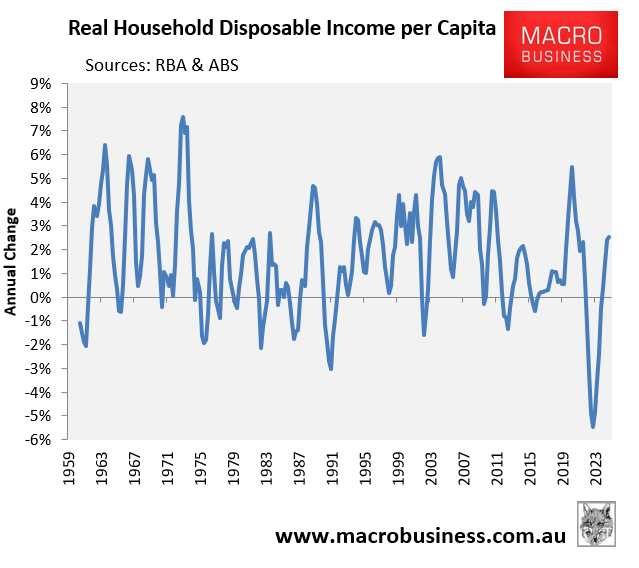
The rebound reflects a combination of the Stage 3 tax cuts, lower interest payments (following rate cuts), and modest annual real wage growth.
As illustrated in the next chart, real per capita household disposable income has yet to recover to its pre-pandemic trend, but at least it is headed in the right direction.
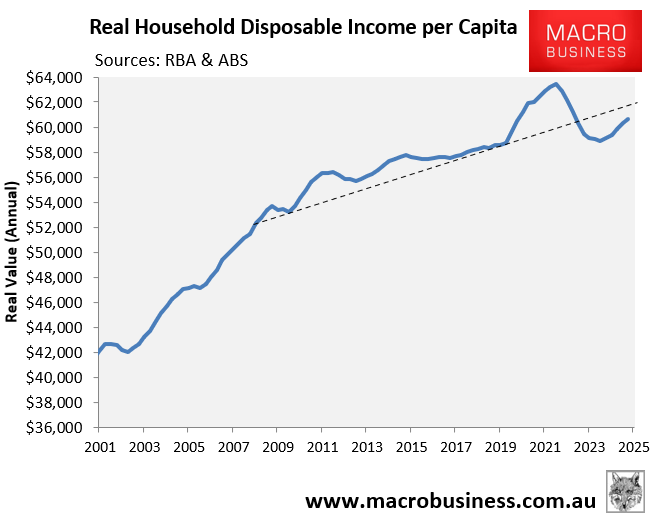
This decade is still shaping as the worst for growth in real per capita household disposable income on record.
As illustrated in the next chart, the average growth in real per capita household disposable income has averaged only 0.51% so far this decade. This compares poorly to the 0.95% annual growth during the “lost decade” of the 2010s and is significantly lower than the 3.19% annual growth in real per capita household disposable income during the commodity boom of the 2000s:
The situation is slightly worse when we compare real household disposable income with the growth in the adult population (as gleaned from the 15-plus civilian population published in the monthly labour force account).
The surge in immigration this century and the collapse in the birth rate have seen the adult population grow faster than the population at large.
As a result, real household disposable income per adult has grown more slowly than per capita, as illustrated below:
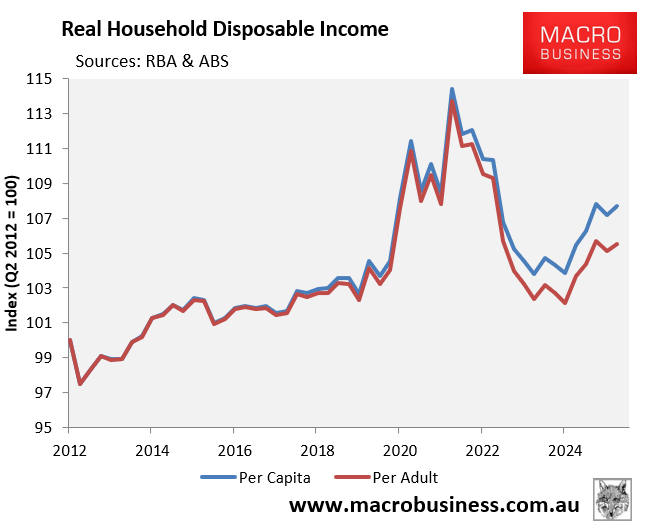
Since the June quarter of 2012, real household disposable income per adult has grown by only 5.5%, well below the 7.7% per capita growth.
The outlook for growth in real household disposable incomes remains poor given that the Reserve Bank of Australia’s latest Statement of Monetary Policy forecasts that real wages will barely grow in the period ahead.
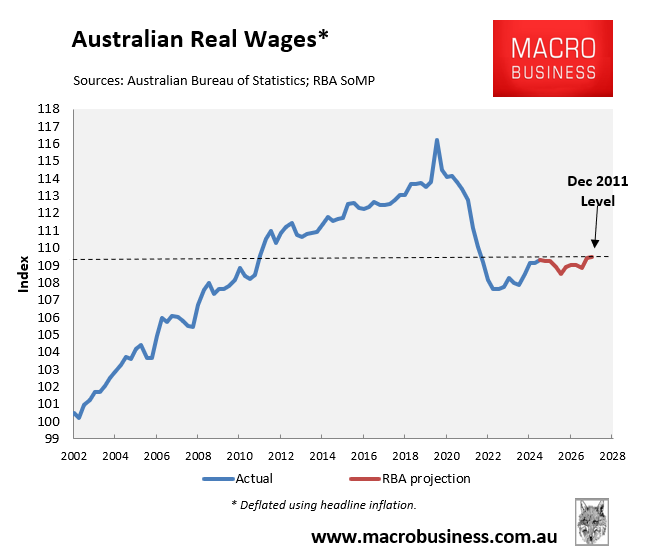
Without strong labour productivity growth, Australians face another ‘lost decade’ of poor income growth.
