
The Greens are right about gas.
On Monday, the Greens signalled they would use that leverage to block any mechanism that “financially incentivises” gas production, and declared a levy on LNG exporters the only viable approach to rebalance the market without underwriting new development.
Greens resources spokeswoman Steph Hodgins-May said Australia had ample supply and should use fiscal policy to steer more gas into the domestic system.
“We don’t have a gas shortage, we have a gas export problem,” she said.
The party is instead pushing for a 25 per cent levy on exporters – a measure that would hit producers hard and, in practice, could encourage them to scale back output. The Australian last week revealed the government had previously considered such a tax.
…“A levy makes the problem worse,” one senior industry source said. “If you want supply, you don’t tax it.”
No, it doesn’t. An export levy makes exporting gas less attractive and delivers an abundant local supply.
The only problem with the Greens’ policy is that it is far too lax. A 25% export levy will equate to about $10.50 for spot and $13.50 for industry, with a decline of about $30MWh in wholesale power costs. These are still crazy high prices.
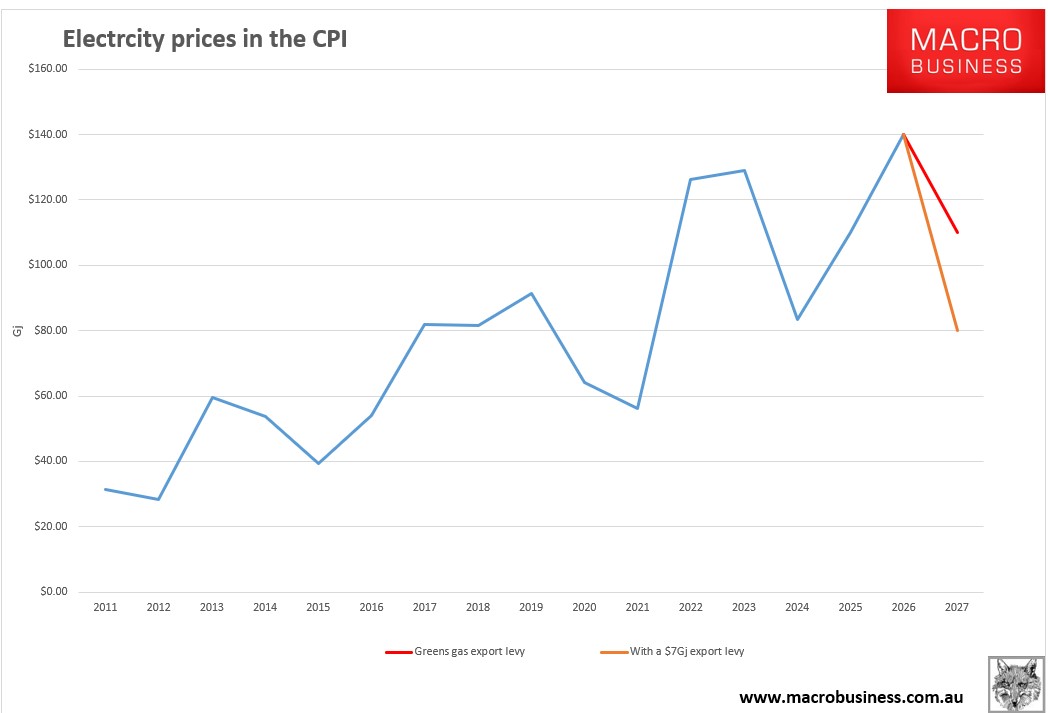
The levy will raise roughly $5 billion, which could be recycled as permanent bill relief, dropping power prices by another $30, which the Greens should also insist upon.
But that hardly makes for a fair tax take and will not be enough to stabilise gas-dependent industry.
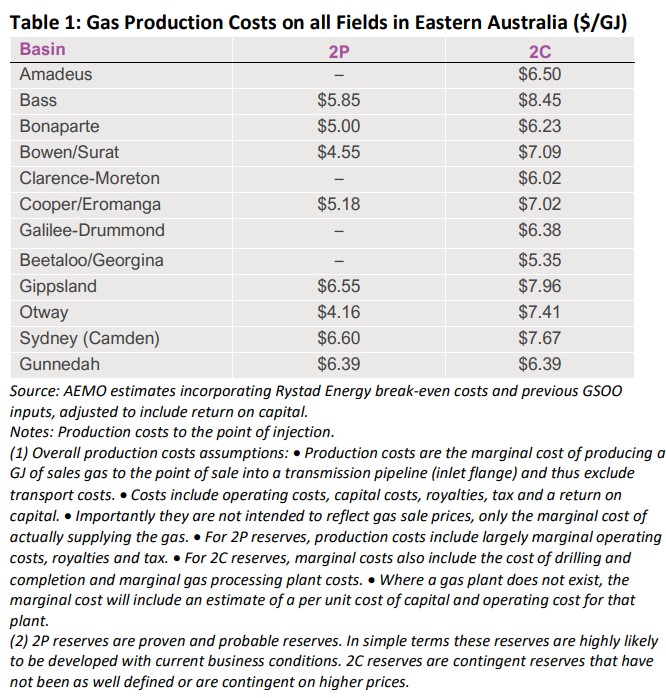
The levy should be 50% or set at 100% of every export dollar above $7Gj%.
The cartel still pumps money at that level, noting that cash costs are much lower than the all-in costs in the below table.
Meanwhile, we have a gas peaker at last!
Queensland’s new energy road map isn’t everyone’s cup of tea, but it has helped spark a $1 billion-plus investment in a new gas power plant that should be the envy of other states and their energy transition plans.
The new Brigalow Peaking Power Plant, about 300 kilometres west of Brisbane, will be built alongside the Kogan Creek coal-fired power station, run by the government’s CS Energy, and used to firm up wind and solar power in morning and afternoon periods of peak demand. It can go from cold to full output in just five minutes.
Australia’s APA Group, a gas pipeline and power infrastructure owner, has committed the first $800 million to build it, in return for an 80 per cent stake.
…It’s interesting because we hear a lot about gas peaking plants and how they’re required to firm up a grid that is supposed to be dominated by renewable power in coming decades.
…Why? It is all about returns and the willingness of parties like CS Energy, whose business is wholesale power, to develop and take long-term price risk or write contracts with someone like APA Group to do the developing (and co-investing) for them.
It is also about flip-flopping government policy, which makes those long-term contracts even harder to write, and weak-stomached boards and investors who are more interested in next quarter’s earnings than next decade’s power.
Rubbish. There is only one reason gas peaking plants are not going up all over the East Coast, and that is there is no security of supply or price with the gas cartel choking the supply of the fuel.
Fix that, and you fix everything.
