
The taxation arrangements around electric vehicles (EVs) are a reverse Robin Hood arrangement that extracts taxes from ordinary Australians to distribute to the rich.
A case in point is the EV fringe benefits tax (FBT) exemption, which was introduced in 2022 to make EVs more affordable for employees through salary packaging and novated leases.
Treasury expected the FBT exemption to cost around $200 million annually but now estimates the scheme to cost over $1 billion a year in forgone revenue.
Nearly half of the tax benefits have gone to those earning more than $150,000, raising equity concerns.
The total cost is forecast to rise to $9.7 billion between 2026-27 and 2029-30, as the number of EVs increases.
With the federal budget under intense strain, the AFR reported that the Albanese government is considering scrapping or phasing out the EV FBT exemption.
Critics argue the policy has disproportionately benefited wealthier Australians who can afford new EVs.
Veteran budget watcher Chris Richardson labelled the FBT exemption “very bad policy” and the “dumbest way ever” to reduce emissions.
“This is just outrageously expensive. This is about feel good rather than do good”, he said.
As usual, car leasing companies and EV advocates defended the subsidies, warning that removing the exemption could slow EV adoption.
EVs receive other subsidies and incentives from governments.
EVs are eligible for a higher luxury car tax threshold than internal combustion engine (ICE) vehicles.
Several Australian states and territories offer direct subsidies, stamp duty exemptions, and registration discounts for battery EVs.
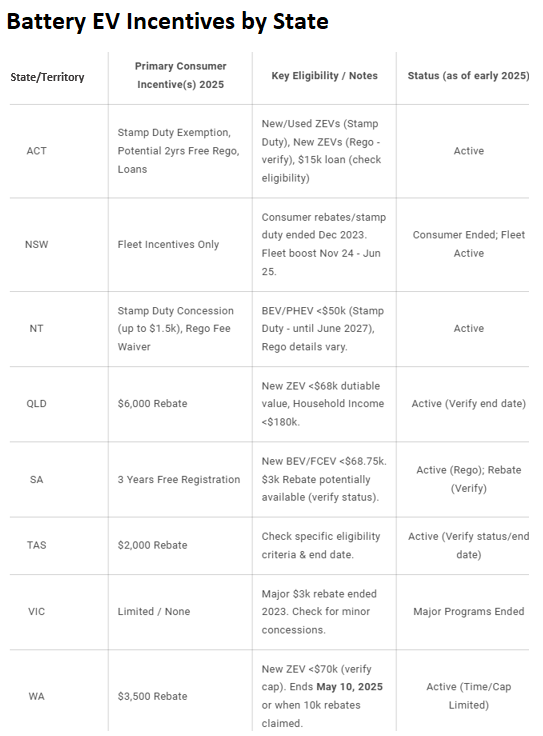
EVs are exempt from road user fees, including the 51.6 cents per litre fuel excise.
With over 300,000 EVs now on Australian roads, the cumulative loss in excise revenue is substantial—estimated to be in the hundreds of millions of dollars annually. This figure will only grow alongside the growth of EVs on Australian roads.
The federal government’s New Vehicle Efficiency Standard (NVES) is also designed to force Australians into buying EVs by taxing new ICE cars out of existence.
Despite the generous carrots and sticks used by governments to force widespread EV adoption, consumer demand remains sluggish.
The Australian Automobiles Association’s (AAA) Electric Vehicles Index for the September quarter of 2025 showed that purchases of EVs (blue line below) are barely higher today than they were three years ago:
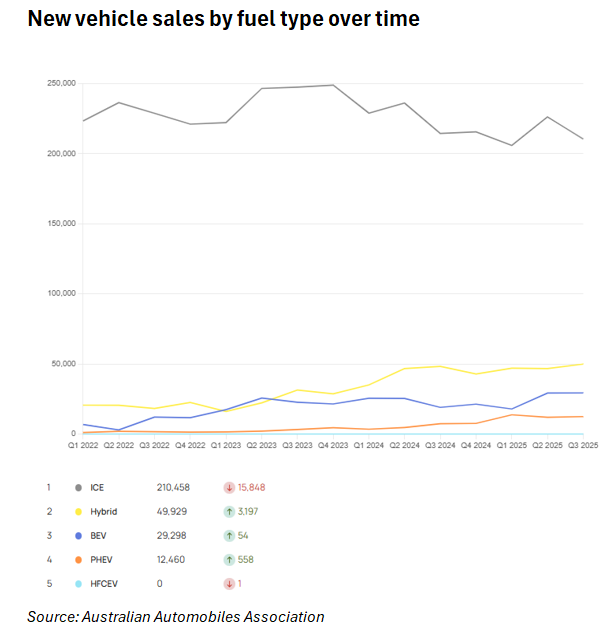
In the year to September 2025, battery EVs comprised only 97,774 out of 1,188,162 total vehicle sales in Australia, a share of just 8.2%.
In comparison, there were 232,105 hybrids sold over the year, a 19.5% share of total vehicle sales.
Australia’s governments should stop wasting scarce taxpayer funds on subsidising private car purchases.
Most of these subsidies benefit wealthy inner-city residents, resulting in billions in lost tax revenues for federal and state budgets, and exacerbating inequality.
Moreover, if EVs were superior to ICE and hybrid vehicles, they wouldn’t need taxpayer subsidies and outright bans on combustion engines, as consumers would choose them because they are a better product.
The EV lobby’s persistent demand for additional subsidies, incentives, tax breaks, and outright bans on ICE vehicles, aimed at “encouraging” people to switch to EVs, is an acknowledgement that EVs cannot compete with ICE or hybrid cars on an equal footing.
It’s time for the government to eliminate all subsidies and let consumer preference and the market decide what cars are purchased.
