
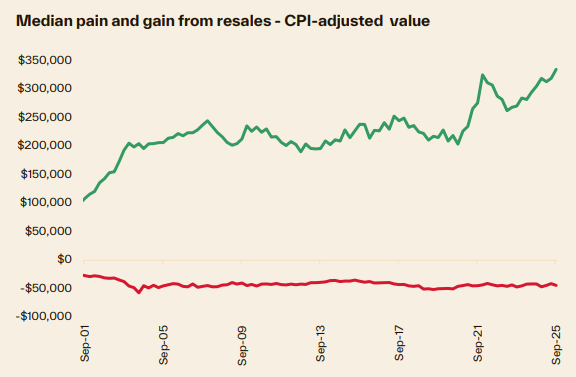
Last week, Cotality released its Pain & Gain Report, which measures gains and losses on established homes sold across Australia in the September quarter of 2025.
Cotality revealed that the September quarter was Australia’s most profitable resale period in two decades.
95.5% of established homes sold nationally in the quarter made a gross profit, with a median gain of $335,000—a record high.
Source: Cotality
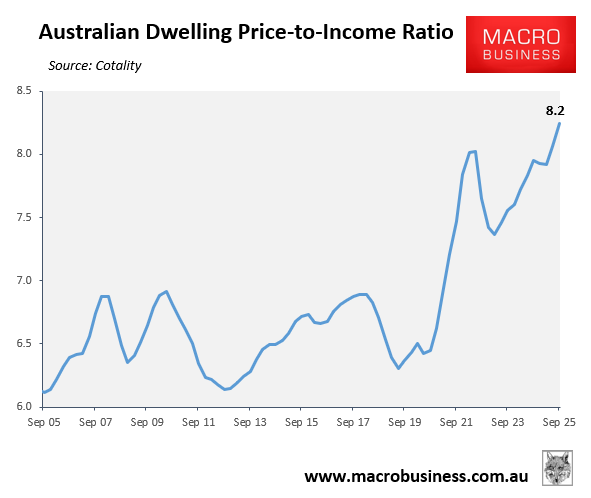
While homeowners have benefited from rising values, those looking to purchase or rent are facing record-low affordability and poor conditions.
The median dwelling value in Australia hit a record high of 8.2 times median incomes in the September quarter, according to Cotality, up from 6.4 at the start of the pandemic.
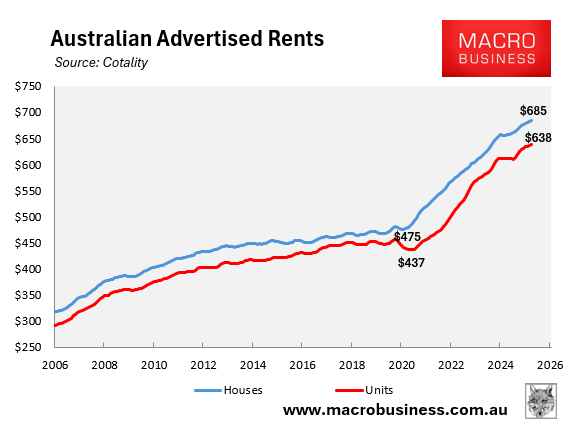
Advertised rents nationally have increased by 44% over the past five years, adding about $10,600 to the annual cost of renting for the median Australian tenant.
As a result, it has never been more expensive to rent a home, with the percentage of income required to meet rental payments on the median home surging to 33.4% as of Q3 2025, up from 26.2% five years earlier.
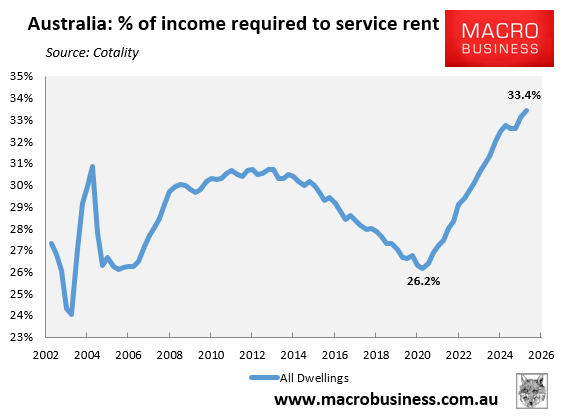
Australia’s housing market has, therefore, become an inequality machine, with homeowners benefiting from soaring wealth, while prospective buyers and renters are facing record unaffordability.
Who is really better off?
Aside from investors, who really benefits from forever rising prices?
Sure, while the median profit on resale was a record high of $335,000 in the September quarter of 2025, for anybody upgrading or downgrading to another home, these paper profits are worthless because one buys and sells into the same market.
So, while a typical vendor made a handy nominal profit from selling in the September quarter, they will have to pay a higher price (and stamp duty) on the next home that they purchase.
In this regard, Australia’s 25-year property price boom has delivered trillions of dollars of home equity but little in the way of actual tangible wealth.
A home holds the same purpose and utility whether it is valued at $200,000 or $1 million. Its primary purpose—shelter and stability—is the same.
However, the surge in home values and rents is a disaster for those who are seeking home ownership or are currently renting. They will have to dedicate a significant portion of their income to servicing mega-mortgages and rents.
Affordability outlook remains bleak:
The outlook for housing affordability remains bleak.
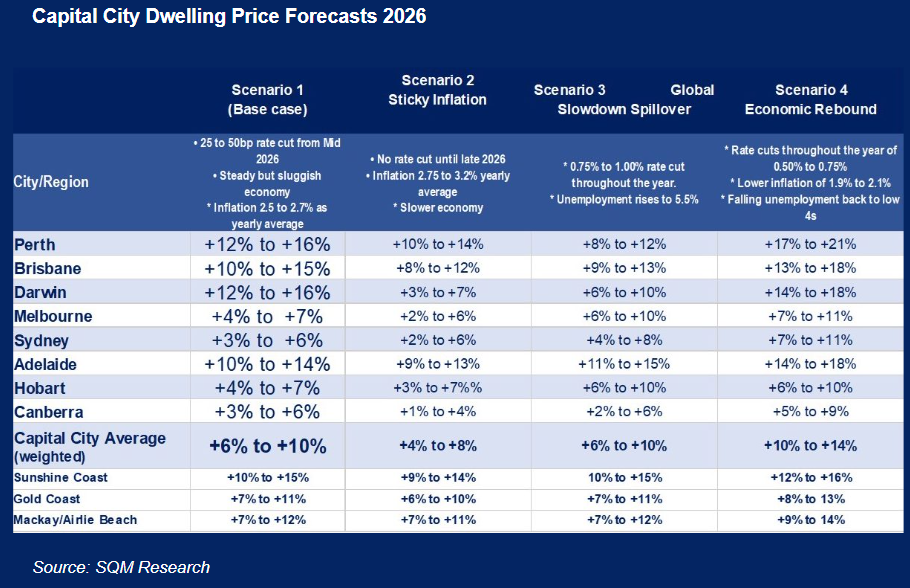
SQM Research forecasts solid house price growth in 2026, while the RBA is expected to keep interest rates on hold for the foreseeable future.
The REIA has also published similar price forecasts for 2026:
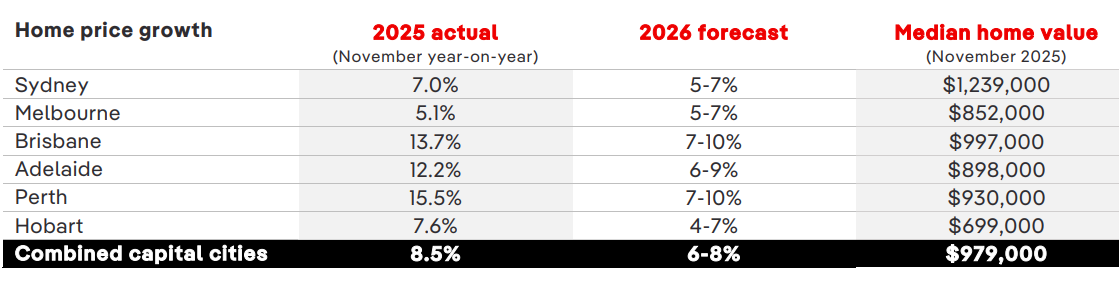
Source: REIA
Meanwhile, Cotality has reported record low rental vacancy rates and rising advertised rents.
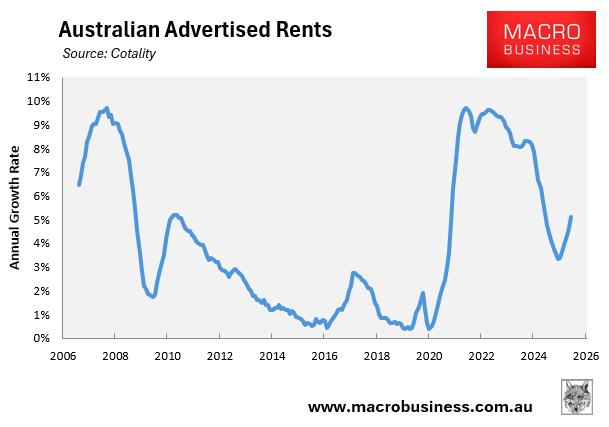
Such conditions will ensure that life becomes even more difficult for prospective home buyers and renters in 2026.
I discussed these issues in the weekly Treasury of Common Sense on Radio 2GB/4BC:
