
Victoria has legislated a target to source 95% of its electricity from renewable energy by 2035. This is one of the most ambitious renewable energy goals in Australia and globally, designed to accelerate the state’s transition away from cheap brown coal and toward cleaner energy sources, such as wind, solar, and storage.
The target is embedded in the Renewable Energy (Jobs and Investment) Act 2017 (Vic), giving it legal force. The following timelines have been set to reach the 95% renewable energy target:
- 25% renewables by 2020
- 40% by 2025
- 65% by 2030
- 95% by 2035
The target coincides with the planned closure of the Loy Yang A coal power station in 2035, a decade earlier than originally scheduled.
While the policy aims to deliver cleaner, cheaper, and more reliable electricity over time, this is an impossible goal.
Since renewables are unpredictable, intermittent, and have low capacity factors, Victoria would need to build massive extra capacity, redundancy, and storage to ensure a consistent supply to meet demand.
Victoria’s energy system is also compromised by the fact that the state experiences cold winters, suffers from short days, and is prone to extended periods of wind drought. As a result, solar and wind power are far less effective, making the state reliant on stable sources of power or imports from interstate.
Regardless, the costs of meeting Victoria’s 95% renewable energy target, were it even possible, would be enormous, driving up retail power bills and taxes (via subsidies).
Indeed, the AFR reported in June that Victorian energy users face a 50% increase in electricity bills to pay for the rollout of transmission lines to support the state’s 95% renewable energy target:
The total cost to households and businesses for the upgrade to Victoria’s electricity grid, required to support the shift to renewable energy, will be more than four times the $4.3 billion figure set out in a transition road map unveiled last month.
Experts say the bill for building the network of poles and wires is likely to be more than $20 billion…
“This is a bit over five times the total regulated value of Victoria’s existing transmission network”, [Professor Bruce Mountain, the director of the Victoria Energy Policy Centre said].
The cost of building and maintaining poles and wires are recouped via consumer energy bills, which Mountain said would rise by about 50% or more under the plan.
AusNet’s Transmission Revenue Reset Proposal 2027-2032 warns that power bills will rise significantly to pay for network upgrades to meet renewable energy integration, electrification, and decarbonisation goals.
AusNet’s revenue proposal sets out the maximum allowed revenue it can recover from transmission customers. This is based on forecast expenditure, return on capital, depreciation, and operating costs.
AusNet has revealed that it will need to spend $2.4 billion on upgrading the state’s network between 2027 and 2032 to reduce the risk of blackouts. This will add an average of $52 a year to household energy bills and $129 to small businesses.
However, AusNet’s capex is only the tip of the iceberg. Extra capital spending outside of AusNet’s remit includes $7.9 billion for new VicGrid projects and $11.1 billion in federal upgrades, which will build high-voltage lines and other transmission systems needed to plug in renewable energy.
These expenditures will be added to the regulatory asset base and will be recovered from retail power bills, as illustrated in the following chart:
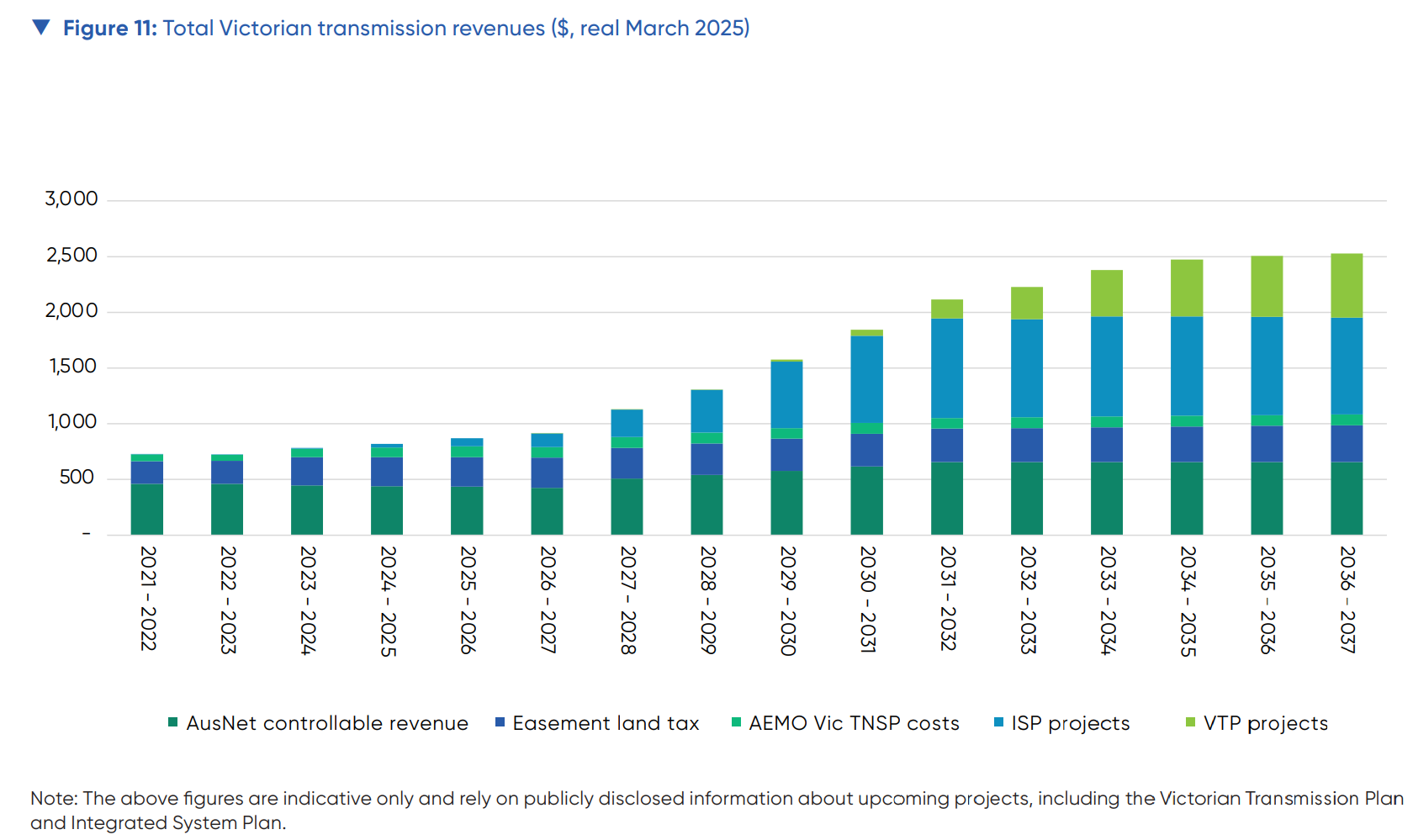
As you can see, the maximum revenue that will be recovered from transmission customers is forecast to roughly triple in real terms between now and 2036-37.
Policymakers should stop obfuscating and be upfront about the significant costs and trade-offs in Australia’s renewable energy transition.
