
Last month, former Sunrise host David Koch told Sydney radio presenter Ben Fordham that young Sydneysiders should adjust their lavish lifestyles if they want to enjoy the same housing benefits as their parents.
They “don’t have a cost-of-living issue, they have a cost-of-lifestyle issue”, Koch claimed. “You’ve gotta give things up, you’ve gotta sacrifice things to build your deposit”.
David Koch wrote an article in the Daily Mail, admitting that Australia is experiencing a housing crisis:
“Back in the 90s, the average loan size in Australia was $67,000. It’s now nearly 10 times that amount at $637,000 or more if you want to live in the capitals”.
“But the housing crisis isn’t just about unaffordable prices – it’s about supply shortages, regulatory constraints, and the growing gap between wages and property values”.
“A key difference between the 90s and now is that average mortgage size has risen six times faster than wages”.
Koch proposes five big solutions, namely:
- Negative gearing reform.
- Make room for medium-density.
- Reforming zoning regulations and encouraging higher-density developments in well-serviced areas.
- Prefabricated homes.
- Do away with rubbish demand-side policies that push up prices (e.g. first home buyer grants).
While some of these policies are worthwhile, Koch has conveniently neglected to mention the giant elephant in the room: significantly cutting immigration.
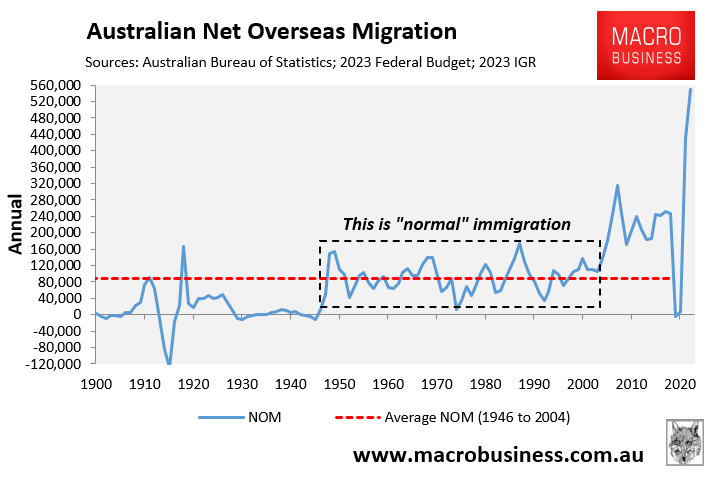
The primary reason why Australia has a structural shortage of housing is because net overseas migration was more than doubled in the mid-2000s:
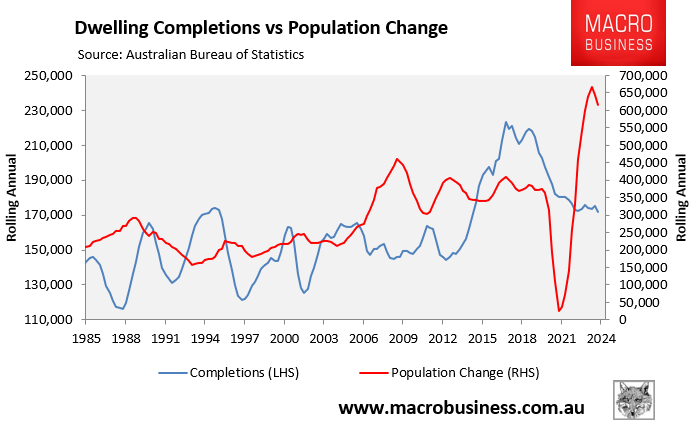
As a result, housing demand has outpaced construction, as illustrated below:
MB’s own David Llewellyn-Smith tore David Koch apart in an interview with the Daily Mail.
“[His points] are the classic case of the Australian media trying to find answers to support the unsupportable, sustain the unsustainable”, DLS told Daily Mail Australia.
“To pretend to fix the problem while keeping the Ponzi party going”.
“Which one of David Koch’s solutions is actually going to make housing more affordable for first-home buyers?”
“None of them. Some of them briefly but none of them for any enduring period”.
“Why isn’t David Koch talking about demand? Why doesn’t anyone in the media talk about demand? Why is immigration off the agenda?”
“Would prices fall at this stage if we reduce negative gearing? It might help keep a lid on growth for a while but as long as you sustain the demand-side pressure, it’s never going to fix it”, DLS said.
Daniel Wild, the deputy executive director of the Institute of Public Affairs think tank, also ripped into Koch for ignoring the immigration elephant.
“David Koch typifies the out of touch, wealthy elites of Australia who refuse to acknowledge that out of control and unplanned mass migration is the driving force of our nation’s housing affordability crisis”, he said.
“Australians do not want to live in high-density apartments”.
“They want to live in proper, detached houses, where they can raise families and build roots in the local community”.
“This has been a foundation of the Australian way of life”. Wild said.
High immigration is especially detrimental to would-be first home buyers for two reasons.
- It drives up the cost of renting, making it harder for first home buyers to save a housing deposit.
- It drives up house prices, pushing home ownership further out of reach.
Significantly cutting immigration to sensible and sustainable pre-2005 levels would do far more to improve housing affordability for first home buyers than the proposals put forward by Koch.
Moreover, lower immigration would reduce the need for future Australians to live in cramped high-rise shoe boxes.
