
Immigration minister Andrew Giles has announced nearly 10,000 more skilled migrant spots for the states, in the process making the ‘skilled’ visa system even less skilled.
“Our approach is fairer and will get the skilled workers our country needs, turning the page on a decade of a broken system”, Giles claimed.
“The Albanese government is ensuring skilled workers can bring their knowledge and skills to areas across the country that need it the most – without contributing to further backlogs, delays, and waitlists”.
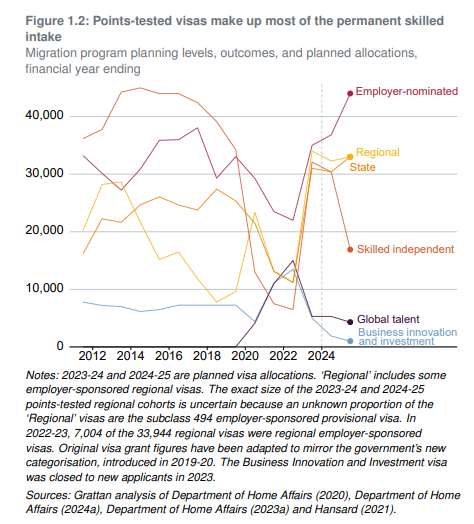
As illustrated in the next chart from the Grattan Institute, state and regional points-tested visas currently account for approximately two-thirds of all points-tested visas (see below chart).
However, as illustrated below, migrants from these two visa streams tend to work in lower-skilled occupations and earn significantly less than employer-sponsored visas:
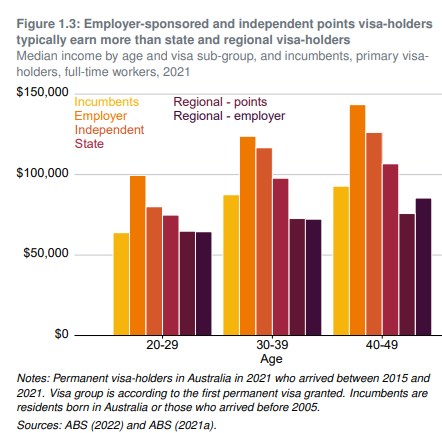
Thus, by increasing the allocation of ‘skilled’ visas to state nomination, Labor has effectively dumbed down the skilled visa system.
Labor instead should have cut the overall allocation and significantly increased the share going to employer-sponsored visas, since they have by far the best labour market outcomes in terms of employment rates, participation, and earnings.
Skilled migrants nominated through employer-sponsored visas already have jobs lined up or are already temporary migrants working in jobs in Australia. Therefore, they have good labour market outcomes and have generally already proven themselves.
The pay floor for these employer-sponsored migrants should then be set at a rate higher than the median full-time salary (~$90,000 currently).
As an aside, the above chart from the Grattan Institute is misleading because it makes out that skilled migrants earn more than they actually do, while understating the earnings of incumbent residents.
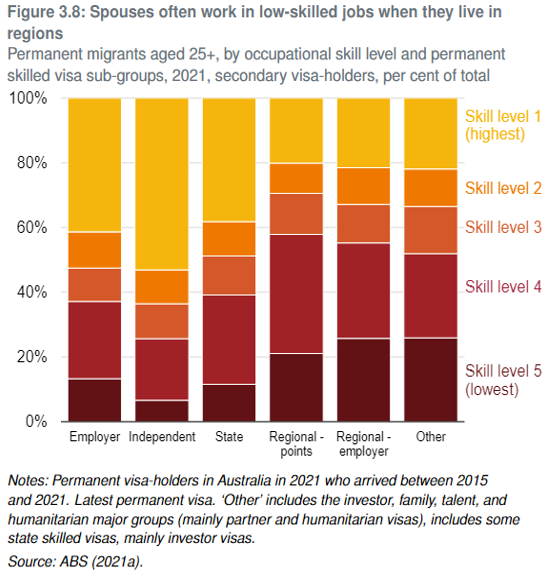
First, the above chart only shows primary skilled migrants and not their spouses, who lend to work in lower skilled jobs and get paid much less:
Second, Grattan has compared the median full-time earnings of primary permanent skilled migrants against the median earnings of incumbent Australians, which includes unskilled workers.
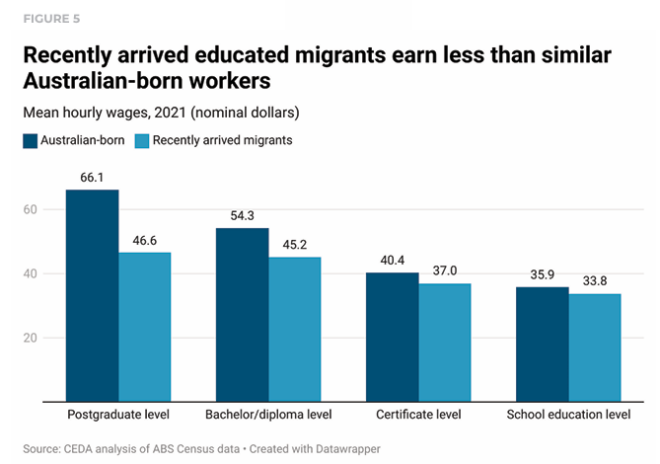
If Grattan had instead compared skilled permanent migrants against skilled incumbent Australians, it would have found that skilled permanent migrants actually get paid more than 10% less than incumbent skilled Australian workers.
This was shown in research from the Committee for Economic Development of Australia (CEDA), which also found that higher-educated migrants have the largest shortfall in earnings compared to skilled Australian workers:
CEDA’s research also found that “migrants have become increasingly likely to work in lower productivity firms”.
The above data highlights why Australia’s permanent skilled visa system should transition to a high wage employer-sponsored system.
Economic benefits would be maximised through Australia having a smaller volume of highly skilled migrants, not large volumes of moderately skilled migrants.
Sadly, the Albanese government has opted for volume over higher quality.
