
Westpac with the note.
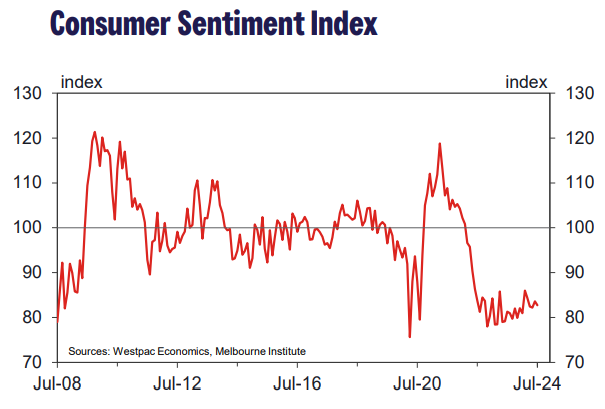
Sentiment remains stuck in the same deeply pessimistic range that has dominated for two years now.
The July update shows that fears of persistent inflation and further interest rate rises are again weighing more heavily on the consumer mood, offsetting any boost from the arrival of the ‘stage 3’ tax cuts and other fiscal support measures.
While these measures came into effect from July 1, many consumers would not have seen any cash flow impacts so far given that payment cycles – for both incomes and for the electricity and rent expenses set to receive more cost of living support – are often fortnightly or monthly.
The component indexes show the latest sentiment dip centred around family finances.
The sharpest fall was in the ‘family finances vs a year ago’ sub-index, which dropped 8.4%, giving back almost all last month’s promising 9.7% lift.
At 63.5, the sub-index remains at extremely weak levels.
Consumer expectations for their finances also deteriorated. The ‘family finances, next 12 months’ sub-index declined 4.5% to 92.1, the weakest read since the end of last year.
On a combined basis, the two sub-indexes tracking finances declined to their weakest level since November.
Other components improved slightly, with consumers a little less pessimistic about the economic outlook and around attitudes towards spending.
The sub-index tracking assessments of the ‘economic outlook, next 12 months’ rose 3.6% to 81.4, while the ‘economic outlook, next 5 years’ sub-index nudged up 0.5% to 94.5. The ‘time to buy a major item’ sub-index lifted 3.1% to 82.1 but remains well below its long-run average of 124.
The most striking move in the month was again around consumer views on the interest rate outlook.
The Westpac–Melbourne Institute Mortgage Rate Expectations Index tracks consumer expectations for variable mortgage rates over the next 12 months.
It jumped 12.8% in July, marking the steepest monthly rise since we began running this question in every survey at the start of 2022.
The Index has surged 30% in just three months, from a below-average read of 122.8 in April to 159.2 in July (the average historically is 143.8).
That sudden hawkish turn is the sharpest we have seen in the last seven years.
The detailed responses show about just under 60% of consumers expect mortgage rates to rise over the next year.
Sub-group responses provide an interesting perspective on how the shifting interest rate view impacted sentiment in the latest month.
The July sentiment decline was most pronounced amongst middle income earners, Victorians and those employed in the hospitality and construction sectors.
Sentiment amongst consumers with a mortgage actually posted a solid 6.5% rise in July but was coming off a bigger 7.6% decline over the previous three months.
The message here seems to be that the main concern in July was around how high inflation and rising interest rates may impact parts of the economy that are already struggling.
Consumers are still relatively untroubled about job security.
The Westpac–Melbourne Institute Unemployment Expectations Index improved marginally, declining 3.3% to 128.6 in July (recall that lower index reads mean fewer consumers expect unemployment to rise over the year ahead).
Overall, sentiment around jobs is close to its long run average levels – consistent with subdued but stable labour market conditions rather than a sharp weakening.
The shift in interest rate expectations has had little impact on how consumers are assessing the housing market, with buyer sentiment still bumping around weak levels and price expectations still relatively upbeat.
The ‘time to buy a dwelling’ index rose 4% to 75.7, reversing most of the decline seen in June. The index continues to bump around extreme cycle lows.
By state, buyer sentiment is a little less downbeat in NSW (averaging 78.6 over the last three months) but much weaker in Western Australia (averaging 67.2) and South Australia (averaging 62.7).
The Westpac Melbourne Institute Index of House Price Expectations declined 1.6% to 161.2, unwinding June’s small gain but remaining at a high level overall. At 161.2, the index remains close to the peaks in early 2021.
Interestingly, despite much weaker homebuyer sentiment, consumers in Western Australia and South Australia are still more bullish on the price outlook, with state index reads tracking above 170.
The Reserve Bank Board next meets on August 5–6.
While we still expect the Board to remain on hold at this meeting and the next, this view is contingent on inflation continuing to decline broadly in line with our (and the RBA’s) expectations.
The June quarter CPI release and labour market data will be important inputs into the Board’s near-term decisions.
The weekly ANZ version was not much better.
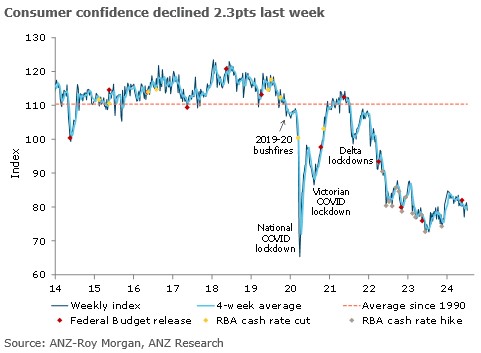
ANZ-Roy Morgan Aus Consumer Confidence fell 2.3pts to its second lowest level for the year, dragged down by a 9.0pt fall in the ‘time to buy a major household item’ subindex.
It’s lights out for the consumer if the RBA hikes again.
The jawbone should be enough.
