
Aussie interest rate hawks need to calm down
Economist Stephen Koukoulas has been ridiculed for making the common-sense claim that “base effects” drove the big jump in the May CPI indicator, and that these same “base effects” will likely cause inflation to fall sharply over the coming months:
I am sure #Insiders will note the monthly volatility in the monthly inflation data and note how the base effects will see annual inflaiton fall below 3% in the next few months
ICYMI https://t.co/sReNYYPzwd— Stephen Koukoulas (@TheKouk) June 29, 2024
The “base effects” that Koukoulas speaks of are illustrated in the following chart plotting the monthly CPI indicator over the 13 months to May:
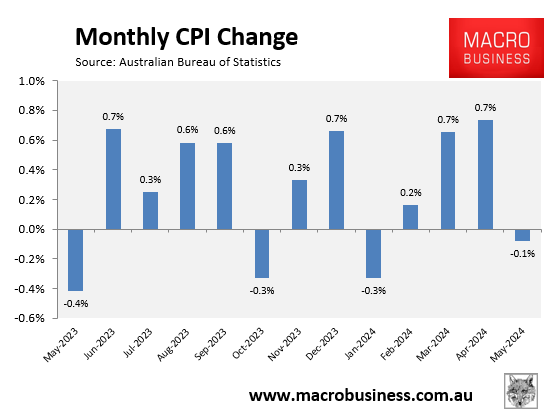
As you can see, inflation fell by only 0.1% in May 2024 compared to a 0.4% decline in May 2023, which led to the sharp increase in the CPI indicator.
As a result, annual CPI inflation jumped by 0.3% to 4.0%.
However, June will see last year’s large 0.7% reading drop out, which will be repeated in August and September when two consecutive large 0.6% readings roll off.
Therefore, as noted by Koukoulas, over 2.2 points of inflation will be replaced by something lower over the next four months, pulling annual inflation back towards the RBA’s target.
In any event, the RBA will receive two retail sales prints, the June labour force survey, and the all-important Q2 quarterly CPI release before its next board meeting in early August.
As such, the inflation picture could easily change between now and the next RBA meeting.
So, while the inflation picture undoubtedly soured a little following last week’s May CPI indicator print, the media’s incessant fearmongering over inflation and rate hikes seems way overdone.
Further rate hikes from the RBA are by no means a done deal, with the majority of economists still tipping rates to remain on hold this year before cuts arrive in 2025.
