
By Gareth Aird, head of Australian economics at CBA:
Key Points:
- We expect the RBA Board will leave the cash rate unchanged next week in a straight forward decision.
- The Q1 24 national accounts and recent labour market data were largely in line with the RBA’s latest economic forecasts.
- The June Board meeting comes in the wake of the 2024 Federal Budget, which was a little more expansionary than anticipated. But we do not think the Budget has shifted the dial on the RBA’s assessment of the economic outlook.
- RBA Governor Bullock stated that she does not think the $300 energy bill relief will have, “a material impact on reducing (underlying) inflation, but it is also unlikely to make inflation worse”.
- We anticipate the RBA Board welcomed the Fair Work Commission’s June decision to increase the award wage by 3.75% in 2024 (i.e. the risk sat with a higher number and we think the Board will assess wages dynamics to be moving in the desired direction).
- We expect the Statement accompanying the decision to reiterate that the Board “is not ruling anything in or out”.
- The RBA puts much more weight on the quarterly CPI than the monthly CPI indicator. As such, we consider the next potentially ‘live’ meeting to be the August Board meeting (to be held the week after the Q2 24 CPI prints).
A straight forward decision once again and a likely similar statement to the May Board meeting:
The RBA Board meets next week. We expect the cash rate will be left on hold in what should be a straight forward decision.
The recent run of key economic data has largely been in line with the RBA’s forecasts from the May Statement on Monetary Policy (SoMP).
The Q1 24 national accounts confirmed that economic growth has ground to a halt. More specifically, real GDP grew by just 0.1%/qtr in the March quarter.
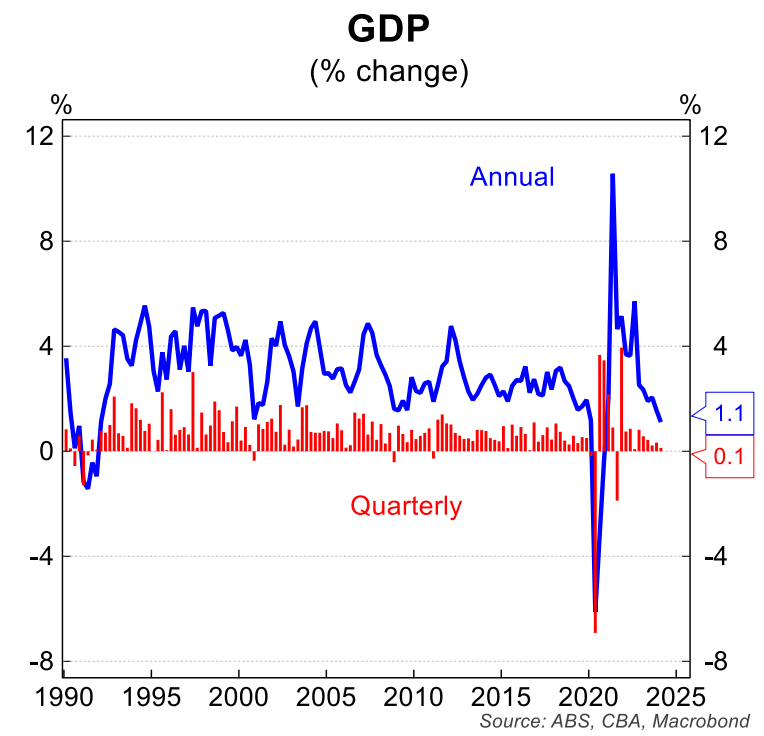
And the six month annualised pace of GDP growth to Q1 24 fell to 0.8%. This compares with population growth of 2.4%/yr. The upshot is that the economy has contracted a lot in per capita terms.
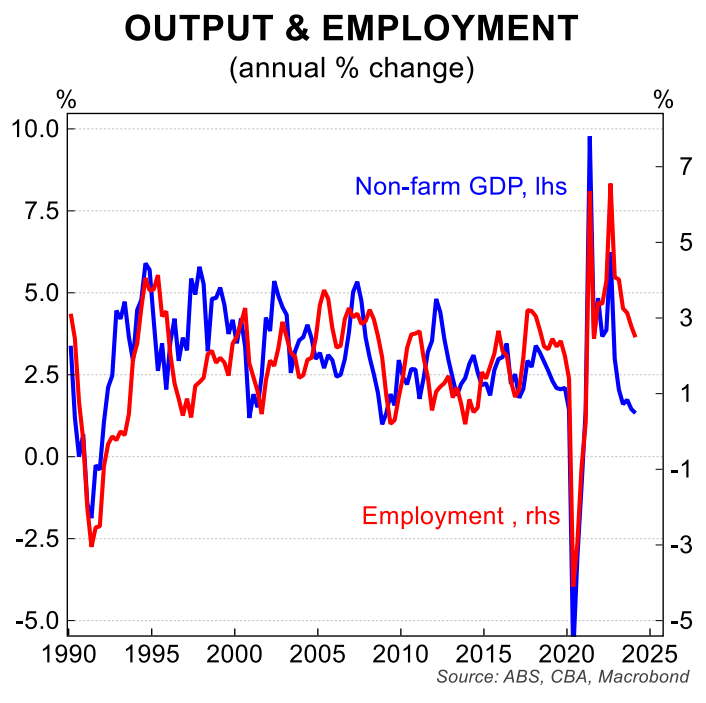
Well below trend GDP growth will lead to an increase in the unemployment rate and a loosening in the labour market more generally. But that picture is taking a little longer than we anticipated to emerge in the monthly ABS labour force survey.
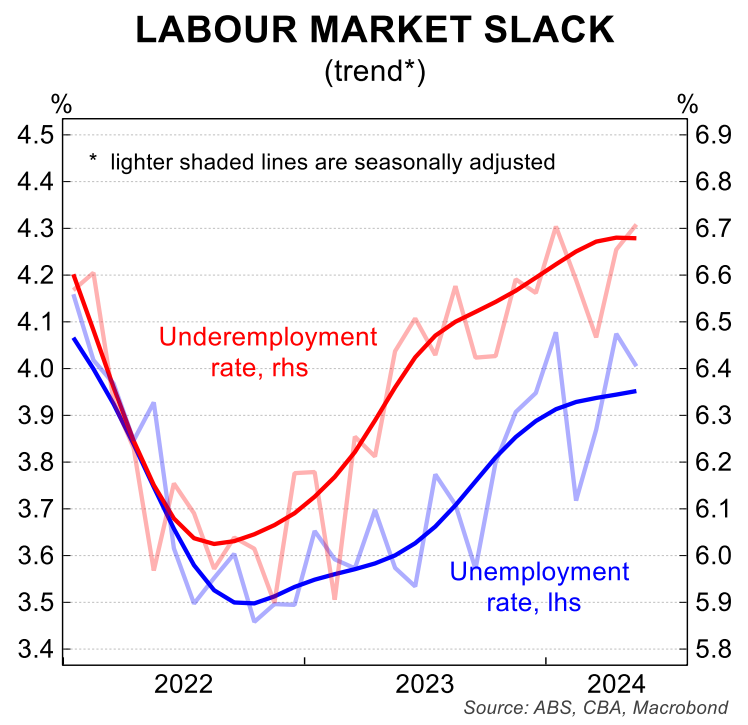
Notwithstanding, the labour market is loosening on all key measures. Trend unemployment and underemployment are on a gradual upward path. Hours worked is weak. And job advertisements are on a clear downward trend.
There have been two monthly labour force surveys since the RBA Board met in May. The data is choppy month to month. But overall the track of the unemployment rate is broadly evolving in line with the RBA’s latest forecast.
For context, the RBA forecasts the unemployment rate to average 4.0% over Q2 24. So far the unemployment rate has averaged 4.04% over the first two months of the June quarter.
Put simply, there is nothing in the recent labour market data that would influence the RBA to change their tune in either direction on the policy outlook at the upcoming Board meeting.
Governor Bullock stated in a parliamentary committee meeting on 5 June that the RBA point estimate for the non-accelerating inflation rate of unemployment (NAIRU) is 4.3%. But there is a wide range of uncertainty over that estimate.
The RBA’s forecasts put the peak in the unemployment rate at 4.3% over the current forecast horizon (which extends to Q2 26). So the RBA does not expect the unemployment rate to rise too much further from its current level.
In contrast, we see the unemployment rate climbing to ~4.5% by end 2024.
Our expectation for a more material loosening in the labour market relative to the RBA’s forecasts is a key reason why our base case sees the RBA commence an easing cycle in late 2024. But given the challenging underlying inflation backdrop and a shortening runway between now and November, the risk to our call is increasingly moving towards a later start date for an easing cycle.
The 2024 Commonwealth Budget:
The RBA is reluctant to comment on fiscal policy for the obvious reasons. But in the Governor’s recent parliamentary testimony Michele Bullock was asked about the Commonwealth Government’s $300 energy bill rebate, which was new policy announced in the 2024 Budget (i.e. it was announced after the May Board meeting).
The Governor stated that the $300 energy bill relief will not have a “material” impact on reducing inflation, but is also unlikely to make inflation worse.
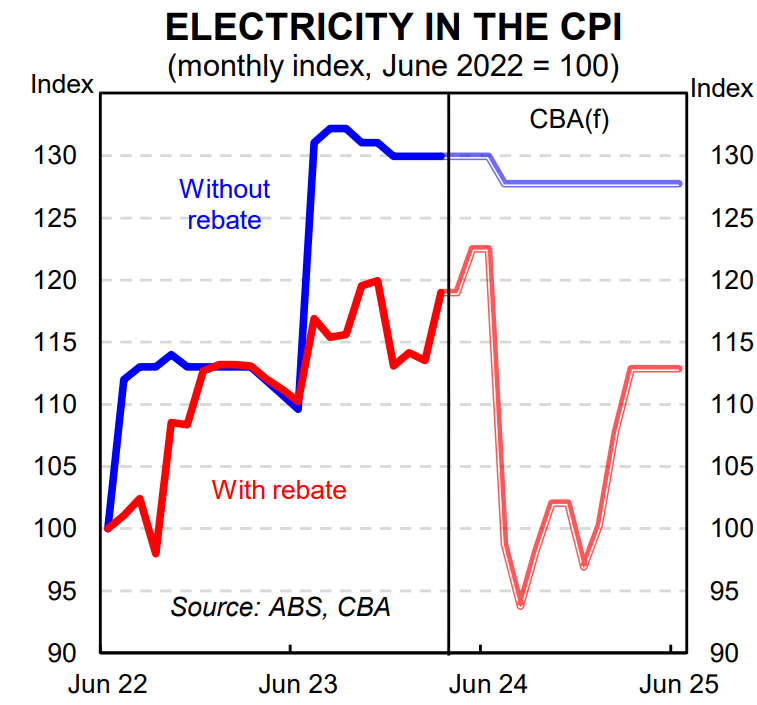
My colleague Stephen Wu calculated that the combined impact of the Commonwealth and State Government electricity rebates will shave two-thirds of a percentage point off Q3 24 CPI. This is clearly ‘material’. But the RBA is more focused on the underlying pulse of inflation, which will strip out the impact of the energy rebates.
On that score, the Governor does not consider the rebates to have shifted the outlook for consumer demand or inflation. Indeed the Governor stated, “If you think about the $300, or the $75 a quarter, off your electricity bill, are people going to go out and spend big on that? I really don’t think so. It is different than giving someone $300 and saying, ‘Here’s $300.’ I think, at the margin, it’s not really going to have much impact in the second-round sense …….. I think psychologically, they (i.e. people) think of that differently”.
We very much agree on the spending front. And we take the view that the mechanical lowering in headline inflation from Q3 24 due to rebates will help to lower near term inflation expectations for households and businesses. This in turn will help to anchor wages expectations over 2024/25.
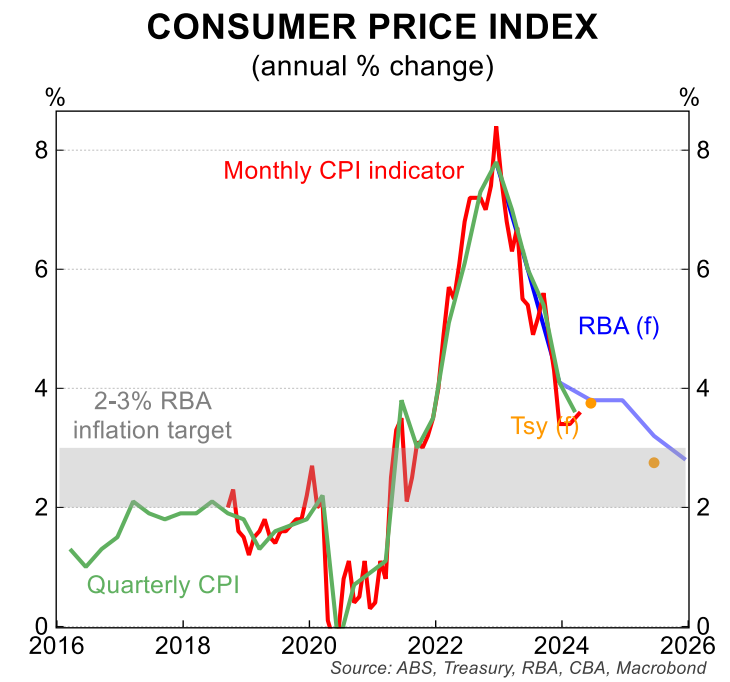
Here we note that on our forecast profile headline inflation will be within the RBA’s 2-3% target band from Q3 24.
Of course given the RBA’s focus on underlying inflation all eyes will be on the Q2 24 CPI, which prints in late July (i.e. the week before the August Board meeting).
At this stage our forecast for trimmed mean inflation in Q2 24 is 0.8-0.9%/qtr. We believe such an outcome would be sufficient for the RBA to leave the cash rate on hold. But a core print stronger than our forecast would test the RBA’s resolve to not tighten policy further.
The 2024 Fair Work Commission (FWC) decision:
The other key economic development since the May RBA Board meeting was the 2024 FWC decision. The FWC decided that award rates of pay will be increased by 3.75%, effective from 1 July 2024. The national minimum wage has also been increased by 3.75%.
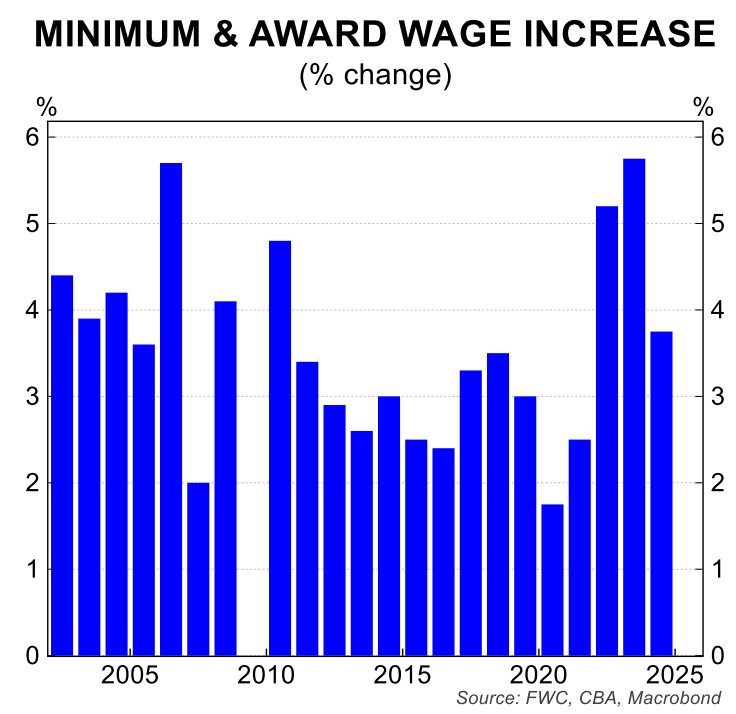
We had expected an outcome of ~4.0% for the increase in the 2024 award wage. And we suspect the RBA would have had a similar outcome in mind based on its forecasts for the wage price index.
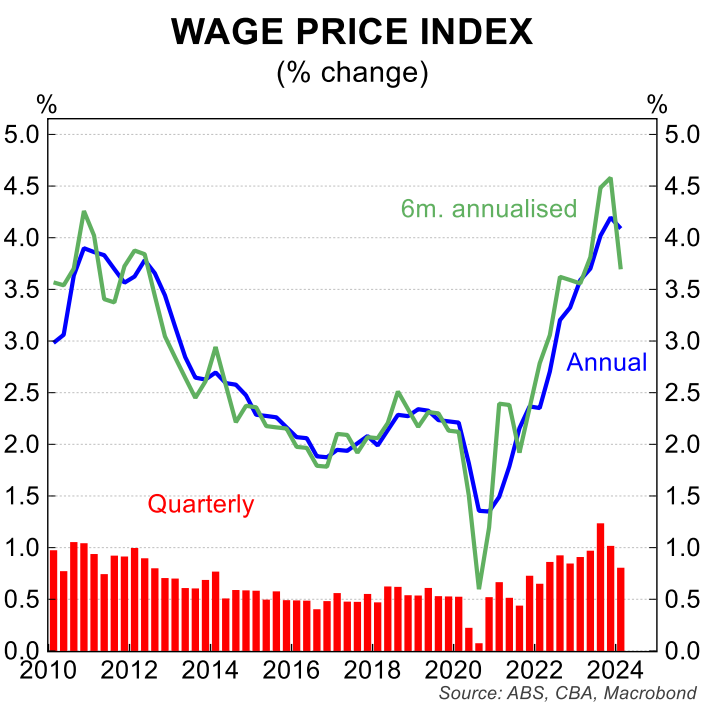
As such, we think the RBA Board will have welcomed the FWC decision behind closed doors. The wages story in Australia should not be a problem for the Board in restoring inflation back to the target band provided that productivity growth lifts.
Our expectation is that productivity growth will lift over the period ahead due to the significant business investment undertaken over the last few years (with more to come). Business investment lifts capital deepening (where the capital per worker is increasing in the economy).
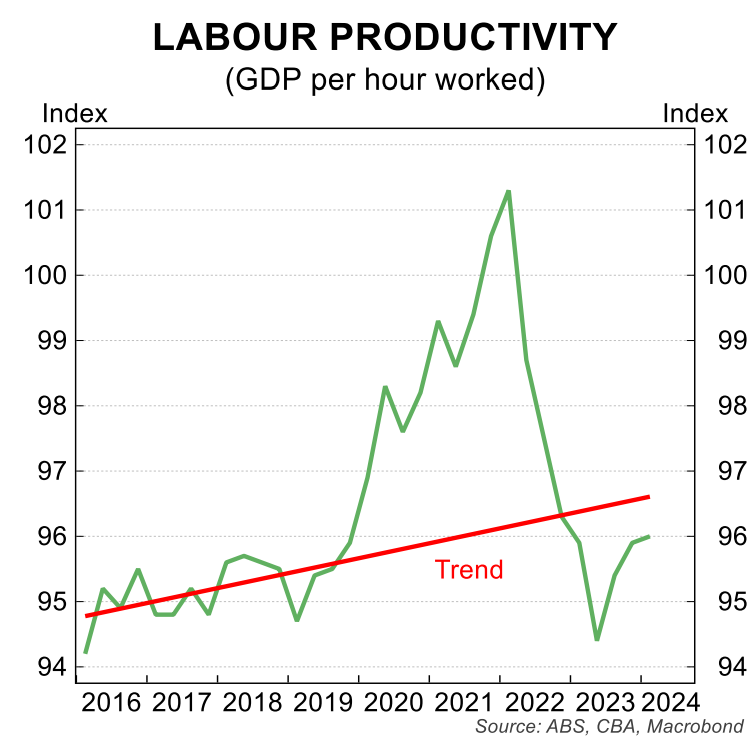
In turn, this improves measured productivity (output per hour worked). But the process takes time.
It is worth noting on the wages front that the Q1 24 wage price index was 0.8%/qtr, which was a touch below the RBA’s expectations.
The RBA is therefore likely to downwardly revise its forecast profile for wages growth in the August SoMP.
Finally, it is worth considering that when the 2025 FWC decision is handed down the annual rate of headline inflation on our forecast profile will be ~2¾% (i.e. around 1.0ppt lower than the 3.6% rate of inflation when the 2024 FWC decision was delivered). This we believe will likely see a lower outcome for the 2025 award wage decision relative to the 2024 decision.
Neutral bias to be retained in the Statement:
We expect the RBA to maintain a neutral bias in the Statement accompanying the Board decision. More specifically, we expect the line to be retained from the May Statement that, “the path of interest rates that will best ensure that inflation returns to target in a reasonable timeframe remains uncertain and the Board is not ruling anything in or out.”
And we anticipate the Governor’s press conference will strike a very similar tone to the May conference.
