Godman with the note.
This year’s US presidential election is still almost six months away.
But the first debate, now scheduled to take place in less than a month (three months earlier than usual), may increase focus on the election and provide fresh clues as to how the market is viewing its impact on asset markets. Ahead of this, and the summer convention season, we update our views around the potential asset market impacts of the main election outcomes.
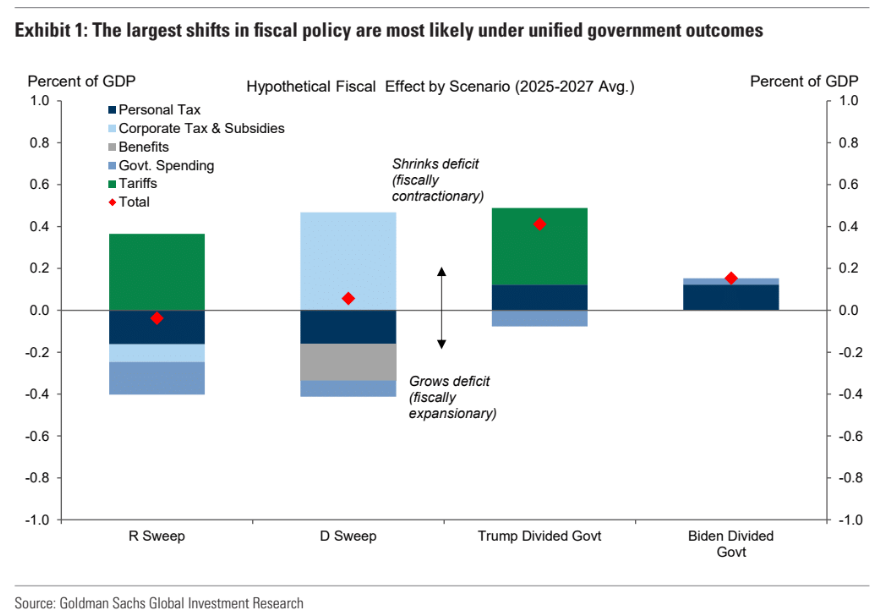
We focus on the likely impacts from shifts in fiscal, tax, and trade policy. Unified government control is likely to generate the most positive fiscal impulse, while divided government is likely to lead to more fiscal restraint—but in all scenarios, the likely fiscal effects in each scenario are much smaller than in 2020, and so the market’s potential reaction to proposed tariffs may be the biggest swing factor.
At this stage, our baseline scenarios predict 1) a modest rally in equities, higher yields, and USD strength in a Republican sweep, 2) modest equity downside, higher yields, and USD weakness in a Democratic sweep, 3) modest equity downside, slightly higher yields, and USD strength in a Trump with divided government outcome, and 4) equities flattish, lower yields, and USD weakness in a Biden with divided government outcome.
If fiscal proposals wind up being larger, or the market reacts more intensely to tariff proposals then these outcomes could be quite different.
Other potential policy shifts that we do not explicitly consider here (geopolitical tail risks, Fed risks) may also broaden the asset impacts.
Given the uncertainty around these reactions, a Republican sweep may not reliably follow the asset footprint seen in 2016.
We still see a stronger USD as the most reliable impact of a potential Republican victory because it is the most consistent response to tariff risks.
Higher yields are more likely in either “sweep” outcome than in divided government outcomes.
Our baseline estimates do not make a strong case for hedging equity exposures, but there are scenarios that could generate more significant equity pressure.
Because FX and rates impacts vary across different potential risk scenarios positioning for deep equity downside directly may still offer the most efficient protection for long risk portfolios.
The challenge for positioning for or hedging against election outcomes is that the election itself is still some time eaway.
But market focus could pick up ahead of that point.
Volatility in many parts of the market remains quite low by historic standards, and even lower still ahead of the October/November period.
We think that presents opportunities to look at positioning for increased focus in the election through the summer and beyond.