
Developer lobby: immigration behind Australia’s housing shortage
The Urban Taskforce has said the quiet bit out loud, admitting that immigration has outstripped the building of new homes for decades.
According to an Urban Taskforce examination of Australian Bureau of Statistics (ABS) data, reported in the Daily Telegraph, the population of New South Wales increased by about 1.5 million people in the 15 years preceding Covid, with more than one million overseas migrants migrating to the state.
However, over the same time period, 688,000 additional homes were built, with low deliveries compounding over decades to produce the current housing supply crisis.
Since the onset of Covid, skyrocketing immigration has contributed to 99% of population increase in NSW, with more than 186,000 people added last year alone.
“It should have been obvious that if you massively increased migration, you will need more housing”, Urban Task Force chief executive Tom Forrest said.
“The housing supply and affordability crisis is real, and is getting worse”.
Australia’s population growth ramped up in the mid-2000s, when the federal government more than doubled the migration intake.
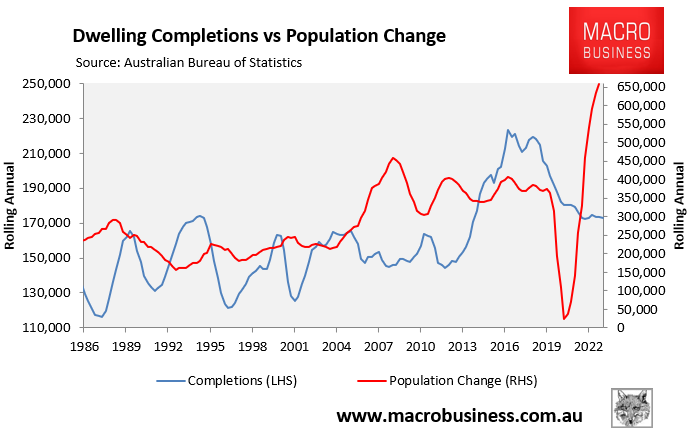
Ever since then, Australia has been unable to build enough homes for its ballooning population.
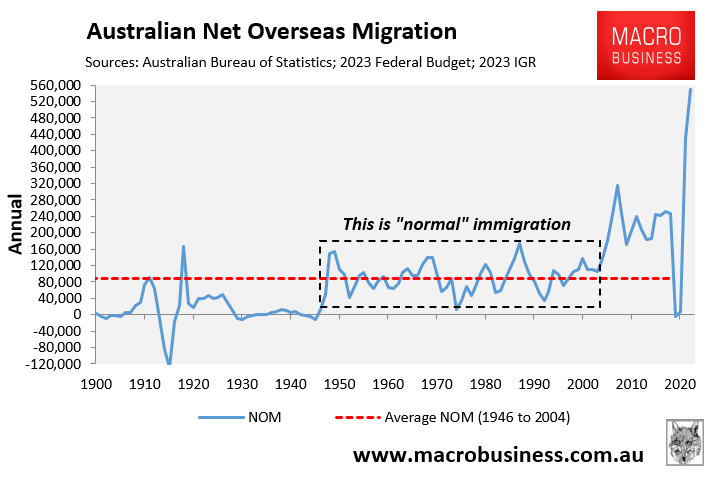
Hilariously, instead of advocating for a reduction in net overseas migration to sensible and sustainable historical norms of around 120,000 net migrants a year, Tom Forrest says that demand must not be tinkered with and we just need to magically build more homes.
“The focus must be on creating more housing supply rather than tinkering with demand”, he said.
“There is no one silver bullet that will solve this challenge, Governments need to be using all policy leavers, from housing types to investment in enabling infrastructure” .
“Currently, with costs so high for developers and borrowing capacity diminished for buyers it’s very hard to make many projects feasible. Developers can’t start a project if the outcome is them going broke”.
“Supporting growth where there is existing infrastructure is the key to speeding up delivery times, our … housing targets will see more than 80 per cent of new homes to be delivered at infill areas over the next five years”, Forrest said.
So, “all policy levers” need to be used, so long as it does not involve the easiest, fastest, and most sensible lever of cutting net overseas migration to historical levels? Okay Tom.
Why is it that the fundamental law of supply and demand never applies to conversations about Australia’s housing shortage?
Why is the problem always presented as a supply issue, rather than an excessive demand (immigration) issue?
There is an obvious answer to these questions: follow the money.
It is not in developers’ financial interests to actually solve the housing shortage. They make higher profits from continually pump-priming the market with large volumes of new warm bodies.
