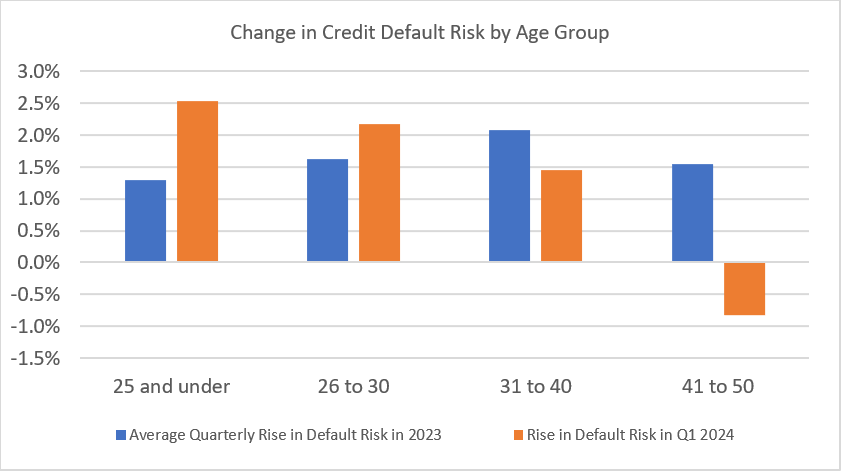
In its latest Consumer Credit Stress Barometer, illion found that younger Australians, who are mostly excluded from home ownership, are struggling to ‘get ahead’ financially due to higher rent and personal borrowing servicing costs.
After recovering in the second half of 2023, Australian credit default risk has dropped to October 2023 levels, with February and March 2024 indicating higher risk.
The long-term tendency is 9% higher than in 2022.
Further stress shifts could create a societal split between older and younger Australians, generating a ‘Gen-Z recession’.
“It’s a real concern that the credit default risk of Australians under 30 and those with non-mortgage loans like personal loans and lines of credit has risen substantially,” said Barrett Hasseldine, illion’s Head of Modelling.
The March quarter saw both rise 2-2.5%. This suggests credit stress is spreading to economically unstable socioeconomic groupings.
The average young person has less savings, income, assets, and work experience.