
The Market Ear with the wrap.
Will the AI trillions pay off…?
Tech giants and beyond are set to spend over $1tn on AI capex in coming years, with so far little to show for it. So, will this large spend ever pay off? MIT’s Daron Acemoglu and GS’ Jim Covello are skeptical, with Acemoglu seeing only limited US economic upside from AI over the next decade and Covello arguing that the technology isn’t designed to solve the complex problems that would justify the costs, which may not decline as many expect.
Blasphemy in the AI church
1. “Given the focus and architecture of generative AI technology today… truly transformative changes won’t happen quickly and few—if any—will likely occur within the next 10 years”. – Daron Acemoglu (MIT)
2. “AI technology is exceptionally expensive, and to justify those costs, the technology must be able to solve complex problems, which it isn’t designed to do” – Jim Covello (GS)
Only at 0.5% boost
Daron Acemoglu at MIT is AI skeptical.
1. He estimates that only a quarter of AI-exposed tasks will be cost-effective to automate within the next 10 years, implying that AI will impact less than 5% of all tasks.
2. And he doesn’t take much comfort from history that shows technologies improving and becoming less costly over time, arguing that AI model advances likely won’t occur nearly as quickly—or be nearly as impressive—as many believe.
3. He also questions whether AI adoption will create new tasks and products, saying these impacts are “not a law of nature.” So, he forecasts AI will increase US productivity by only 0.5% and GDP growth by only 0.9% cumulatively over the next decade.
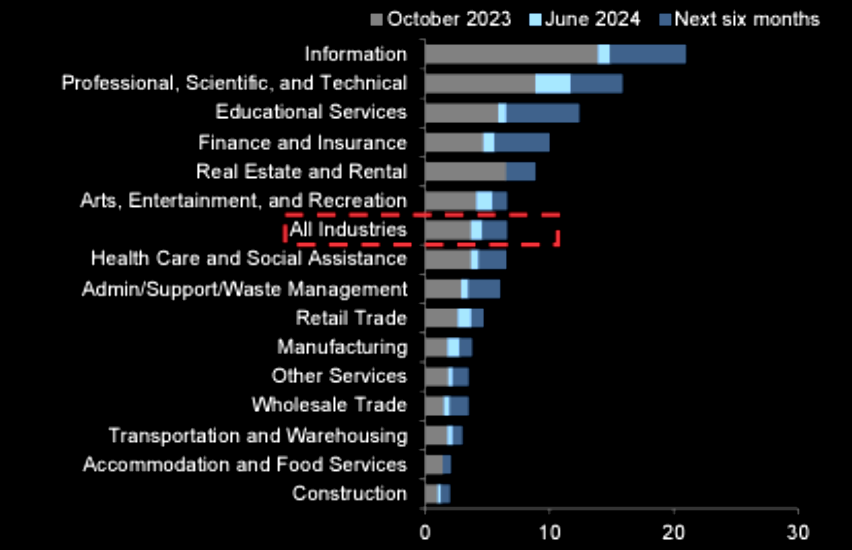
Chart shows share of US firms using AI by sector, %.
Goldman
Challenging the new AI conventional wisdom consensus
1. “I am less convinced that throwing more data and GPU capacity at AI models will achieve these improvements more quickly. Many people in the industry seem to believe in some sort of scaling law, i.e. that doubling the amount of data and compute capacity will double the capability of AI models. But I would challenge this view in several ways”
2. “I question whether AI technology can achieve superintelligence over even longer horizons because, as I said, it is very difficult to imagine that an LLM will have the same cognitive capabilities as humans to pose questions, develop solutions, then test those solutions and adopt them to new circumstances”
Daron Acemoglu
What if the “secret sauce” is not that hot…?
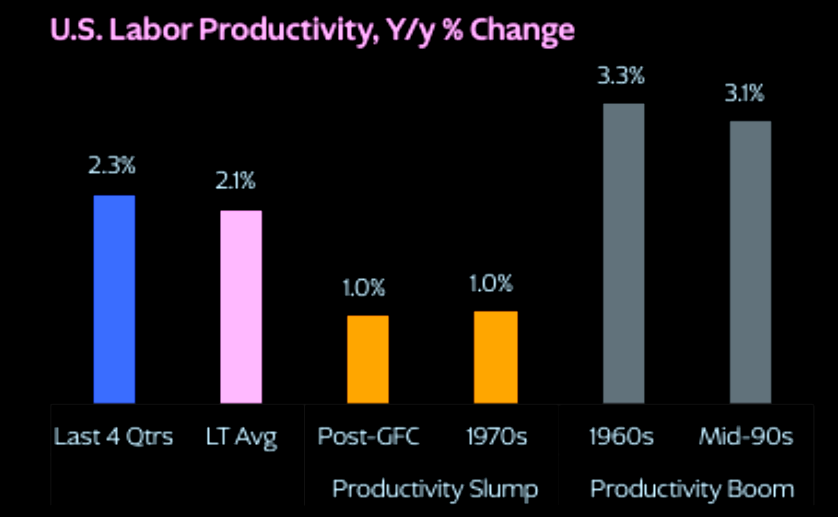
The AI bulls argue that stronger labor productivity is the ‘secret sauce’ to extending the business cycle, allowing for higher non-inflationary growth. A lot of bullish long-term GDP forecasts need to be revised down if Daron is correct.
KKR
Not currently capable
Jim Covello is Head of Global Equity Research at Goldman Sachs. He argues that to earn an adequate return on costly AI technology, AI must solve very complex problems, which it currently isn’t capable of doing, and may never be.
“My main concern is that the substantial cost to develop and run AI technology means that AI applications must solve extremely complex and important problems for enterprises to earn an appropriate return on investment (ROI). We estimate that the AI infrastructure buildout will cost over $1tn in the next several years alone, which includes spending on data centers, utilities, and applications.”
The polar opposite
“So, the crucial question is: What $1tn problem will AI solve? Replacing low wage jobs with tremendously costly technology is basically the polar opposite of the prior technology transitions I’ve witnessed in my thirty years of closely following the tech industry.” (Covello continued)
Skeptical about both
Question: Are you just concerned about the cost of AI technology, or are you also skeptical about its ultimate transformative potential?
Jim Covello’s answer: I’m skeptical about both.
1. “Many people seem to believe that AI will be the most important technological invention of their lifetime, but I don’t agree given the extent to which the internet, cell phones, and laptops have fundamentally transformed our daily lives, enabling us to do things never before possible, like make calls, compute and shop from anywhere. Currently, AI has shown the most promise in making existing processes—like coding—more efficient, although estimates of even these efficiency improvements have declined, and the cost of utilizing the technology to solve tasks is much higher than existing methods. For example, we’ve found that AI can update historical data in our company models more quickly than doing so manually, but at six times the cost….”
Covello continued…
2. “More broadly, people generally substantially overestimate what the technology is capable of today. In our experience, even basic summarization tasks often yield illegible and nonsensical results. This is not a matter of just some tweaks being required here and there; despite its expensive price tag, the technology is nowhere near where it needs to be in order to be useful for even such basic tasks. And I struggle to believe that the technology will ever achieve the cognitive reasoning required to substantially augment or replace human interactions. Humans add the most value to complex tasks by identifying and understanding outliers and nuance in a way that it is difficult to imagine a model trained on historical data would ever be able to do. ”
AI FOMO
“The big tech companies have no choice but to engage in the AI arms race right now given the hype around the space and FOMO, so the massive spend on the AI buildout will continue. This is not the first time a tech hype cycle has resulted in spending on technologies that don’t pan out in the end; virtual reality, the metaverse, and blockchain are prime examples of technologies that saw substantial spend but have few—if any—real world applications today.”
Staying dumb
“I place low odds on AI-related revenue expansion because I don’t think the technology is, or will likely be, smart enough to make employees smarter.” (Covello)
It will end badly
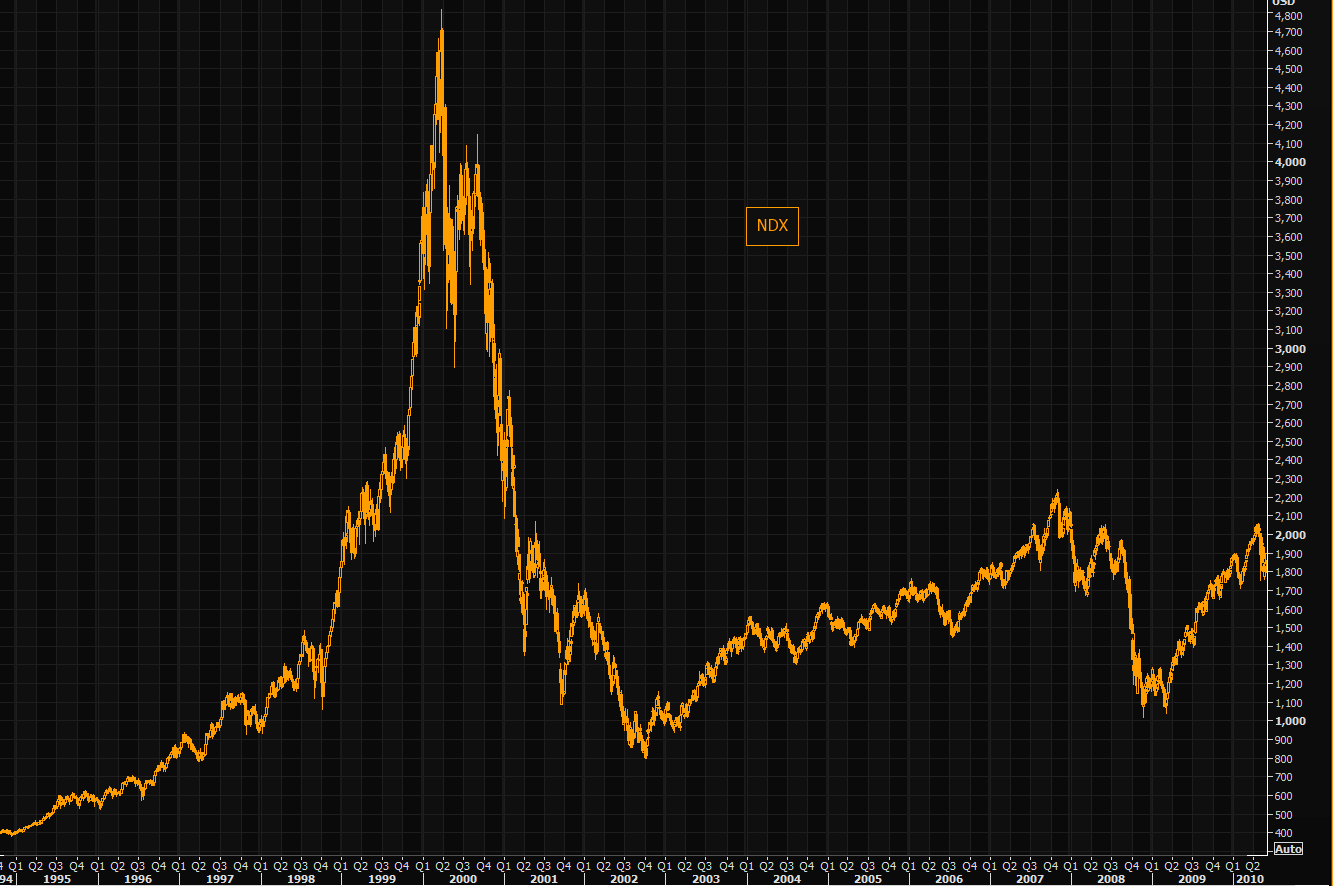
“Over-building things the world doesn’t have use for, or is not ready for, typically ends badly. The NASDAQ declined around 70% between the highs of the dot-com boom and the founding of Uber.”
Refinitiv
Even the best…
In regard to AI FOMO, recall the quote from one of the world’s best traders, Druckenmiller, and his late dot.com era trades: “I bought $6 billion worth of tech stocks, and in six weeks I had lost $3 billion in that one play. You asked me what I learned. I didn’t learn anything. I already knew that I wasn’t supposed to do that. I was just an emotional basket case and I couldn’t help myself. So maybe I learned not to do it again, but I already knew that.”
See my critique of Acemoglu modelling here.
As for the Goldman critique, the cost of AI will be commoditised over time. That’s what today’s boom is all about: an investment supercycle chasing outsized profits in AI early movers.
My view is that AI will be typical of most new technology cycles. The stock market will price massive short-term gains that are elusive but will come through in the longer term.
In real time, I am seeing AI eat media and software. I can’t see why this will not spread to other information-driven industries, in particular the employment-heavy sectors at the top of Goldman’s chart.
Hence my basic argument that AI is likely to deliver a stock market bubble in the short and medium term and then a material boost to corporate profits in the long.
This will likely include major stock market busts along the way as hype and reality wrestle.
