
Deteriorating economy crashes RBA interest rate hawks
One month is an eternity in the world of interest rate commentary.
On 24 April, the Australian Bureau of Statistics (ABS) published the March quarter consumer price index (CPI), which showed that CPI inflation was tracking a little higher than economists and the Reserve Bank of Australia (RBA) expected.
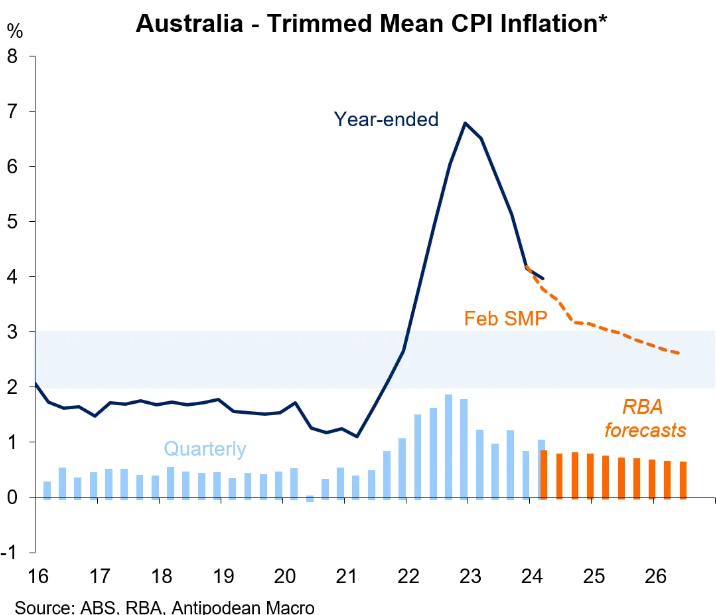
This sparked a procession of economists predicting that the RBA would raise interest rates soon.
Warren Hogan of Judo Bank was the most hawkish, forecasting three interest rate hikes by the end of 2024.
Hogan subsequently backtracked on his forecast. Last week, he told Sky News that the RBA was unlikely to hike rates again due to soft consumer spending:
“Bracket creep alone has taken $41 billion out of household budgets in the last two years, that’s a pressure that’s there, so even though the RBA hasn’t raised rates this year, and only raised them once this financial year, we can still see the soft retail spending because of that bracket creep”.
“They’re not going to raise rates while the consumer’s this week even if employment remains strong and even if inflation is just bouncing around at the top of that sort of 3% to 4% level”.
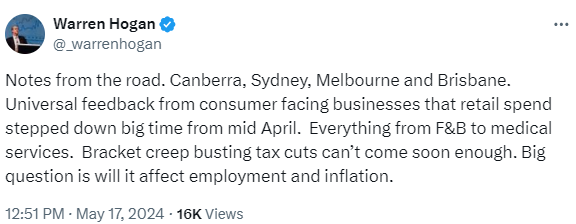
Hogan also noted on Twitter (X) that discussions with businesses across the country revealed that consumer spending “stepped down big time from mid-April”.
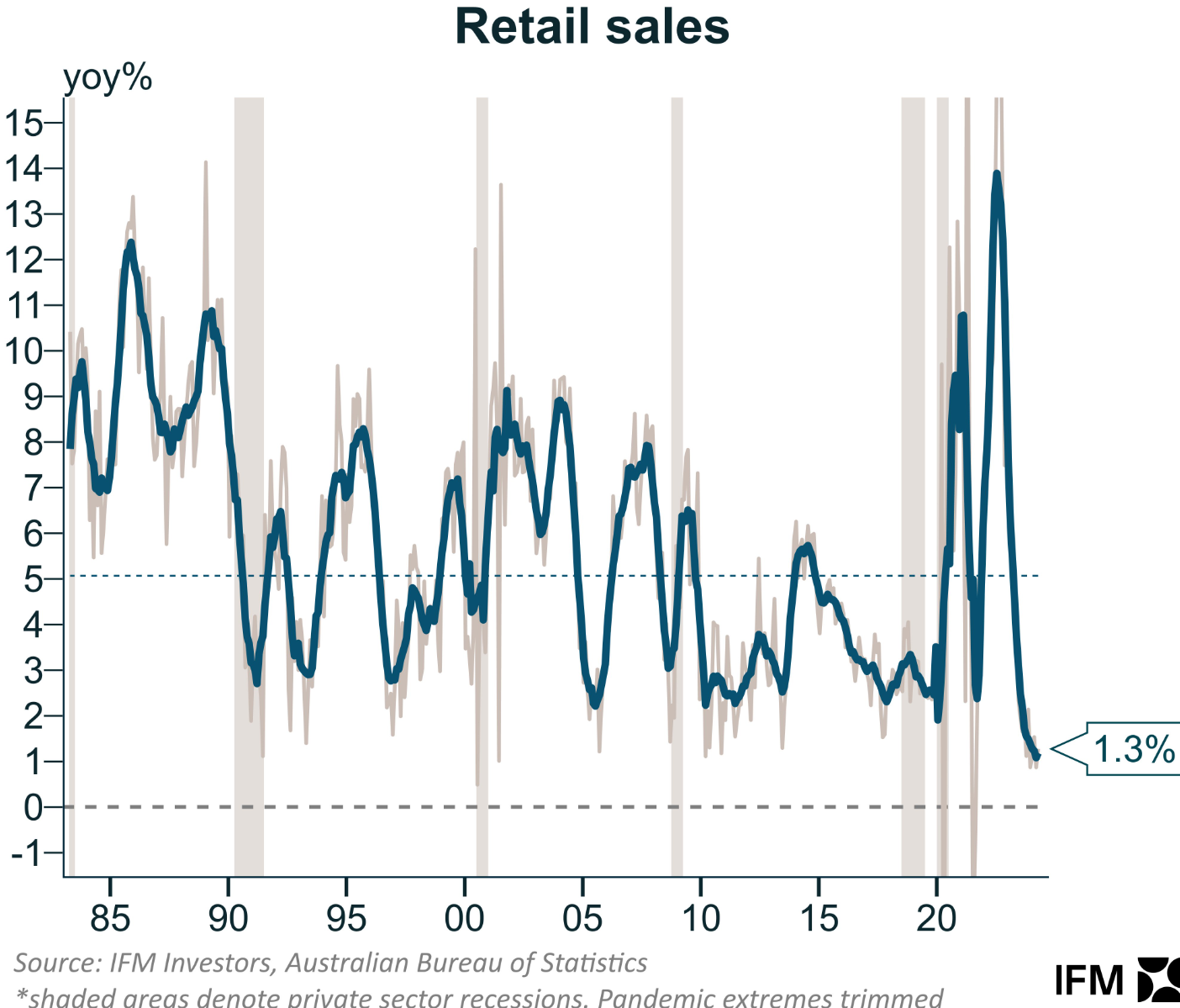
Tuesday’s retail sales data for April from the ABS confirmed Hogan’s findings, with annual retail sales growth collapsing to only 1.3% – the weakest annual result in at least three decades outside of the pandemic:
Adjusting for CPI inflation and population growth, retail sales have collapsed:
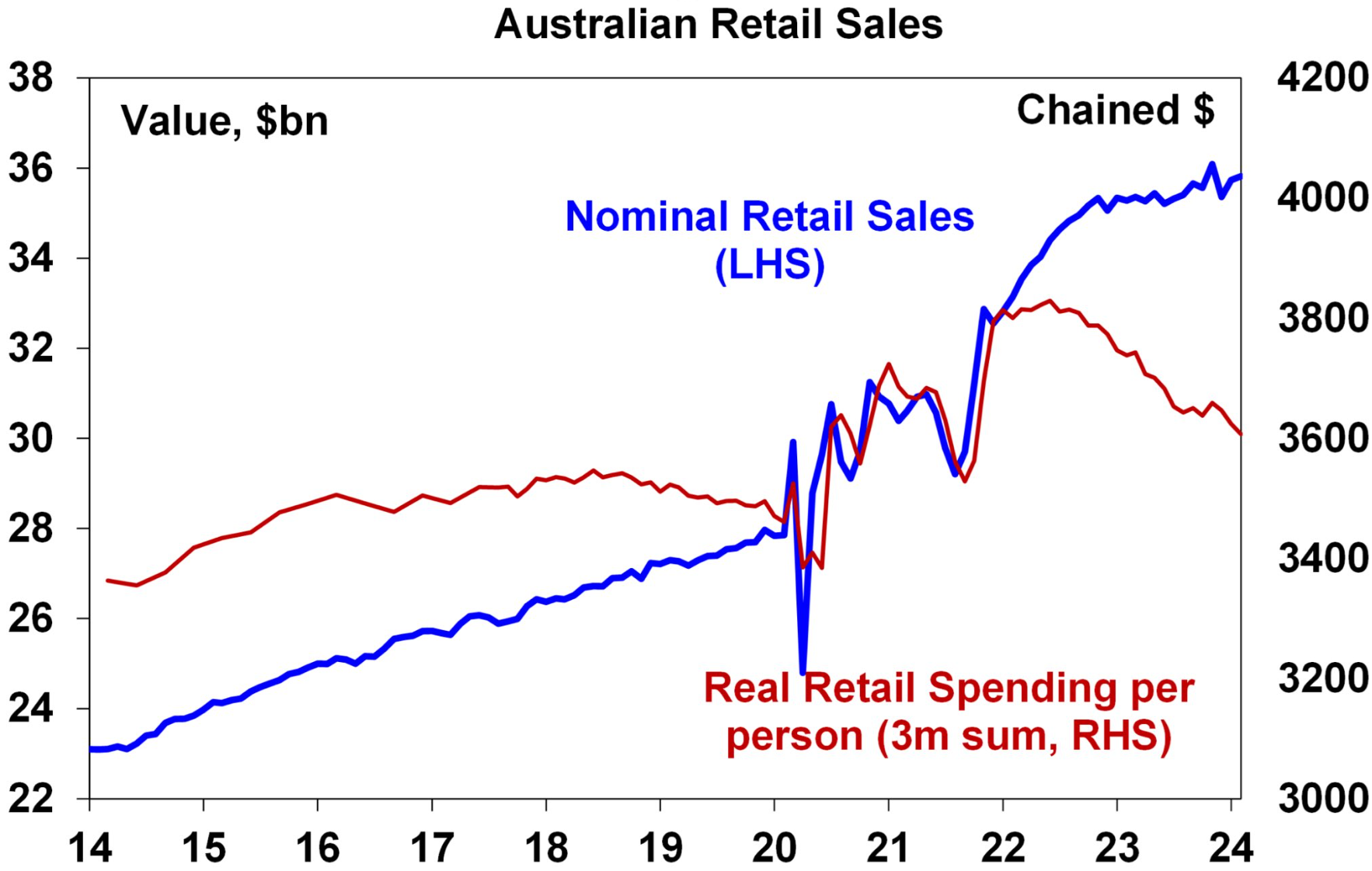
Source: Shane Oliver (AMP)
Perma-hawk Terry McCrann also noted that this level of retail sales would traditionally have forced the RBA to cut rates, although the massive stimulus handed out over the pandemic means these are not “normal times”:
“When allowance is made for inflation, retail sales have fallen by around 3-4% over the past year”.
“When further allowance is made for our extraordinary immigration-driven near-3% population growth, real per capita sales have fallen by closer to 6%”.
“Retail sales are usually a very good indicator of overall consumer spending; and consumer spending adds to nearly 70% of the economy”.
“That would normally be signalling – indeed, statistically shrieking – recession with a capital-R”.
The reality is that nearly all of the economic data released since last month’s shock CPI inflation print has been below expectations.
In April, Australia’s unemployment rate increased by 0.2% to 4.1%, while the underemployment rate rose by 0.1% to 6.6%.
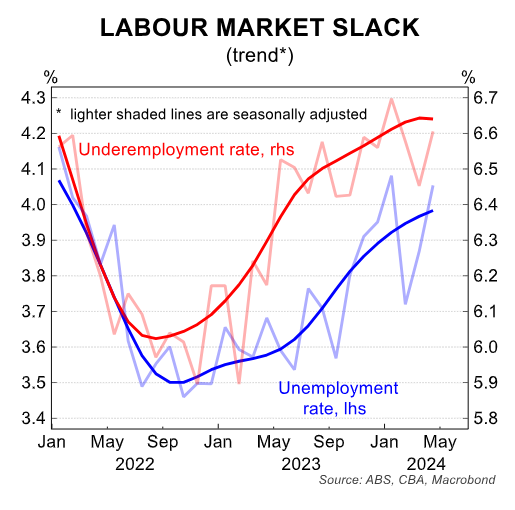
The unemployment rate is dangerously close to the RBA’s end-of-year unemployment prediction of 4.3%.
Hours worked remained steady in April, but have fallen 0.8% over the last year, indicating a weaker labour market and a shift to part-time work.
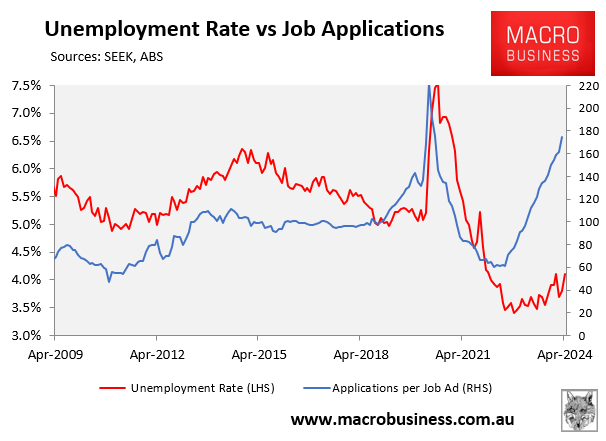
The data follows a dramatic increase in the number of applicants per job post reported this month by SEEK, which is currently tracking 55% higher than 2019 levels.
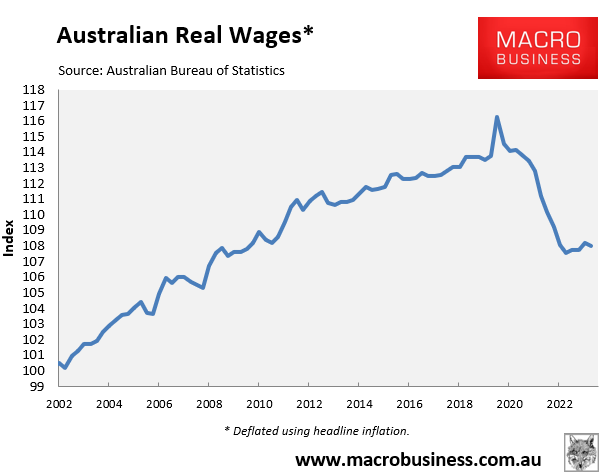
The ABS wage price index also showed that wages grew by only 0.8% in the March quarter (3.2% annualised), which was below economists’ and the RBA’s expectations.
Wage growth was also below the March quarter’s headline CPI growth of 1.0% and underlying inflation of 1.1%.
This means that Australian real wages are decreasing once more, and they are now 7.1% lower than their June 2020 peak.
Finally, this month’s NAB business survey showed slower economic activity, slower job growth, lower labour cost increases, and lower inflation. It also indicated that Australia’s per capita recession had worsened.
The RBA’s two mandates are price stability and full employment.
As a result, with such weak conditions, the RBA is unlikely to raise interest rates.
To the contrary, the next shift in interest rates will most likely be lower. It is simply a question of whether it happens this year or early next year.
Upcoming data releases will tell the tale.
